
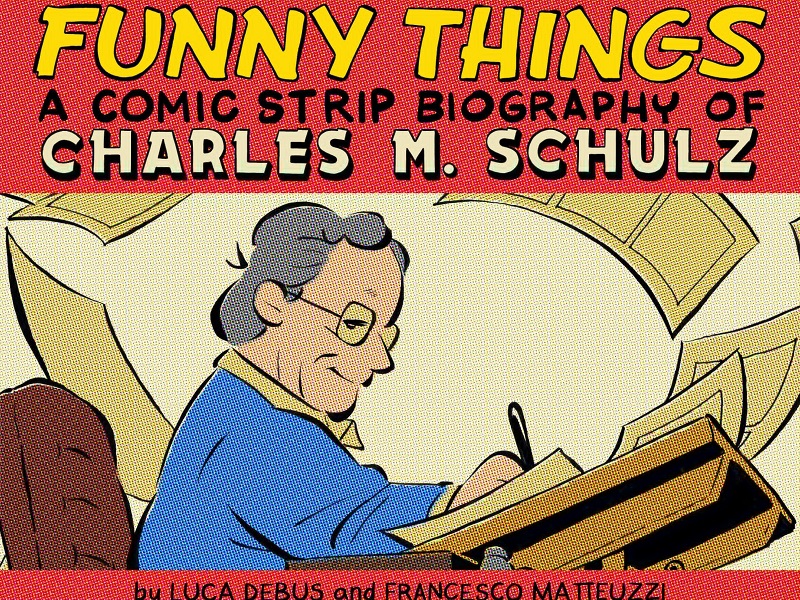
Good Grief: An Interview With The Creators Of ‘Funny Things: A Comic Strip Biography Of Charles M. Schulz’
by Rachel Bellwoar
There would no Peanuts without Charles Schulz (and if you grew up loving Snoopy and watching the holiday specials every year, you know what a crushing blow that would be). My mom is the one who introduced me to Charlie Brown, and I’ve been a fan ever since, yet in all those years of watching Sally call Linus her “sweet babboo” and Lucy offer friends advice for a nickel, I never really bothered to find out more about Schulz and his life. If you’re in the same boat, then Luca Debus and Francesco Matteuzzi‘s upcoming graphic novel, Funny Things, could be the perfect solution — a biography on Schulz in comic strip form, that covers everything from his time in the army to the many rejection letters he got for his work. Co-written by Debus and Matteuzzi (Debus is also responsible for the art), find out why Schulz had the gang lean on a brick wall and the typo that resulted in an alternate title for Funny Things in an interview with Debus and Matteuzzi below:

Rachel Bellwoar: Growing up in Europe, were the Peanuts gang as prominent in Italy as they were in pop culture in the US, and which character do you relate to the most?
Luca Debus: It’s hard to estimate how popular Schulz’s work is in Italy compared to the US, but it’s for sure one of the most beloved comics of all time. In fact, the comic strip itself is more popular than the TV specials in Italy, which seems to me to be the opposite than in the US.
Francesco Matteuzzi: However, the strip in Italy isn’t published daily on newspapers. You can read it only in magazines or collections, but since I can remember, these characters have always been very popular. The strips, of course, together with the many merchandising objects available, such as school diaries, t-shirts, mugs, greeting cards and so on.
Debus: In any case, the Peanuts gang is well-known by everyone in Italy, and I’m sure it’s met with love and smiles anywhere in the world. As for the character I relate to the most, it won’t come as a surprise to anyone who knows me even a little bit that, already as a child, I was often crippled by anxiety. Because of that, I see a lot of myself in Linus. In the most troubled moments, I would resort to my security blanket like Linus does in the panels of Peanuts… except my blanket was actually Schulz’s comics!
Matteuzzi: When I was a child my favorite character was Woodstock, so tiny and emotional, the best friend everyone would love to have. Right now, depending on the feelings of the moment, I can mostly relate to Linus, to Charlie Brown or to Peppermint Patty. But I still love Woodstock a lot.
Bellwoar: Charles Schulz famously was against calling his comic strip, Peanuts. For the comic strips in your biography of his life, how did you decide on the title, Funny Things?
Debus: Giving a title to our book was no small feat. We’ve considered a lot of options, but eventually we happily landed on Funny Things. Schulz would often describe the craft of making comics as simply the ability to draw funny things. This definition is somehow double charged. On one hand, it sounds like an understatement of the incredible art that Schulz has given us. On the other, it shines a light on the importance of the funny little things in life. Because of these two reasons, we thought that this title is very telling of Schulz’s personality and of the way he understood his own creation.
Matteuzzi: The first time I read the phrase “funny things” was the one reported by artist and creative director at Schulz’s studio, Paige Braddock. She tells about the time when she was helping Schulz putting together his last strip. At a certain point, going through characters and situations, he laughed and said: “I really drew some funny things”. An expression so simple, so sober, and yet so powerful… it immediately stuck in my head since then.
Debus: Other than that, on a standard keyboard, the “i” and the “o” keys are awfully close to each other. This makes it very easy to mistype the title of our book as “Funny Thongs”. It happened to me so many times, and it always makes me laugh. I do believe it has happened and it will continue to happen to everyone who has to work on our book. I love to think that it makes everyone laugh who does it. Now isn’t that fun!

Bellwoar: It’s amazing the difference one letter can make! They say you shouldn’t meet your heroes. Having done all of this research into Schulz’s life, would you say that that’s true and what surprised you the most about him?
Matteuzzi: I think it’s generally true: you should never meet your heroes. And that’s because when you appreciate somebody’s work, you often idealize them, so that meeting them in real life may be extremely disappointing. As for Schulz, well, I never met him in person but I’ve read a lot about him, and what amazed me the most is the fact that he appears to have been exactly as the strip is. He even said it himself once, and I think he was absolutely right: reading the strip was like knowing him personally. So, if the strip is a comfy and reassuring place, somewhere where you can get shelter in case of need, I think it would have been amazing to have him as a next door neighbor. This is certainly one case in which meeting your hero couldn’t case any harm.
As an example, there’s one particular thing that he once wrote and that struck me. At the beginning of the strip, whenever the characters had to just sit and talk to each other, Schulz used to draw them sitting on the edge of a sidewalk. He stopped almost immediately doing so, however. Instead of the sidewalk, he provided to his characters the iconic brick wall behind which the characters would stand and lean onto to converse. The reason behind that change was that, sitting on the curb, a child could easily be hit by a car. He wouldn’t allow kids to put themselves in danger imitating the Peanuts characters. I think this is a huge example of humanity: an honorable thought that leads to immediate action.
Debus: You should never meet your heroes… I would say that the proverb is true, but in the sense that I would be more afraid of disappointing my hero, rather than my hero disappointing me. That’s why I shouldn’t meet my heroes. I’ve actually dreamed a couple of times that I met Schulz. He absolutely hated me. If my dream persona can’t even charm Schulz, the real me would have absolutely no hope! What a disaster. Anyway, doing all this research on Schulz didn’t decrease my love and admiration for him one bit. In reality, I’ve been researching his life way before Francesco came to me with the idea of making this book. Because of that, I knew Schulz and his life already well enough not to be surprised by it. However, after drawing his life, I do feel like I’ve reached a deeper level of intimacy with him. Of course, this is a completely one-sided relationship, like the most tragic love stories. Charlie Brown would approve! There’s one fact that’s surprised me about Schulz’s life, though. Well, more than surprise, I’d say confuse. In Rheta Grimsley Johnson’s biography of Schulz, Good Grief, it’s reported that Schulz as a child bought a present for his mom with the money he earned at his first job. What was that job? “Modeling knickers at the department store”. I’m still trying to understand what all that entails. The “funny thongs” debacle doesn’t cease to amaze.
Bellwoar: Writer’s block has been depicted in a lot of ways but I think imbuing blank pages of paper with the spirit of Linus’ blanket might be my favorite. How did you come up with that idea?
Debus: I believe that Peanuts was an outlet for Schulz to channel his emotions and thoughts. The world he created represents a safe space where he was the one in control, and where he could say and do everything he wanted. This idea of the strip as a safe space immediately brought Linus’s blanket to mind. I remember clearly being on a train coming back home and thinking: wouldn’t it be fun if the blank papers came alive like Linus’s blanket and made Schulz’s life impossible? So, I jotted down a couple ideas and quickly sent them to Francesco in what must have been the most confusing email!
Matteuzzi: It has been fun to work on that bunch of strips, and when Luca came up with the original idea I was excited to see where it could bring us, because it was a perfect metaphor for what Schulz was living as well as a clever, unmissable reference to his work. What could the strip do that was both fun and capable to bring forward the situation we were telling? It was time to go and find out, and I agree that this idea was pure genius!
Bellwoar: Did you decide as a rule early on that you wouldn’t try to depict any of Schulz’s characters or was there a draft where you drew Snoopy and Charlie Brown into the story?
Matteuzzi: That was one of the first decisions that we made, actually: never to have the Peanuts character in the book. Of course, we would have loved to write and draw those characters, but it didn’t feel right for a bunch of reasons. First of all, Schulz himself said that that he didn’t want anybody to continue his strip. And even if Funny Things is of course not Peanuts, using those characters in the book felt disrespectful to him. Moreover, their presence would have been distracting from his story, and we didn’t want that.
Debus: Exactly. We wanted the focus of the book to be Schulz and his way of making art, rather than his art itself. Peanuts is rightfully credited and celebrated so much in our culture, but many people know so little of its creator and of the genius that changed the landscape of cartooning forever. For once, we wanted to set Snoopy and Charlie Brown in the background and direct the spotlight on Schulz himself. We do reference his comics throughout the book thanks to their iconography, but we didn’t show any of the characters.
Matteuzzi: Another reason is that we could’ve met some major copyright problems by showing the Peanuts characters, and of course this is something we wanted to avoid at all costs.

Bellwoar: One figure whose role comes to light in this biography is that of ghost cartoonist, Jim Sasseville, who didn’t work on the daily strip but was responsible for some of the Peanuts comic book stories (and was the uncredited artist for Schulz’ series, It’s Only A Game). How important was it to you to bring attention to his contribution to the series?
Matteuzzi: I’ve been fond of Sasseville since when I first read the It’s Only A Game collection with his side notes. After that, doing my research for the book, I learnt his full story. So, when Luca came to me saying: “We need to tell his story as well!” I was like: “Do you mean within Funny Things or as a new whole book? I’m in anyway!”
Debus: The world really needs a whole book dedicated to Jim Sasseville’s life! He’s always fascinated me. He’s the archetype of the talented artist that never makes it. Some people simply won’t break through. It doesn’t matter how great their craft, passion, and talent are. Jim was one of them. Probably, this fascination for him arises from my own fear of sharing his destiny. For that reason, it’s very easy to identify in his struggles… that’s not surprising. Charlie Brown himself taught us that nothing is as relatable as failure! I encourage everyone to look up his solo work, because it really is remarkable, although never published during his time. Derrick Bang wrote a beautiful article about Jim Sasseville that encompasses more of his misadventures. You can find it online. Please go and read it! Let’s break the mold and finally celebrate Jim’s work! Justice for Jim Sasseville! Once and for all!
Bellwoar: Some of the first work Schulz got professionally was as a letterer, which is why it felt appropriate that the lettering should change for the section where you talk about how the Charlie Brown Christmas special came to be. Was it difficult making the dialogue in that section rhyme, and what do you think more people should understand about the art of lettering comics?
LD: When it came time to write the story about making the Christmas TV show, it was actually Christmas time. I wanted to make something special, but I wasn’t sure what to do. Suddenly, I got possessed by the Christmas spirit, and my path was clear: everything had to rhyme! It sure was a challenge, but I had so much fun trying to make festive rhymes, while also maintaining the punchline structure in the strips. However, a huge help came from our editor, Leigh Walton, who made sure that the metric and rhythm of the rhymes made sense. Sometimes, it’s hard to fully understand the metric of a foreign language!
Matteuzzi: Now that the book is done, I’m the first one to be amazed when I realize that, every time, having to chose between different paths, we never went for the easy one, always trying to surprise each other with something “more”. And, if I’m allowed to digress a bit, that’s probably the reason why, even having worked so much on these stories, with all the discussions and the confrontations, we never grew tired of it. As a matter of fact, when the book was sent to print, I was almost saddened knowing that it was the end of our work. But I’m too much off on a tangent, let’s get back to the lettering!
Debus: I feel like lettering comics is an art that’s getting more and more forgotten. Nowadays, with some exceptions, the lettering is usually written completely digitally with some chosen font. This makes the process much faster and more convenient, but sometimes it takes the magic out of the characterization and uniqueness of the comic artist’s handwriting. I tried to combine the tradition of a personal handwriting and the convenience of digital lettering by creating my own font with multiple letter variants. I believe this is a strategy that many cartoonists deploy nowadays.
Matteuzzi: Something that Schulz and many cartoonists of his generation did was starting the inking process with the lettering part. Only after finishing that, they would move on to ink in the drawings. It was a perfect method to optimize and balance their panels, but it’s something that is rarely done nowadays. Digital lettering is a great tool to save time, but often completing a task in less time also means that you have less time to think about how to complete that task, resulting in questionable solutions. Fortunately, after some not entirely successful attempts that we’ve seen in the past, digital lettering has finally become something important.

Bellwoar: You can only pick one: A Charlie Brown Christmas or It’s The Great Pumpkin, Charlie Brown?
Matteuzzi: That’s a hard choice between two masterpieces, but I pick It’s the Great Pumpkin, Charlie Brown. I don’t think that it’s objectively better than the Christmas special, but there’s something in the Great Pumpkin that resonates better with me.
Debus: Yeah, I think I’ll go with It’s The Great Pumpkin, Charlie Brown as well. It’s the first Peanuts special I’ve ever watched, and I’ll always love it.
Matteuzzi: Furthermore, the rocks that Charlie Brown gets instead of sweets during the “trick or treat” bit are just hilarious.
Debus: Here’s to the ones who got rocks from trick-or-treating!
Bellwoar: Here’s indeed! Thanks for agreeing to this interview, Luca and Francesco!
Funny Things: A Comic Strip Biography of Charles M. Schulz goes on sale August 30th from Top Shelf.
