
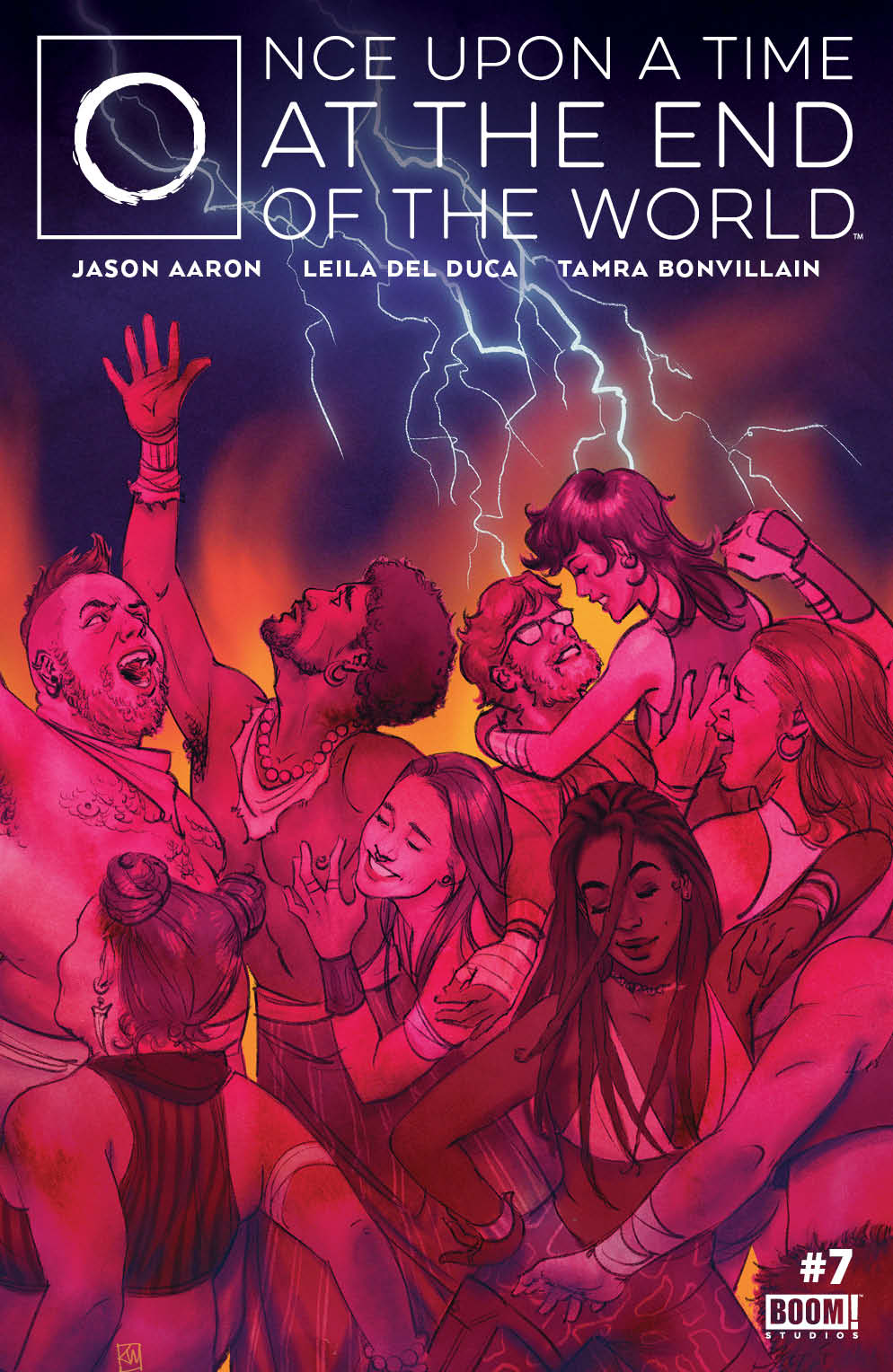
Welcome To Golgonooza: Reviewing ‘Once Upon A Time At The End Of The World’ #7
by Tom Smithyman
In comic books, just as in life, one thing is certain: when things look brighter than they’ve ever been, certain disaster and disappointment can’t be far behind.
Things seemingly couldn’t be better for Maceo and Mezzy. After years of scraping by on a post-apocalyptic world, they finally found their Golgonooza, named after William Blake’s city of art and imagination. It’s a paradise filled with massive foam slides, cuddles and compliments parties and plenty of kink.
The issue, written by Jason Aaron, chronicles how the pair created the utopia over several years while recruiting new young people in search of something more. It’s largely expositive, with no conflict to drive the story. That conflict, though, is clearly coming. For now, Aaron would like readers to revel in the oasis in the desert of dystopian life.
As a standalone issue, though, it’s not really enough, though. And when combined with the previous chapter’s sexapalloza, it’s not been a compelling start to this middle story arc of the planned trilogy.
Artist Leila del Duca has plenty to work with though. While there is no real tension in the story, del Duca gets to show off her skills by illustrating sections of Golgonooza, including the Pillow Fight Dome, the Christmas Hot Springs (clothing optional, naturally) and the group massage spa. But her best work (as well as that of colorist Tamra Bonvillain) can be found toward the end of the issue as she illustrates life in the city with Blake’s own words from Jerusalem, the poem where Golgonooza comes from, overhead.
Once Upon a Time… still has a lot of work to do to the level it achieved by the end of the last story arc. But there are some indications that that things are trending in the right direction.
Once Upon a Time at the End of the World #7 is currently available for purchase at your local shop.
Overview
This installment is an odd one with virtually no conflict to move the story along. Instead, it represents a high point for the character, only likely to bring everything crashing down again soon. But there’s some nice artwork and fans of the poet William Blake will get a kick out of the use of his poem, Jerusalem.
