
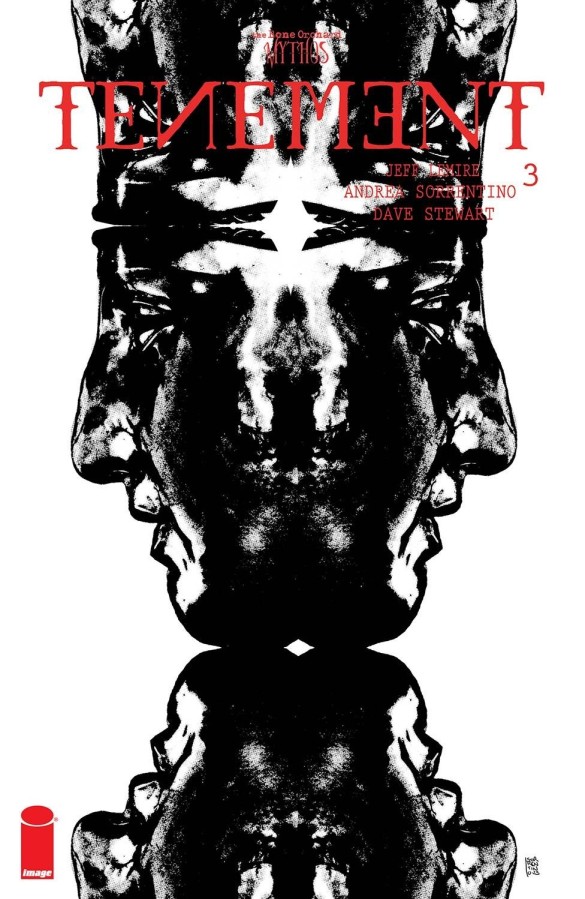
Advance Review — ‘Bone Orchard: Tenement’ #3 Demonstrates How To Transition A Series
by Tom Smithyman
Overview
Transitional issues don’t have to be boring installments full of talk talk talk. When they are done well – and they are done very well here – they help to move the story forward while also giving readers some much needed action.
Overall
9.5/10Transitional issues can be difficult to pull off. They require the right mix of exposition and action. Answer too many questions and run the risk of giving readers too much information. Give them all action, and they may wonder why they started the series in the first place.

It’s an art, not a science. But if it were a scientific equation, the creative team behind Bone Orchard: Tenement has nailed the calculus in this latest issue.
In this third chapter, the residents of the apparently haunted tenement building descend a mysterious staircase in search of a young boy who is lost. They argue among themselves all the way down, using dialogue so realistic, you forget you’re reading a comic book. They come upon a threat, which forces them to separate.
It may not sound like the most exciting installment, but under writer Jeff Lemire’s pen, the issue is over before you know it. That’s a both a good thing and a bad thing. If nothing else, Lemire leaves the reader wanting more, which is precisely his job.
Artist Andrea Sorrentino makes the most of the story. While he doesn’t have the sweeping otherworldly cityscape he depicted in the last issue, Sorrentino’s lifelike faces demonstrate what these terrified characters are thinking better than any words could.
And his trademark innovative use of panels continues to astound. On one page, he starts out with a couple horizontal panels that then start to bend in the middle of the page. By the time the reader gets to the bottom, the panel is a perfect circle. That circle then becomes the dominant choice of panels for the next several pages. Sorrentino has turned the medium on its ear, and we’re all the better for it.
Dave Stewart’s use of color – or lack for much of the issue – helps set the spooky tone. When some mysterious bad guys arrive, he colors them all in red. It may not be subtle, but it’s incredibly effective.
Transitional issues don’t have to be boring templated pieces meant to move the plot from point A to point B. Other creative teams would be wise to study this issue for tips and tricks on how to master the calculus.
Bone Orchard: Tenement #3 will be available for purchase tomorrow.


