
A Tribute To Joe Matt (1963 – 2023)
by Koom Kankesan
I can remember the first time I saw a piece of cartooning by Joe Matt. It was a poster in a comic store just north of Yonge and Eglinton in Toronto that promoted Joe’s collection of one pagers published by Kitchen Sink Press. The collection was called Peepshow: The Cartoon Diary of Joe Matt. I was still a teenager and had no idea what a ‘peepshow’ was. The poster reprinted the one pager in which Joe describes his various strategies to cut costs and pinch pennies. It grabbed me because it was so true and so funny and because the cartooning was so clear and impeccable: the design and care that had been put into all of the small panels, the meticulous organization of it, was evident. All that black ink and the richness of the content on that wheel of panels pulled me in; I bought the book on the basis of that poster. I related to the cheapness exhibited so gleefully and unreservedly on the poster (who hasn’t gone to an art gallery opening just to score food and drinks?), and buying an unknown collection of strips went against my own frugal inclinations. By exposing his failings, Joe had overcome mine.

I was a high school senior, had tired of Marvel and DC comics, especially the shenanigans of the Image era, and Joe’s comics and Love and Rockets proved to be my gateway into alternative comics. I had read excerpts from RAW in magazines or had taken a couple of those odd anthologies of alternative comics stories out of the library but now I sought the issues out. There was something literary, almost epic, about the Hernandez Bros.’ creations – they seemed very cool and very far away – but Joe’s work seemed very immediate, close by, relatable in its diaristic, intimate scale. It was and continues to be extremely accessible in ways other alternative comics aren’t. Joe himself was living in Toronto at the time and this collection outlined a very clear picture of who he was, how he spent his days, and introduced Chester Brown and Seth as fellow cartoonists in Joe’s life. I ended up meeting Seth first and then Joe and Chester through him but it was always Joe’s comics I found the most relatable and impactful. I grew to appreciate Chester and Seth as my tastes expanded and refined but Joe had a power that made his comics compulsively readable, definitely the sidesplitting funniest on the alternative block. It’s what makes people want to read his comics again and again. Time and growth have allowed me to see that this wasn’t just happenstance on Joe’s part – there’s a precision and boldness to his work. At its best, its execution is sublime like a Marx Bros. film: easy to laugh at, very difficult to replicate.

I had a few interactions with Joe but I don’t want to focus on them because the nature and effectiveness of Joe’s comics immediately tie in people’s minds with whether he was actually the way he portrayed himself (he was), making him an object of amusement and curiosity, a laughing stock, perennial butt of some cosmic joke, a caricature of what it is to be human, to be neurotic, to suffer in nerdish agony. There was an inverse relationship between Joe’s self-expose cartooning and his personal life: the more he revealed, the more compelling it was to read his comics, the more it sort of made him unhappier and brought strife into his life. The aspects I couldn’t relate to in his comics were the porn addiction and the tortured relationship with Trish. Trish certainly wasn’t comfortable with Joe portraying their relationship and its ups and downs and their final breakup in his comics was something Joe grappled with for a long time. Seth, whom Joe fashioned into a very funny and perhaps slightly fictional foil, asked Joe to eventually stop portraying him also. Chester said that once Joe stopped using his relationships for fodder, he was a lot happier in them.
What I did relate to was the intense love Joe had for cartooning, nostalgia for the trappings of his youth, his neurotic and easily troubled or wounded personality, his affection for the films of Woody Allen (one of his many heroes) and other humorists, the desire to not be materialistic (except for books, cultural artifacts, and nostalgia from his childhood), the kind of rigorously cheap, spare, determined outlook and lifestyle he’d drawn for himself, the cynical armour he affected as a way to protect himself, and most of all the humorous sensibility he’d cultivated to process all of this. As neurotic as he could be, his work, both in the way he rendered people/body language/facial expressions and the timing of the storytelling/humour, was exceptional because he strove to be a perfectionist and had a strong, stubborn personality. It wasn’t always a likeable personality and if he saw you as a potential customer, he would repeatedly try to sell things to you or inflate the price of something you were interested in, but that was his way of being a survivor. In some ways, Joe was even more of a collector than he was a creator and if any of us have been collectors of one kind or another, it’s impossible not to see ourselves in him and the lengths to which he went to acquire his nostalgic artifacts. He was found dead in his room at his desk but chances are he’d been looking at Viewmaster reels or scrapbooks of old comic strip clippings or photos of people’s cats he adored or comics by some of his favourite creators or campy horror toys and reminiscing on their craftsmanship shortly before he expired.

All of Joe’s naked craft and gumption got him attention and acclaim in the nineties. It was brave and revealing. I’m sure he inspired other cartoonists to explore their own lives and faults through autobiographical comics that were more developed, a step forward and different from that of Crumb’s era. He also garnered his share of complaints and criticisms. Julie Doucet reportedly referred to him as a jerk and women criticized him for being selfish, insensitive, and misogynistic in his comics. Joe’s comics seemed to be a unique combination of self-revelation while desperately seeking self-awareness but I don’t think he was misogynistic in the hostile way predators and aggressors are. If anything, he longed to be in love, for women’s attentions, he pined for them, without completely understanding why he did this or what his limitations were. There might have been bitterness but it came from great weakness in his desire for women, not a hatred of them, perhaps to be pitied and definitely relatable. We were all young once and motivated by inner forces we couldn’t completely comprehend or control; we did things we regretted and which in time humiliated us. His stubborn refusal to grow was a kind of cynical armour thinly veiling this fact. All of this and the controversy it engendered were par for the course, par for alternative comics in the nineties and early two thousands. Alternative comics by their very nature were awkward, controversial, raw, naked, neurotic, and vulnerable. Comics by contrast today seem much more slick, discussion around controversy much more flammable – things burn up really quickly, things are often stark, and the crowd moves on to the next sensation. The more prevalent use of the internet and the kinds of combustible debates we get now don’t allow the time and permeation that seemed baked into the alternative fare of the nineties. There would be months between issues and only true enthusiasts seemed to know about them anyway.
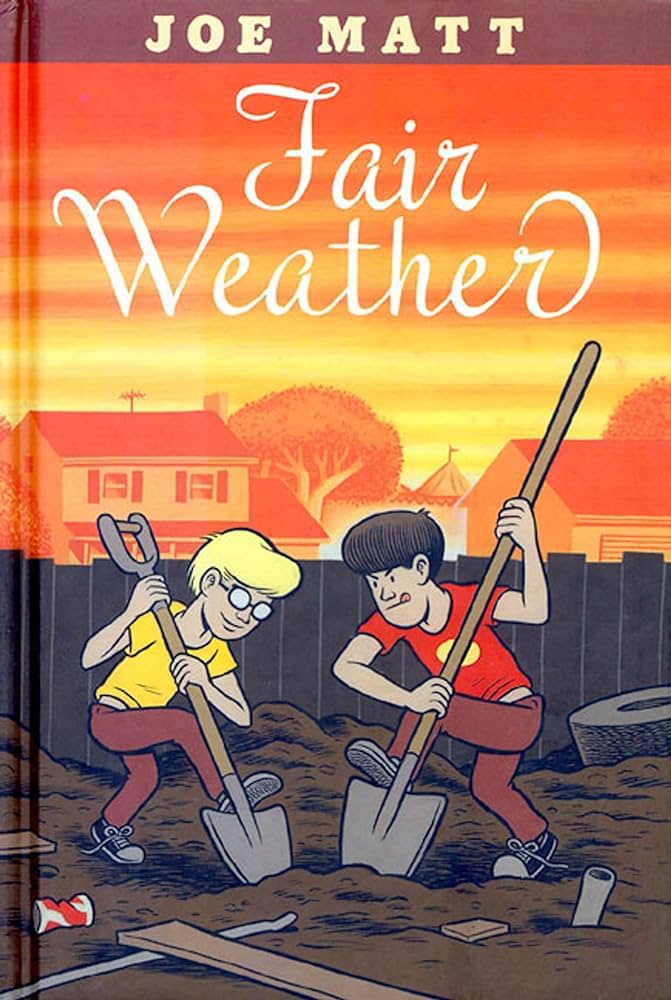
There was a period when Joe took a reprieve from all this controversy and put out Fair Weather, a charming four issue story that hearkened to his childhood, focusing on nostalgia for that period in the seventies revolving around his love of TV horror entertainment, childhood summer pursuits, friendship, suburban life, and of course, chasing down comic books. His next story, collected in Spent, took a darker path, attempting to tackle the nature of his obsession with porn. It wasn’t just darker, it was also lonelier, more miserable, and lacked the springy humour that had characterized earlier works. The issues came out years apart and it didn’t seem as if Joe had achieved what he wanted to do or even come to a satisfactory ending, if you’ll pardon the pun. It seemed like a time of great frustration. There were many sequences where his character sat alone in his room reflecting, regretting, and in a couple of instances thinking very ill thoughts about his ex-girlfriend Trish. The kind of onanism that Joe had been criticized and mocked for metaphorically (using the dregs of his own life as material) as well as literally (masturbation will probably never be a topic that people will be completely comfortable with) seemed to have pushed him into a corner both socially and creatively.

Just prior to the time when alternative comics and graphic novels finally became recognized in bookstores, Joe made a break from his dead end and moved to L. A. to escape his trappings and attempted to get an HBO pilot made based on his comic. This is a time I know very little about as there were no Joe Matt comics to buy and all that I can know about it is gleaned from interviews. I know that the HBO pilot didn’t happen but Joe stayed in L. A. and somehow managed to survive there for twenty-one years. At some point he became a regular poster on Facebook and when I found out, I added him. He didn’t remember me from Toronto (it had been almost twenty years since I last saw him), but I really enjoyed seeing his posts and I conversed with him online from time to time. He seemed to be turning a new leaf, or leaves, and though most of his posts were predictably nostalgia based, they were often positive and yearned towards a more joyful and accepting outlook. He was trying to grow and the loving, sentimental side of him came through.
He really struggled with the time Louis C. K. was accused (Louis C. K. was another comedic hero of his) during the #MeToo movement, but Joe came around to accepting that the comedian had done something wrong and should accept his mistakes and apologize. Joe probably felt a resonance with the criticisms that had been levelled against his own comics and humour; Louis C. K.’s indiscretions specifically were tied to masturbation. Perhaps, by that time, Joe was feeling that his own work would be forever buried under society’s judgments which could be harsh and unforgiving, and maybe this was unfair. I am sure that critics of his work would say Joe never changed or grew and didn’t work hard enough on changing the nature of his comics, but for many of us fans, just the fact they existed was enough. Joe was never going to win mainstream approval or success with his work and he jumped tracks at a time that perhaps proved fatal to his career, although he certainly seemed happier in some regards as a result of doing so. I learned at some point that he was working on new pages and was slowly building the contents of a new issue. Presumably it would have contained the vignettes that had been included in Drawn & Quarterly’s twenty-fifth anniversary hardcover and some other stuff that reflected his life in L. A. Since I was interviewing comics creators at the time, I asked him about doing an interview and he agreed but he wouldn’t share his new pages with me. When it came time for our interview, he made excuses around not being able to make the videochat function, and I guessed it was more of a reluctance and anxiety to commit himself to the certainty of finishing that new issue. Sammy Harkham was going to publish the issue once it was ready and I know Joe slowly worked away at it; it’s one of the ironies of life that his death furnished the final deadline: it might be what causes those final pages to be finally revealed.

About ten days before he passed away, Joe posted on Facebook that his books were out of print and indicated which printing of The Poor Bastard he preferred from the past. I asked in the thread if there was no chance that Drawn & Quarterly would reprint his books. Joe typed a lengthy, serious reply saying that he thought the part in his work that shows him giving Trish a black eye (according to Joe, physical fights were an unfortunate part of their relationship, often instigated by Trish who began them) would prevent Peggy Burns from ever reprinting his work, especially as D&Q publishes a great many female cartoonists’ books now. I don’t know if there was underlying bitterness but his public response was earnest and serious; he seemed to have accepted his lot although he talked about forgoing royalties in the past or getting his royalties last so that D&Q could recoup their costs first. In characteristic contradiction, he didn’t seem to mind this despite being fairly money conscious because he felt that he and the publisher were in it together during the nineties, in the trenches so to speak. He seemed to feel more betrayed than anything. It’s always a cliche to say this but Joe truly was a person of contradictions: he was blissfully romantic but also bitter, he was careful yet profligate, he was cynical and vulnerable, timid and bold, he was both a perfectionist and a procrastinator, excitable yet depressive. He wore his humanity on his cartoonist’s sleeve. Anyone who finds it hard to relate to him at all is either lying or not looking very closely.
My previous online conversation with Joe before that was on July 29th when he posted the commission below that he’d recently completed for someone. It portrayed him and Seth and Chester playing cards as was their wont in a Toronto diner back in the day. The moment itself reminded me of a time when I’d met them in the Jet Fuel cafe and Joe was checking out a young woman who sat at another table. At the time, I was young and mesmerized by the weird concurrence of Joe in real life acting out one of the famous traits of his cartoon self. But this was real life; it was more subdued and just ‘real’: no cartoon droplets flying off Joe’s face or rubbery expression of anguish or crooked speech bubble emanating from his mouth in an emotional puddle. Just longing for the woman who read a novel by herself at another table, looking at her through his glasses, uncertain, as Seth watched him, completely understanding what was going on in Joe’s mind but keeping quiet, letting it pass. The irony was that I knew the woman at the other table and had even lent her my Peepshow comics because I loved them that much; I lent them to everyone and I think they all found them compulsively readable, whatever other reactions they might have, because of the strange and entrancing power Joe’s comics had. What can ya do? I didn’t mention any of this to Joe recently (he wouldn’t have remembered the moment anyway because it was like a hundred others) but I inquired about the odd choice of wall art he’d put in the commission – those ambiguous swirls are not reminiscent of the kind of art you’d see in a Toronto diner. He explained his reasons (he didn’t want the paintings on the wall to distract from the figures in the foreground) and we discussed which diner he was depicting in the picture.

Unless we’re really, really close to a cartoonist or an artist, we primarily know them through their work. In the case of someone like Joe who famously made his life the subject of his work (“not so much warts and all as they are warts is all” as Keith R. A. DeCandido wrote), it can be very difficult to draw a distinction. In an odd way, Joe’s life was itself a work of art, a creation, not because he accomplished great things but because he was so unique and driven to be himself. His cartooning was the honing of that persona or that struggle in life, and I believe a great deal of thought and work went into the execution of that art. I’m sure it took him days to create some of those pages that could provide instant and instantaneous laughter within a span of microseconds. Even his death, despite the tragedy of its unfairness and how young he was, seems evocative of the life and work he built for himself. His heart, that ol’ heart plagued with neuroses and guilt and despair and self-satisfaction and torment and glee and vulnerability gave out. Apparently he had been complaining of chest pains for a while but hadn’t gotten them checked out by a hospital. Whether this is due to prohibitive costs (he lists doctors as one of the ‘foes of frugality’ in the poster above) or the fact he didn’t take the symptoms seriously, I’m not sure. His father had heart disease and Joe mentioned this in his comics. It’s hard to believe that he’s been taken so suddenly, so young, not unlike one of those sixties rock stars like Keith Moon or Brian Jones, which in his own nerdy way, in the field of alternative comics, he was.
I know I’m being overly, unnecessarily, metaphorical here but perhaps the drugs he overdosed on were nostalgia and sadness and a love for comics. In the end, reminiscences like the one I’m writing are never for the deceased but ourselves. We see something of ourselves in the departed and try to reckon with their leaving us. For me, I still see the frugality, the spareness in my own life, both in a lack of possessions but also emotional relationships, even as the world becomes more capitalistic, that echoes some of Joe’s own struggles. Certainly the Quixotic pursuit of creativity and the fight to complete my own projects seem to be of a kind with Joe, as are my own longings for nostalgia and memories and warmth from things and experiences of my past. Perhaps other people reading this who also appreciated Joe’s work will see something of themselves in his comics too, for better or worse, and will understand what I mean. I hope that comics history will be kind to Joe (I doubt it will) for his talent and what he contributed to alternative comics but as Joe mentioned, we don’t even know if his comics will be reprinted ever again.

That feels like a strange thing to have typed but Joe’s death does seem to be kind of a knell for the cartoonists of his generation. The forces that pump people up and spur them on inevitably decline and sometimes even pull us apart. Things have been changing for some time and we’re all getting older. I recognize fewer and fewer of the names on the guest lists of comic conventions nowadays. I’m sure that if Joe were to debut today, he’d be heavily attacked and rejected and even cancelled for his naïveté and daring in terms of the subject matter his work would present. I don’t think we as people have fundamentally changed all that much; dysfunctional relationships and relations between the sexes sure haven’t, but society and the comics industry certainly have. What will Joe’s place be in the history of the medium as things march forward? I’d like to think he’d be recognized for his craft and intent as opposed to being a continued butt for critics. It’s not easy to play the fool and reap the consequences. People laugh in the moment but they rarely think about the craft and the timing it took to get the reader there. The memory I’d like to end on is one of Joe sitting at a table with myself and Seth, talking about how much he appreciated MAUS. It was easy to understand why Joe loved Robert Crumb and Harvey Pekar’s comics but given that Joe was not one to discuss history or politics or ethnic struggle, I was surprised he thought so highly of MAUS. That day, he raved about poring over Art Spiegelman’s rough drafts and how Spiegelman pared the storytelling down, sought to economize and show his story through panels in an increasingly efficient and clear manner through subsequent drafts. I can also remember Joe raving about Chester Gould’s Dick Tracy for the clarity of its rendering but he had an especial reverence for MAUS. Joe has left behind a relatively small body of work but its efficiency and compulsive readability is testament to how special and unique, how powerful it is.
Rest in peace, Joe. No need to pinch those pennies anymore.

