
Exorcising Personal Demons: Discussing Crowdfunding ‘Exorcists’ With Writer Tom Leveen
by Tom Smithyman
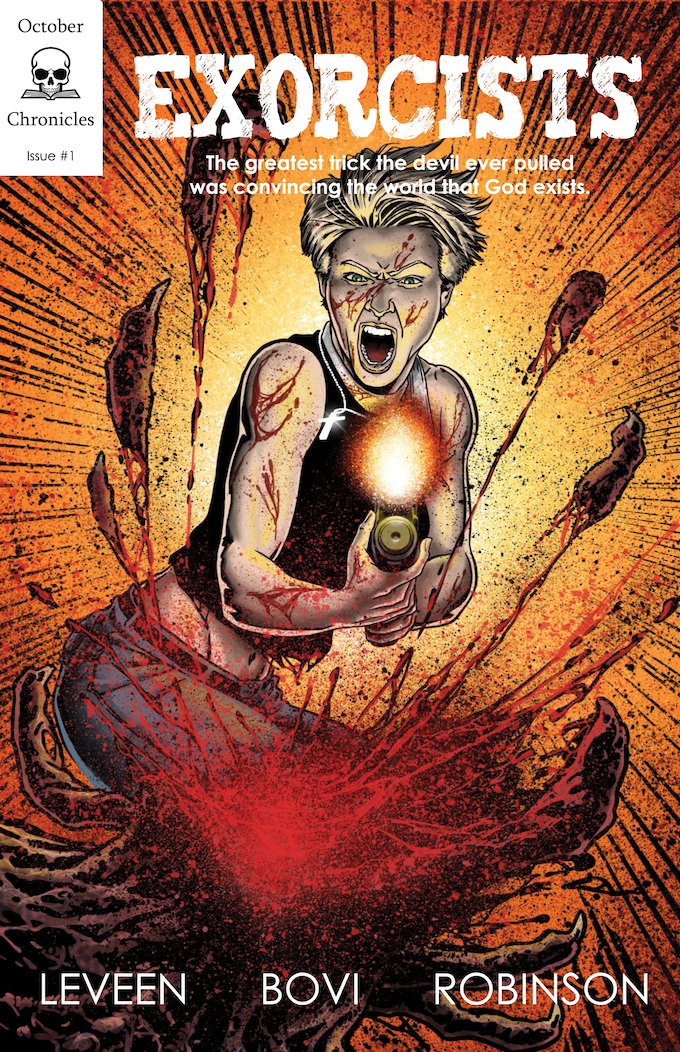
Novelist Tom Leveen is bringing his trademark horror stories to comic books with his upcoming series Exorcists. The three-issue series, which is seeking crowdfunding on Kickstarter, revolves around three survivors of a demonic possession apocalypse who must attempt a global exorcism to save the world from descending into Hell. In a Comicon.com exclusive, Leveen discusses his personal journey that went into writing Exorcists and his other works as well as nostalgia for the 1990s.

Tom Smithyman: A global exorcism is needed to save the world and one of the three people who can perform it is already possessed. Sounds pretty dire.
Tom Leveen: Well, our real-world situation is pretty dire, and horror often acts as a way to wrap my head around it. I straddle the line on being a firm believer in existential threats…but I’ve also already survived several of them, so I have a sort of hope for the world, too.
But as to the writing, yeah—gotta keep those stakes up! At the same time, good horror is good horror not just because of the monsters or the stakes, but because we care about the characters. We can see ourselves in them. That’s what makes great horror stories so scary.
We like Laurie Strode! Despite the demons and mayhem, Exorcists is and will always be about the characters and how they grow and change. The dire situation serves as a means to that end. Horror and other speculative genres let us examine and interrogate ideas in ways nonfiction can’t. It reaches in at a gut level, a heart level.
Smithyman: Exorcists is a sequel of sorts to Sackcloth & Blood a novel series that you wrote but one that has not yet been released. Are you hoping to go back to release that series if Exorcists is successful?
Leveen: Absolutely! My writing partner and I have a draft of the first novel, which follows the attempts of the incarnation of War, one of the Four Horsemen, to stop this one person from unleashing hell. We have the rest pretty well outlined (not to mention banners we made for previous ComiCons…), so if Exorcists gets some steam behind it, Sackcloth & Blood will definitely get moved ahead in the queue of both our manuscripts to get done.

Smithyman: You touch on some heady issues in Exorcists, including faith, service to the community and loyalty to one’s family. It seems like a lot to take on in only three issues, especially while making sure there’s enough action for readers. How do you find the right balance while writing the script?
Leveen: The first three issues are designed to be a self-contained arc, with enough threads to keep going if reader demand is there, so I don’t feel like every single issue needs to hit on every single theme. I’m hopeful that the series will be long-running, with room to breathe and more fully develop each of these themes.
That being said, I think there’s kind of a tiered or layered approach to including all the themes I want to explore, while still blasting away at scary monsters with shotguns. For instance, in any given scene, what’s NOT being said might be just as important as what is on the page in dialogue. Also there’s the old issue of storylines: the “A plot,” the “B plot,” etc. If I can get the “A plot” humming along, then there is often room to step back for a page or two and visit the “B plot,” which is usually not an action-adventure arc. B and C plots, for me, are usually the emotional arcs. None of this is easy, by the way!

Smithyman: It certainly doesn’t sound easy. You’ve mentioned that Exorcists is really about grappling with our demons. Are you comfortable talking about some of your own demons? Has creating Exorcists helped you to put any of them to bed or are they a lifelong struggle?
Leveen: I am 100% comfortable talking about my demons publicly, and have been doing so since my writing career started, because I quickly realized not everyone else should or could, and that if something I can share helps them, I’m in.
You mentioned themes earlier; those themes are all present in my own life. What do you do when you’ve lost faith in a belief, system or person? What do you do when you know you need to help the world…but depression makes it feel physically impossible?
My biggest demons are depression and PTSD from heinous shit that happened to me as a kid and young adult – violence and breathtaking neglect, for example. Plus imposter syndrome, of course, we all have that one in one way or another. These are lifelong struggles.
On the other hand, I’ve also made conscious, deliberate efforts to recover from them as best I can, notably when my first child was born. I remember sitting in the kitchen with my wife when my son was maybe a year old, and just saying, “I can’t be like this anymore.” (To which she correctly replied, “You’re right.” And from that moment, we got to work on making me better.) Character David Marshall will go through this as well in the story, as he slowly claws away from those debilitating episodes and grows in his ability to love and trust people again.
With something like depression, some days it’s just about hanging on one more minute. Literally counting it down on a stopwatch if necessary. Just stay here one more minute. Then repeat, until the worst of the thing has passed.
I don’t think writing the comic has put any of my demons to actual bed, but the sheer act of writing, this act of creating that I love so much, does help me navigate through them. You’ll see in the very first issue David reacts instinctively to some things that he never would have believed he could; despite the depth of his grief and sadness, he takes action and does the right thing when it needs doing. That inspires me, it reminds me that I can do that, too.

Smithyman: It sounds you have been on a quite a journey, but the good news is that that journey is continuing.
Marco Bovi illustrates the series, but this isn’t the first time you’ve worked together, right? What does he bring to the storytelling process?
Leveen: Exorcists as a story is the first time we’ve worked together, but we built out the eight-page free sample arc together before moving on the Kickstarter series. That was kind of our test to make sure we gelled. Marco is, firstly, very talented, and is able to render what I write just how I see it but with his own ideas and flair. For instance, in issue #1, I didn’t really get too specific about the monsters, I tried to let him have free reign there and show me his personal interpretation.
Marco is also fast. And responsive. Two things that are worth a lot in his business! He’s been so enthusiastic about the project, and I feel fortunate to have found him. I think as we work more and more together on this, we’ll develop that special shorthand that creators often do, and make each issue better than the one before it.

Smithyman: Why does so much of your writing take place in the early 1990s?
TL: The ’90s were a faux-peaceful time. People in my cohort had spent our childhood under the threat of Armageddon during the Cold War – we were raised on Red Dawn, War Games, The Day After, etc. We didn’t know when the bombs were going to fall, just that they probably would. Then suddenly there was David Hasselhoff in a light-bulb jacket in Berlin singing about freedom when the Berlin Wall fell. We won!
989 kicked off this decade where the president played sax on late-night, and we had this sense that everything was going to be okay now. We had the privilege and space to be sad or happy whenever we wanted, we could create things, thinking they would last forever and not be melted by nuclear fallout. We had the luxury to keep being kids, or start being them, as was often the case for a lot of us who didn’t have the childhoods we ought to have had.
Then Columbine happened. We thought it was a one-off. Clearly, we were wrong about that. Then 9/11. We’ve never really recovered since.
So I like to revisit the ’90s not just because of nostalgia, but because as a storyteller, there is: 1. less technology to rely upon for help (i.e. can a place like ‘Salem’s Lot even exist in 2023? We’d have a Google Map of the place!), and 2. there was more room to focus on our emotional worlds, on the melodrama that our collective, perceived safety afforded us.
Finally, that era was where I found my family. Not blood relatives, but actual family who I could rely upon. I was fortunate to find them, and grateful for that time, so I celebrate that a lot in my work.

Smithyman: There’s a new movie in The Exorcist series coming out soon. What is your favorite movie about demonic possession, and how did it influence your series?
Leveen: True story: The last time I tried to watch the original Exorcist — on a small TV, in a brightly-lit room — I passed out. Straight up hit the floor unconscious. It’s the only time that has ever happened to me, so…I have a healthy fear of that movie.
Depending on one’s definition, I’d include Hereditary in the list, and it’s a movie that I will never watch again. It was too well-executed. It does such an amazing job with grief and sadness, and it left a mark on me. I think Paranormal Activity could fall into this category as well, though I’m not sure you’ll see much of it in Exorcists. But for straight-up possession/exorcism, I’d probably say The Possession with Jeffrey Dean Morgan. That one had a lot of parent-child relationship-building that I appreciated, and it probably had more influence on me than I’m even aware of.
The thing these movies tend to have in common is that parent-child dynamic – often a father-daughter focus – and I think that will show up in these scripts when David is powerless against a force he cannot always fight. Helplessness is a constant as a parent, and I exorcize that particular demon of my own by writing horror stories, trying to plumb some of those depths and ask: “What do you do? What do you do when the worst happens?”
That was the entire focus of my novel Hellworld, for example: What do you do when you know tomorrow is going to be worse? In that case, it was a metaphor for our family struggling with a parent with Alzheimer’s. In the case of Exorcists, a lot of it (those B and C story arcs) is just me asking how I, as a parent, can help when the child has something horrific happening that we can’t just wish away?
Then hoping like hell to never find out how to answer that question in real life. Being a parent is low-grade terror all day, every day.
In The Possession, the girl screams, “Who am I?!” And I’m like, yeah, I hear you! I’ve said that when I was your age; I’m a lot older now and STILL ask it. Sometimes scream it, just like she does! (Speaking of exorcizing demons…) Except now I’ve got kids who might have those same fearful thoughts and I have to be “grown up” to help them walk through it even while having my own personal battles. It’s a lot to handle, and writing scary comics and novels is maybe one of the most healthy ways I’ve found to juggle it all.
Smithyman: I think you’ve nailed what it feels like to be a parent, for better or worse. Best of luck in exorcising your own demons and with Exorcists!
