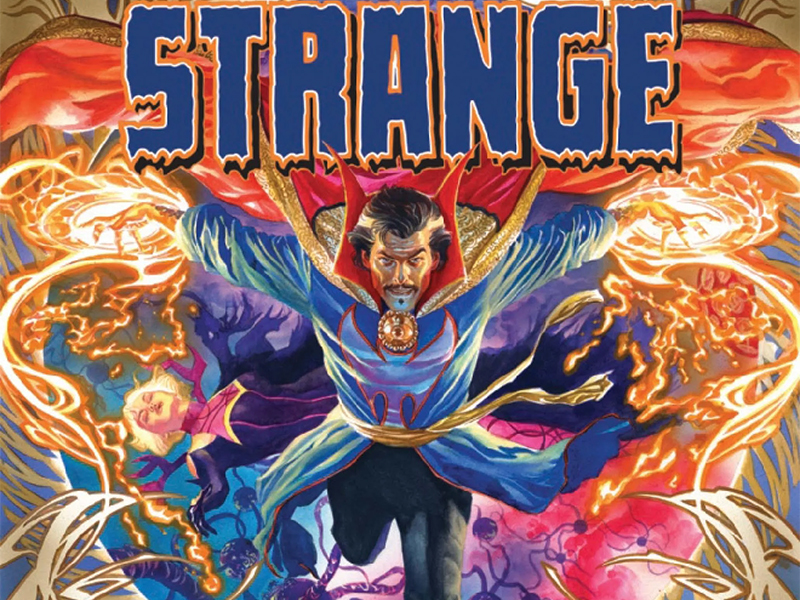
The Doctor Is In, Again — Reviewing ‘Doctor Strange Vol 1: The Life Of Doctor Strange’
by Scott Redmond
Overview
Doctor Strange Vol 1 kicks off the third chapter of the new era for the sorcerers supreme, as the married couple works to bring aid to those most in need. A fantastical and wonderous beginning to this latest volume depicting the magical side of the Marvel Universe.
Overall
9.5/10Doctor Stephen Strange died, but then he got better. Now he’s back in business with his wife Clea at his side. Turns out, it’s just in time for a whole new, yet old and familiar, threat to rear its head.
This is definitely not what the Doctor ordered.

Doctor Strange Vol 1: The Life Of Doctor Strange collects the first five issues of this new series from Jed MacKay, Pascal Ferry, Andy MacDonald, Matt Hollingsworth, Heather Moore, KJ Diaz, and Cory Petit. This includes backup stories featuring the work of Ian Hering, Amy Chu, Tokitokoro, and Fer Sifuentes-Suto.
We’ve seen a variety of takes on Doctor Stephen Strange, the former surgeon born of ego who turned to magic after an injury, including him as the lone man standing against massive magical threats or often as a full to semi-member of various Avengers teams. Here though, we get a Strange that is reborn and has a new respect for life and death with a desire to help those who need help with magical issues while still holding down the responsibilities of the Sorcerer Supreme. Strange as the magical consultant to the heroes, whom he points out are well-intentioned and good people but are lacking when it comes to magic, is perfect.
This also allows for something both classic and modern to take shape. Rather than being a defined story arc that must be five or six parts, this is something most welcoming. A series of issues that are mostly standalone adventures, weaving together towards a common purpose. Basically, an arc without being explicitly an arc. It’s a style that was seen more in the days of classic comics, but some creators favor it and have brought it back with a modern sensibility. Which I’m very much in favor of seeing far more often.

I really like how MacKay is exploring the magical side of the Marvel Universe through these Strange-related books. There are elements of old being brought back into play alongside tons of new lore/characters that help flesh it all out. So much has been added that it makes it easy for MacKay to now begin systematically taking some off the board.
There are many things I love about MacKay’s writing. Chief among them is the attention to deep character work/development as well as a keen wise use of continuity. In every series MacKay makes the character(s) and their world feel rich and old without continuity weighing things down. Essentially, he employs continuity/nostalgia with purpose. It’s not just there for the sake of being there, but it informs the character or plot or both in important ways.
This is a series that was tailor-made for the style of Ferry.

It’s a magical story that weaves through various realms with outlandish characters and spaces popping up all the time. This fits the fantastical and whimsical styling that is naturally part of his artwork. At the same time, there is firmness and even a sharpness to it all, giving a needed harder energy. It really nails the idea that these are real people and real situations with depth and weight to them. While also, at times showcasing they belong to worlds different than ours with elements we can’t even begin to imagine.
Each of the various characters who appear feels unique with a distinctive presence when they appear on the page. All the emotions we’re meant to feel are clear and flow off the characters, swirling around them in an almost tangible way. We can not only feel them upon their faces (even masked characters like Moon Knight) but also through their body language and the wonderful way that Ferry lays out a page panel-wise. These panels are not just a way to contain the various scenes but have such wild energy as they shift in shape and size that they almost become characters in their own right.
It’s amazing how Ferry can switch from one page that feels very tense and deep or chock full of recap panels only to flow right into pages that are far more serene or bizarre fun.

One of the things that always works well with Ferry’s artwork is colorists who understand how to complement it. There is plenty of vividness in some respects but what really works well are the more toned-down yet still out-of-reality colors. Both Hollingsworth and Moore know how to complement this style while bringing something unique of their own to the table.
With Hollingsworth, the vibrant colors needed for the fantastical elements are paired with a more toned-down or natural color palette. It creates a very airy and light feeling but also one of grounding. Heavier elements pop up to help highlight the darker elements of these stories. Peppering in heavier elements allows the audience to grasp the familiar while swirling through the more unusual and color pieces of these worlds. Whether it’s the toned-down or the fantastical, there is a flood of color all over these pages that reminds us just how utterly colorful and alive the world can feel at times, and Hollingsworth nails that so easily in this book.
On the other side, Moore pulls at some of the same strings. While Hollingsworth went with that more washed-out sort of tone, Moore has a style that shifts more towards the brighter and poppier aspects. Some elements still stand out as the browns and grays of various buildings/settings are the heavier less colorful elements incorporated along the way.

Different spaces get their own splashes of distinctive color. For example, the Sanctum is a very vivid yet light green, with cool blues popping up. While the Dark Dimension is far brighter than one would expect with a wider range of colors. Moore also deftly drops in different aura-like colors for specific characters. Clea gets a great glowing pink or purplish color around her in some panels. Strange’s green tones follow him. Various magical elements are very powerful yellow or red at times.
Just like Ferry, MacDonald is a natural fit for a series like this. We see that through both the small backup story in the first issue and then his full work in the fourth issue.
MacDonald has a solid style that taps into that weird fantastical element that these stories need, with lots of flowing action scenes. It brings depth to this world while also not being afraid to dip into the realm of the bizarre. All the characters have great weight and presence, with all the emotion and action flowing smoothly. It all dips into the realms of the exaggerated to make sure the bizarre truly is bizarre but still grounded.
Many of the paneling choices are perfect, really framing the different moments in the best ways. It gets us right down in the action while also making the quieter dialogue-heavy moments feel energetic and compelling.

In his two stories, MacDonald is paired with Herring and Diaz for the colors. Again, both are very fitting for this type of story. Herring brings plenty of very solid dark colors but also out there vibrant bright colors that pop off the page. It helps create some very psychedelic visions, which the story is full of.
Diaz’s colors play right in that sweet spot between grounded and strange. There is a toned-down quality to many of the colors which brings that depth and sense of normalcy. This allows the ghosts, demons, and other elements at times to be somewhat brighter pops of color. Making them stand out because they are pinks and shiny blues or purples.
Not only that, but I love how the color/lighting shifts through the story. Our characters move through a variety of spaces and times of day, and it’s reflected in every panel. There is a night scene with vampires in Hong Kong and it heavily feels night-like, the darkness ever present. It’s reflected in the skin tones, the set pieces, and more because the effect levels of light have is considered so well.

Petit is a name that can be found in a lot of books as one of the usual letterers at Marvel. Each of those books will have a similar style in the lettering but also be unique, and we feel that here. As mentioned, this is a magical colorful supernatural book and Petit lets that play through the lettering work on the page. Colorful bubbles, shifts in style and size for fonts, big colorful SFX, and more.
The best letterers are those that bring in the colors, the various shaped balloons, the changes to the font that showcase volume/tone, and so much more. If the bubbles for Dormammu, the various Warlords, demons, Ghost Rider, and others were just ‘normal’ it would be fine and do what is meant to. Instead, it helps to make sure that we the readers ‘hear’ these voices differently because the presentation tells us to do so.
In the volume, we’re also treated to a stylistic and fun backup story featuring Nico Minoru/Sister Grimm from Chu, Tokitokoro, Sifuentes-Suto, and Petit. Dormammu and Strange also appear, creating that connective thread to the main stories.

I love that it’s a flashback to the Runaways days. Chu has a great feel for the character and where she is mentally at this point. It’s a really fun story that has Nico learning more about her (now well-established) limits while taking on a big villain alongside Strange.
Tokitokoro has a very interesting style that is very sharp and smooth with so much energy. Not only are the characters and other elements sharp, but the panel styles are also crisp and varied. Tons of different shapes, including a half-dome type, which adds even more kinetic energy to the action. Color-wise, there are tons of bright popping colors mixed in with a lot of shadows. It keeps a darker tone for the story while also digging into that sort of colorful energy that makes comics so fun. Sifuentes-Suto keeps it light and infuses the artwork with even more energy.
Doctor Strange Vol 1: The Life Of Doctor Strange is now available from Marvel Comics.