
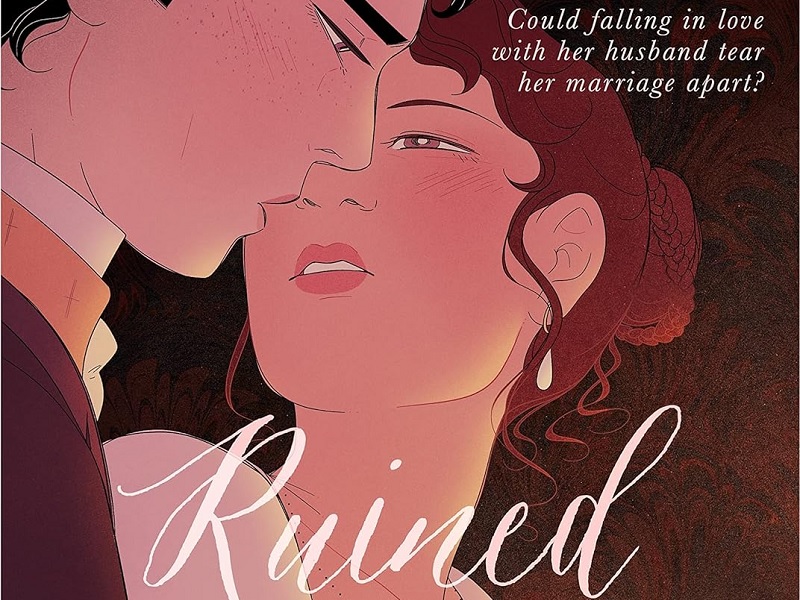
Talking First Second’s ‘Ruined’ With Artist Sarah Winifred Searle
by Rachel Bellwoar
Catherine tried to hold out for true love. Now she’s settled for a loveless marriage, but does that mean her marriage has to stay that way? In writer Sarah Vaughn and artist Sarah Winifred Searle‘s upcoming graphic novel, Ruined, there might be hope for Catherine and Andrew yet. For more on what it’s like to draw a period romance and which era they’d love to draw next, check out this interview with Searle below:

Rachel Bellwoar: The very first time readers are introduced to Catherine and Andrew is on their wedding day. What was it like figuring out how to use body language and facial expressions to bring readers up to speed on their relationship?
Sarah Winifred Searle: Writer Sarah Vaughn (SV) set me up for success when it came to the character acting, which is one of the most fun parts of drawing comics for me. I wanted it to be clear that Andrew is treating their marriage like business, which it is. And Catherine, though she chose this path, suffers from some nervous energy that she can’t quite suppress. That contrast puts them immediately at odds with each other, even if they both want to be there.

Bellwoar: Readers also learn a lot about Catherine from how ignored she is by her wedding guests. Was it strange, drawing a bride who’s not the center of attention at her own wedding?
Searle: I imagined this wedding to be more of a spectacle for the community, two people with “ruined” reputations coming together, than an occasion of joy. And the vibe would definitely be a bit strange for that.
Bellwoar: How do you approach deciding how many and what size to make the panels for each page?
Searle: I asked SV to script an average of four panels per page, as that is my personal comfort zone –– then SV sometimes used fewer to slow down the story’s pace, or more to speed things up. When I look at a page of script, I see if any panels contain interesting moments that deserve more space on the finished page of art. That could be an establishing shot of a room, or an intense emotional beat. Then I design the rest around that.
Bellwoar: Catherine spends most of Ruined at Davener House. Do you have a favorite room or one you enjoyed designing the most?
Searle: They were all fun in their own way! A theme that runs through my solo work as well is settings that become characters in themselves, and being able to draw the house changing around them as the characters grew together was really satisfying. Davener is a place with a past and a future, just like the rest of them. I suppose I especially enjoyed designing Catherine’s gardening project in the ruins of the wing that had burned down before she arrived.

Bellwoar: Throughout the book we see both Catherine and Andrew’s sister, Gemma, grapple with trauma from their past. How did you land on a visual language for conveying trauma in this story?
Searle: I learned a lot of my cartooning language from manga, which shines through here in all the dramatic closeups. I asked inker Niki Smith (NS) to help with the project as I knew I could trust her with the subtlety of emotion that I wanted to convey in those moments, she captures it well in her solo books as well. I sketched the pages, she drew the final line art and dropped in some flat colors using a palette I provided, then I finished/polished the pages.
Bellwoar: The bar set by Jane Austen is so high, but what do you think is the key to pulling off sweeping romantic moments in period dramas?
Searle: It’s hard to compare my work to Jane Austen’s since hers was all in text, but I’ve spent most of my life reading and learning from manga-ka, Kaoru Mori’s, work. She specializes in lavish historical romance, and she knows exactly when it’s fun to lose yourself in fun details and finicky little researched bits versus when a moment needs space to breathe. That kind of contrast helps the reader know immediately when something important is happening, when to FEEL the story. She’s a true master.
Bellwoar: On the other hand, Ruined takes more after Bridgerton when it comes to sex. How much work goes into breaking down a sex scene for a graphic novel?
Searle: I’ve made a lot of sexy comics aside Ruined, so the process is pretty natural at this point! Mostly I just ask myself what would be intriguing and satisfying for readers. A lot of personality shines through during intimacy that you wouldn’t otherwise see in stories, and I try to make the most of that opportunity. It can be tricky getting the flow right, but it’s also really fun.
Bellwoar: What’s one of your favorite things that you learned while researching the Regency period that you were able to incorporate in the art?
Searle: SV did a ton of the research and handed over tons of references with the script, thank you SV!!! I think I enjoyed the clothes the most, looking at examples and then tailoring looks to suit each character’s tastes.

Bellwoar: Overall, would you say you prefer drawing the Regency era or the Edwardian era (which was the backdrop for your graphic novel, Patience & Esther), and is there an era you’d still love to draw?
Searle: I don’t have a preference –– I think what I love most is variety, and getting to spend time in different eras rather than focusing on just one. Keen to try out drawing a story featuring Tudor clothing, though. I’m kind of obsessed with codpieces.
Bellwoar: I hope that ends up working out. Thanks for agreeing to this interview, Sarah!
Ruined goes on sale November 28th from First Second.

