
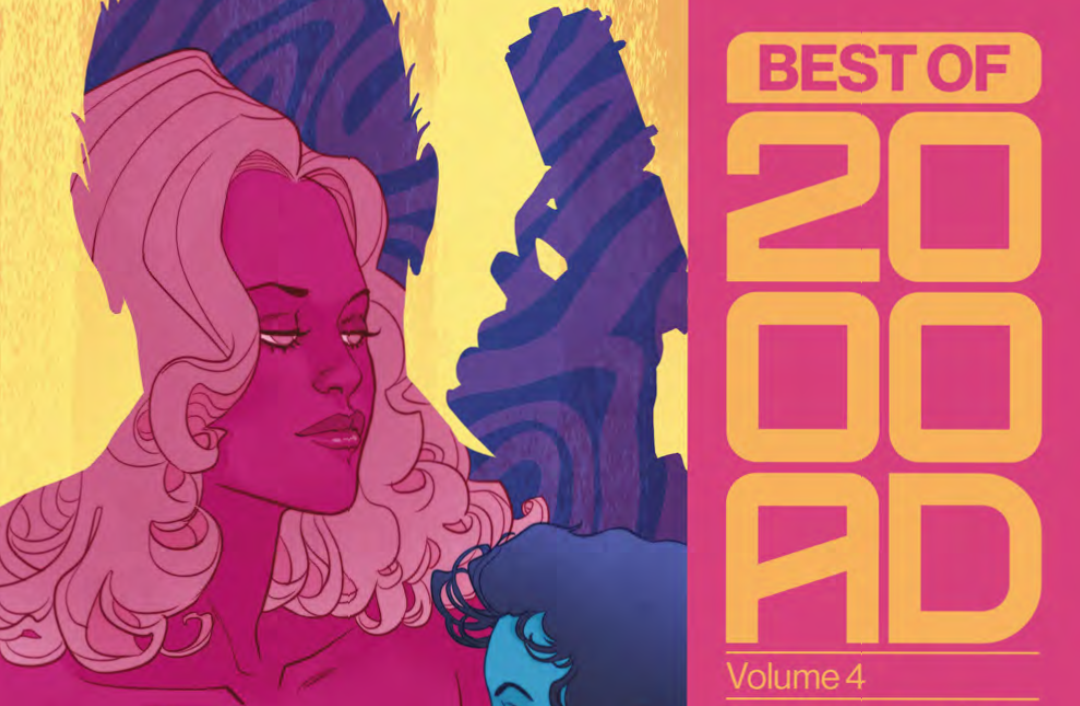
Review: ‘The Best Of 2000 AD Volume 4’ Is Another Perfect Entry Point Into The Galaxy’s Greatest Comic
by Richard Bruton
Summary
‘The Best of 2000 AD’ Volume 4 continues the remit of presenting everything you need to dive into the wonders of Britain’s finest weekly comic. Two incredible ‘Judge Dredd’ tales, a perfect contrast of the old and the new, coupled with two of the more unusual and magnificently strange tales from its history, ‘The Order’ and ‘Hewligan’s Haircut’, this is a volume where all the glorious variety of ‘2000 AD’ comes to the fore in spectacular fashion.
Overall
10/10More from the perfect mixtape to get you into the wonders of 2000 AD; this really is THE Best of Britain’s finest comic.

So far, the three published volumes of The Best of 2000 AD have done exactly what they’re meant to – pulled together an eclectic yet brilliant selection of modern and classic stories from 2000 AD‘s history. It’s also gotten a lot of attention from US press – hopefully something that’s translated into both sales and renewed interest from American readers.
Because that’s what The Best of 2000 AD is all about – getting eyes on the comic. Sure, it’s great to revisit all these strips for those who know them, but the American market has always been a tough nut to crack for a comic with a weekly frequency, anthology format, and traditional British dimensions – three very big strikes against it for American comic shops and comic readers.
Anyway, the fourth volume simply continues doing what the first three did – getting the word out in the best way, by showing everyone just what 2000 AD has always been about, with a delicious mix of stories done by the best talent – a perfect intro to some of the best comics coming out of Britain in the last 40+ years.


Now, I was going to do a review of the whole thing, but I started with the two Dredd tales and just went with it. There’s a fascinating comparison to be made here between the opener of a modern-era Dredd, ‘Mega-City Confidential’, and the classic ‘Cry of the Werewolf’. And it’s one I simply couldn’t resist banging on about. It’s really a toss-up which one is better, John Wagner and Colin MacNeil’s modern, politically charged, ‘Mega-City Confidential’ with Justice’s fist beating down the people yet again or the classic ‘Cry of the Werewolf’ presented in full, all that vintage Wagner & Alan Grant writing plus the sublime artwork of Steve Dillon, and a story that howls greatness.
All of which means there’s not been the space or time to cover the non-Dredd content in full. See, there’s this thing called sleep that I’m trying to do more of and it’s eating into the comic writing time. I know, bloody lazy, that’s what it is.
So, before we get into the couple of staggeringly great Dredds, let’s at least give you an overview of what to expect in the non-Dredd portion of this latest Best of 2000 AD – two feature-length pieces, The Order Book 1 and the complete Hewligan’s Haircut and, as usual, the one-page DR & Quinch Agony Page – of which there’s not that much to say. After all, what’s not to like about Alan Davis art on a strip with the continuing adventures of the Galaxy’s most maladjusted teenagers with weapons of mass destruction?
With the two feature pieces, it’s perhaps the best example so far of the sheer breadth of what you might find in any given week, in any given year. Indeed, it’s a gloriously jarring juxtaposition of the fabulously classical look of John Burns’ artwork on The Order and the chaotic energy of Jamie Hewlett’s art on Hewligan’s Haircut coming just three years after his debut with Tank Girl.

The Order presents the entire first series of Kek-W and John Burns’ series that’s only just wrapped up its epic run earlier in 2023. It’s also most likely the final work from Burns we’ll see, as the veteran Brit artist retired this year.
And, being honest, when I read it in the Prog, there was always something about The Order’s storyline that didn’t quite click for me. I could always see what others loved about it, could always appreciate the beauty and the consummate skill that you see in every line, every figure of Burns’ work. But for me it just didn’t hit.
However, going back and reading this first volume in full, seeing a young Anna Kohl investigating the death of her mysterious and distant father and being flung headlong into a bizarre fantasy adventure as she uncovers the secrets of The Order and goes into battle against the extra-dimensional Wurms, it actually gels far more in this collected version – and of course, every page of it has something gorgeous to look at.

Immediately following The Order, we have the glorious chaos of Hewligan’s Haircut by Peter Milligan and Hewlett. This was always an insane yet rather wonderful flight of comedic fancy, the deliberate chaotic madness of it, in both story and style, writ large on the pages. The whole graphic novel is just one absolute hair-raising wonder, with Hewlett fresh off taking the world by storm with Tank Girl and in full experimental mode here, something that suits Milligan’s writing to a tee.

It’s all about insane asylum inmate Hewligan who, on the day of his release, decides it’s time for a bit of a new hairdo. So, taking a pair of plastic scissors, he sets about it, unknowingly creating something in the exact shape of a secret sigil that causes all sorts of madness to spill forth.
Cue chaos and madness, as realities bleed into one another, something that Hewligan, and his reality-warping new friend, Scarlet O’Gasometer, have to put right, allowing Milligan and Hewlett to just let loose on the page.

This was, as I recall, greeted by long-time readers as either utterly ridiculously stupidity or utterly ridiculous genius. Me, I think it sits, magnificently, somewhere in-between, definitely pointed more in the direction of genius but full of a loveable amount of stupidity – and that’s really the whole point of Hewligan’s Haircut.
At times it’s laugh-out-loud funny and it’s relentlessly chaotic and over-the-top for sure, packed with invention in story and art – but there’s also a sacrificing of storytelling for the insanity of the whole thing. And on any given day, I can really love it or find it a bit too much of a grind to get through. It was certainly a very different sort of 2000 AD strip for the time and it’s testament to the sheer wonderful diversity and variety of the comic that it’s not only gained cult status for fans of both creators but is here, quite rightly, as part of the best of 2000 AD.
Okay then, now for those two Judge Dredd tales that open and close the volume, as perfect an example of how Dredd has changed over the years and how there’s absolute brilliance to be found in Dredd from whatever time you choose.

‘Mega-City Confidential’ is the modern Dredd that opens the volume, with Wagner and MacNeil in blistering form with a really brutal tale of just how far the Justice Department will go to retain control and how the citizens are always the ones that pay for it.
Sure, Dredd and the Justice Department had always been the fascist bullyboys of the strip, but with the Democracy stories and their ilk, Wagner hammered that home, something he does to chilling effect here. This is pure nasty Dredd, stamping down hard on anything that undermines the Justice Department, even when it’s patently obvious, to Dredd and so many others, that it’s the Department in the wrong.
In ‘Mega-City Confidentia’l, there’s yet another secretive department involved with yet another way to keep tabs on the citizens – Section 7 and newly installed spy tech to get inside so many homes in MC-1. But, as the Judge running it tells Dredd, there’s always that human factor that can be difficult and, in this case, that difficult human factor is Erika, one of Section 7’s operators whose conscience is weighing heavy on her. So heavy in fact that she bolts, takes the data, and attempts to get it to Max Blixen, top phone-in jock at Mega-City Confidential, in the hopes that he’ll be able to blow it all wide open.

Of course, things don’t go that way, not at all. And that’s where the story does go very dark. This is one from 2014, very modern, very much in keeping with the way Wagner had taken Dredd, and absolutely brutal. Make no mistake about it, this is Dredd and the Justice Department as the bad guy, obvious and clear, coming down on anything that threatens the Justice Department with jackboots, and big jackboots at that.
But it’s also just got that absolute brilliance of Wagner at the top of his game, telling complex tales and telling them with an incredible simplicity and ease that few other writers on Dredd can manage. Alongside him, MacNeil on art gives us all the darkness and shadows that the story needs. It’s a story shrouded in black, full of beautiful imagery in the dark. There’s a real beauty to the pages, to the way MacNeil portrays the Judges almost wraithlike at times, disembodied figures just merciless as the inevitable end comes.

It’s a masterclass in Dredd and, by the final page, no one reading it can be in any doubt just how far wrong the world here has gone.
‘Cry of the Werewolf’, by contrast, comes from an earlier, possibly a more innocent time. A time where Dredd was still seen by many as the hero of the strip. It’s a straightforward adventure, one of the weird tales where MC-1 comes under threat from something supernatural and strange – werewolves from the Undercity.

And it’s page after page of Dredd as the hero, Dredd and his fellow Judges first defending their city and its people from the Werewolf contagion and then with Dredd heading down into the Undercity to investigate the source of the werewolf problem.
All of this, of course, leads to more fighting, more action, more of that effortlessly amazing Steve Dillon artwork, culminating in the only way it all could, with Dredd bitten and infected, leading to one of the all-time great 2000 AD covers from Dillon…

As I say, it’s a different Dredd, the sort we don’t really get much of anymore, the simple Dredd as hero, one goal in mind. There’s no politics here, none of the darkness of the realisation that Dredd and his fellow Judges are the villains of their tales that we get in spades in the likes of ‘Mega-City Confidential’.
But whilst it’s a different Dredd from a different time, it’s also just a wonderfully exciting thing, packed with action, never letting up, and full of all that glorious Dillon artwork.

Between the two Dredds in here, we have the full range of what the character can be and how, when written and drawn by the likes of Wagner, Grant, MacNeill, Dillon, and many others that do the character right, the world of Dredd can be all things, encompass everything from no holds barred action adventure to deeply political tales. And it’s all the more exciting for it.

As for this Best of 2000 AD Volume 4 as a whole, somehow I had to decide what review rating to give it. I deliberately didn’t lead with that summary and review rating section on this one as I usually do because I knew it was something that needed explaining first.
Purely in terms of my perception of it all, this isn’t my personal favourite of these volumes, taking the four main strips as a whole. As I’ve said already, although the Dredds would be pure 10s, personally I didn’t completely get on with The Order and Hewligan’s Haircut is a strip that I can find hilariously inventive and/or frustratingly too much depending on my mood when I read it.
BUT, and this is the big but, although it’s not the best of the volumes for me, in terms of the actual remit of the thing, to present the very best of 2000 AD in all its glory, showcasing the sheer variety of the stories and art that fill the pages week in and week out, this is absolutely the perfect mix of things. And that’s the reason it’s a 10 here.


