
Talking ‘Creepshow’ With Alisa Kwitney And Mauricet
by Rachel Bellwoar
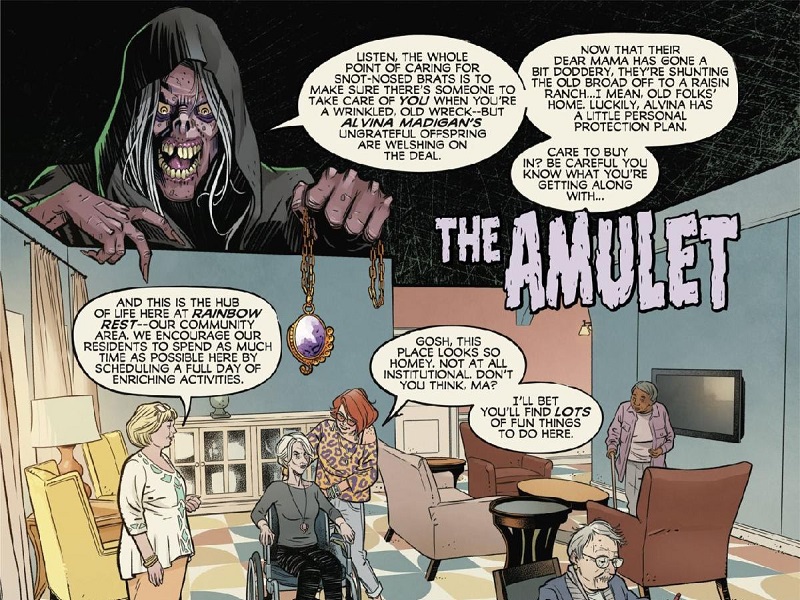
It doesn’t take a magical necklace to know something fishy’s going on at Rainbow Rest Nursing Home, but it might be the only advantage Alvina has in writer, Alisa Kwitney, and artist, Mauricet’s, story, “The Amulet,” for Creepshow Vol. 2 #4. With colors by Mike Spicer and letters by Pat Brosseau, find out what Kwitney and Mauricet had to say about collaborating again and the anthology form in the following interview:

Rachel Bellwoar: As a big fan of your series G.I.L.T., what made you want to collaborate again on “The Amulet”?
Alisa Kwitney: Mauricet and I keep collaborating because the holes in his head fit the pegs in mine, and vice versa. We both love Berni Wrightson style body horror, and the kind of subtle acting shifting into broad humor that Terry Moore is so adept at.
Mauricet: We also love the way early Chris Bachalo captures character interactions, and Duncan Fegredo.
Kwitney: I worked with both Chris and Duncan as an editor at Vertigo, on Shade the Changing Man and Kid Eternity, and they informed my comics taste.
Mauricet: We also are drawn to the same kinds of stories, and we feed off each others’ enthusiasm.
Bellwoar: Similar to Hildy in G.I.L.T., Alvina is a woman of a certain age. Why do you think more comics haven’t embraced older, female protagonists?
Kwitney: Because people keep forgetting that older men and women have money, and would like to spend it. The Golden Bachelor proves that there’s a huge market.
Mauricet: She makes me draw old people. I always used to think I could only draw younger people, but it’s way more fun to draw older people, because it’s easier to make them act. And because I’m getting older!

Bellwoar: Do you enjoy the anthology format, of creating shorter, standalone stories, and how familiar were you with Creepshow going into this?
Kwitney: I love anthologies, both as a reader and writer. There’s something very freeing about working in short, stand-alone stories. As a kid, I loved anthology horror comics, and as a teenager, I felt the first Creepshow movie in 1982 completely captured the feel of old school horror comics.
Mauricet: We don’t have that many anthologies in Europe, that’s not the way we do it here. First thing I read that was really horror was Frankenstein or Lovecraft, and in comics, it was American House of Secrets in a small black and white format.
Bellwoar: What made you want to ground this story in real life horror (elder care abuse) versus creating a monster for Alvina to fend against?
Kwitney: One of the scariest horror comics from my youth involved a house that rapidly aged anyone who entered its doors. And, of course, in real life, the older you get, the more you confront the realities of elder care. In the United States, I think we have a particularly awful model for ageing.
Mauricet: It’s the same in Europe. Unless you have the money, you really can wind up in a horror story.

Bellwoar: Alvina’s relationship with her daughter, Dora, can be summed up by the close-up of Alvina’s hand trying to hold onto her daughter’s wrist. How helpful was body language, in getting across who these characters are?
Mauricet: For me, body language is always important. Most of the stories I draw is about conveying emotion, and emotion is about body language.
Kwitney: New comic book writers sometimes over direct in their scripts. When I’m trying to convey despair or exhilaration or desire in characters, I follow Neil Gaiman’s technique for communicating the inner impulses or life of the character and allowing the artist to zero in on the precise body language.
Bellwoar: While we don’t get to spend much time with them, Alvina isn’t the only person staying at Rainbow Rest. What was it like getting to populate the nursing home with so many lovable residents?
Kwitney: I had to keep cutting lovable residents so Alain didn’t kill me. Or himself, trying to fit them all in.
Mauricet: I enjoyed drawing all of them and making them lovable as contrast to the owner. Drawing the characters is a joyful process for me. I even think the background characters are almost better than the main. Why do secondary characters come so much more easily and feel so much more lifelike?
Alisa: I visit my mother in memory care and I love all the residents. They each are so specific and unique.

Bellwoar: Naturally, Alvina’s necklace plays a prominent role in the story. Did you always know what you wanted the titular amulet to look like?
Kwitney: I sent Alain some early reference, so he could buy it for me on Etsy. Still waiting, Alain!
Mauricet: I looked up Mesopatomian amulets and I mixed up two that looked cool and suited my taste and also what Alisa wanted. I had to draw fast, so I didn’t have time to mull it over too much. I can spend a long time obsessing over such things, though — details are very important for me.
Bellwoar: Thank you so much for agreeing to this interview, Alisa and Mauricet!
Creepshow Vol. 2 #4 goes on sale December 20th from Skybound.