
Advance Review: Reaching The End Of The End In ‘Swan Songs’ #6
by Tom Smithyman
Overview
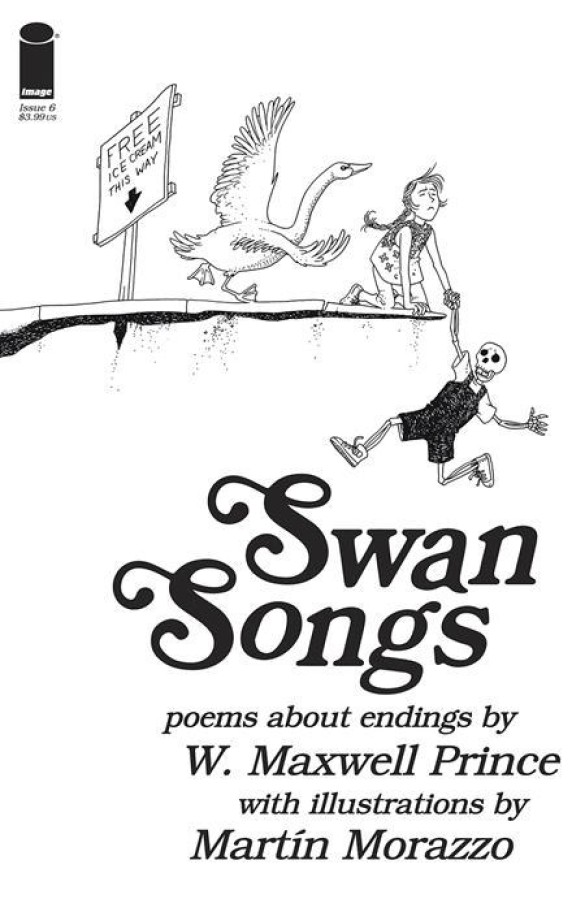
This great series about endings comes to its own conclusion, though — ironically enough — it doesn’t stick the landing. While this horror take on a classic children’s poetry book isn’t bad, it’s not up to the level of previous installments thanks to some clumsy rhyming schemes and a connection to the creators’ other series.
Overall
8/10How do you end a series about endings?

In the case of Swan Songs, writer W. Maxwell Prince’s limited series, it’s by lovingly ripping off a beloved children’s book while loosely tying the story into his other anthology series. If that seems like an odd combination, it is. It doesn’t come off as strongly as it could thanks to that tie-in as well as some occasionally clumsy rhyming choices.
Subtitled, “The end of…the sidewalk,” Prince sets his sights on Shel Silverstein’s book of poetry, Where the Sidewalk Ends. But instead of verses about a girl who eats a whale or a boy who turns into a television, Price tells the story of Thomas, who is committed to an asylum, his wife who turns to sex work to pay the bills, and his daughter who becomes a druggie. The Giving Tree, this isn’t.
It is, however, vintage Prince. At least, it is reflective of Prince’s other series, Ice Cream Man. Where, in most of its six-issue run, Swan Songs has told thoughtful tales about things coming to an end – a marriage, a sentence, even the end of the world – this story would be better off as an Ice Cream Man entry. In fact, there are multiple connections to that series including an introductory poem from the eponymous good humor man himself as well as a cameo from a Figglybump, a creature that appeared in a recent issue. Prince even gets his Ice Cream Man collaborator artist Martin Morazzo to illustrate this installment.
Writing page after page of poetry on a deadline is no easy task. And Prince’s forced rhyming scheme backfires on him in a few places, causing some awkward word choices. (Rhyming disease and weeds, for example, is not an exemplar of Prince’s finest work.) He does, however, break into a traditional comic book format in the middle, where Thomas finds a camcorder and records a plea to the reader to not finish the book or he will die. It’s a lot like another beloved children’s story The Monster at the End of This Book starring Sesame Street’s Grover.
That section also gives Morazzo something more to do. Before and after that interlude, most of his illustrations are frightening imagery in Silverstein’s style, including a failed suicide attempt and Thomas’ wife walking the streets to lure Johns. Morazzo expertly illustrates Thomas’ straight-to-camera recording, including the artists’ trademark buggy eyes.
It’s unfortunate that Prince chose this approach to end this great limited series. Still, even if he didn’t stick the landing, Swan Songs is a strong set of endings worth beginning again and again.
Swan Songs #6 will be available for purchase on January 10, 2024.


