
An Interview With ‘I Feel Awful, Thanks’ Creator Lara Pickle
by Rachel Bellwoar
In Lara Pickle‘s upcoming graphic novel, I Feel Awful, Thanks, change is in the air, but most of the changes are good ones. Joana’s been accepted at her dream job. She’s moving to a city she loves, so why can’t she shake the tiredness and anxiety she’s been feeling lately? With letters by François Vigneault and color assists by Anna Franquesa, find out more about Joana and her journey in this interview with Pickle below:

Rachel Bellwoar: Upfront honesty can be startling, and it’s that startling quality (combined with the politeness of the wording) that really makes the title for your upcoming graphic novel – I Feel Awful, Thanks – standout. Did you always have a clear concept for what you wanted to say with the title and the cover (where Joana’s facial expression doesn’t give away how she’s feeling)?
Lara Pickle: The title for this novel came up in a conversation I had with my former agent back when I was still drafting the idea, and we were brainstorming titles. We were talking about how weird and awkward it was that every time someone would ask others the “How are you feeling?” question, the expected answer would have to be, by default, “I’m fine, thank you!” even though it might not be true. So the idea behind it was… what if the answer to that question was an honest one? What if we responded exactly the way we were feeling? I reckon the tone comes across as sarcastic and funny, but it alludes to that question, and how it’s okay to just be honest about how we feel. It can be quite startling to ourselves to admit that, too! As for the cover, I wanted to make it as neutral as possible. Because the story is about Joana, and how she feels. In this cover, Jo is physically separated from her friends but is fairly neutral about it, and she tells the reader how she feels in a bit of a sarcastic way, inviting everyone to read her story, and by the end of the book she doesn’t only tell the reader how she feels, but she is at peace with it!
Bellwoar: One thing I think the graphic novel format allows is more time for Joana to come to realizations about her mental health on her own schedule, versus following her friends’ advice immediately. Was there ever a moment when you considered breaking Joanna’s story up into issues?
Pickle: As much as a friend’s advice would make sense, everyone discovers and realizes things at their own pace and time. It’s an incredibly personal journey and I tried my absolute best to reflect that. Friends and family can be there to support us, but the journey in itself is everyone’s alone. And sometimes, this can be a very long journey indeed.
This is why I have considered indeed that it would have made a lot of sense to break this story into issues. Mental health is a very delicate topic and it can take a long time for someone to find their way back on track from a depressive episode. I understood that a one-off novel could potentially feel way too short for such a story. The original scripts were, in fact, so much longer, and they entailed several different outcomes and adventures Joana should have gone through while getting to where she stands at the end of the book, it was all a very bumpy road, full of mistakes and learning. Separating the story into various issues would have given me the chance to explore a lot of topics, add a lot more witchy lore – which I adore – and of course, make things burn a lot more slowly, but alas, one single tome is what we were aiming for at the time, and I had to make the best of it in the time and space I had. I’m definitely not done exploring these topics, and I’ve learned so much from the making of this comic, so who knows, maybe there will be more witchy lore in the future!

Bellwoar: For the chapter breaks, what made you decide to organize the book like a playlist?
Pickle: Thank you so much for asking this question! I organized the book like a playlist because music drives my life in every possible way. It means everything to me, and you can always find me with my Spotify on, listening to something! When I read a book, or I need some inspiration, or I come up with an idea, or I go on a trip, or I feel in certain ways, I always make playlists. Or I listen to already-made playlists. And honestly… who doesn’t like to listen to sad music when they’re sad? Or when they’re happy and want to dance?
Music is like poetry to me, and it strikes right into my very soul. There is so much you can feel with just one song! So I thought it was only fair to turn I Feel Awful, Thanks into some sort of mixtape that drives the reader through an emotional journey where they could potentially feel along with Joana and her friends.
Bellwoar: In the backmatter you talk a little bit about what it was like to do your own English translation for the book. Was it difficult knowing how much to rewrite and when to let the text stay the same?
Pickle: When I first read the novel (in Spanish) for the first time months after it was published, I was detached enough from it that I noticed things that I would like to have written differently, so when I was offered to do the translation for the English version, I took the chance and I changed them, and in truth, the rewriting was more about re-wording things that I thought were not clear or was not as well put together in the original version, as well as trying to make the characters sound a bit more day-to-day ish, with expressions and language people use on a daily base. But that alone made all the difference to me because without changing anything from the original message, it felt a lot truer to me. I also had the chance to use and dive into several wordplays – which I love – like the double meaning of “chest” for example.
I will say that I still appreciate the fact that I was a lot more emotionally attached to the comic when I was writing it for the first time, and a lot of what I wrote felt real to me, and I don’t think it was terrible. But having had the chance to revise it after seeing it through a new light, has helped me and the comic show a new light on the story.

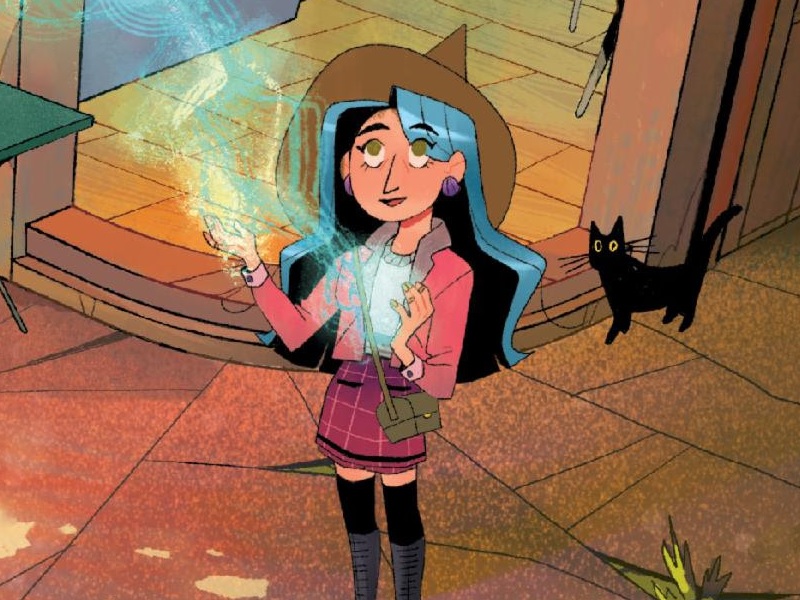
Bellwoar: You also explain some of the lore around the world that I Feel Awful, Thanks takes place in and I was wondering if you could talk more about the decision to have some of the characters wear witch hats and to not have the witch hats be standardized but to let them be reflective of each wearer’s personal style?
Pickle: Well, I thought of it as if someone would choose to wear a personalized suit for an office job in real life. Or how times have evolved fashion in a way that some items that are integral to us have evolved and turned into more fashionable versions of themselves. Witch hats in Joana’s world are a bit of a formal, smart dress item. People wear them to work or to important occasions, and some people would wear them even in their daily lives if that’s how their style goes by. But in the same way dresses, skirts and trousers have evolved for us and we can have different styles, witch hats have evolved in Joana’s magic world; from ancient times when witches would wear cloaks and hats every day, to modern day where this piece of clothing is more of a decorative and maybe representative element of oneself.
I’m personally a big fashion person – or I try to be! – and I love how much someone can express through the way they dress, so I tried to integrate this aspect into the comic in the best way I could. Now I only wish I could have my own witchy hat!
Bellwoar: Throughout the book Joana can be seen saving ticket stubs and photos. Did you always want to give the book a scrapbook quality?
Pickle: Yes. It was going to be a lot more scrapbook-y in the beginning, actually! But because it was a one-off story and it had A LOT to say, it would have been a bit difficult to abuse that resource too much, so I chose to show those things on very specific occasions. I am an avid scrapbook person, and I love to create travel diaries, as well as write down journals of how I feel and how my days are. It helps me understand myself and remember everything I have in my life that makes me happy, as well as record my own patterns of behavior, which in turn, helps me deal with any issue. Scrapbooks are very intimate and can help a story feel a lot more personal, which in turn can help the reader connect a lot better. And in a story as intimate and personal as this one, I could not think of a better way to portray Joana’s journey!

Bellwoar: Why was it important to you to show Joana go through a bad first experience with therapy?
Pickle: Joana needed to go through a bad first experience because in most cases, it takes quite a few tries to find a therapist that clicks with us. Therapists are ultimately the people to whom we pour our emotions, ugly thoughts, and insecurities, and as such, we need to feel safe and that the professional listening to us will click and help us the way we need to. But like any other relationship, sometimes it takes some time to find someone that is in sync with us. This makes people – like I had believed before, as well – think that therapy doesn’t work for them. But most of the time is just that the therapist doesn’t fit one’s specific needs. And that is okay. It doesn’t mean that the therapist is not good, or that therapy doesn’t work. Joana needed to experience that to then reflect on herself and understand that she needed to find someone who would work for HER.
Bellwoar: The mystery of what’s-in-Joana’s-purse builds as the book goes on. What made you want to hold off on revealing the purse’s contents?
Pickle: It has a lot to do with the element of surprise within the story, but it also has to do with the fact that Joana is actively ignoring it. She never explains or talks about it, not to her friends, not to the reader, and never acknowledges its existence in the same way she doesn’t want to acknowledge her “negative” emotions. She doesn’t want them, thus, they don’t exist for her. But it is obvious for us, and her friends, and everyone else around her, that whatever it is that she’s ignoring, is making her feel worse and worse, and visibly weighing more on her. And we would only find out what it is that she’s hiding after she has no choice but to acknowledge it herself. By which point, it’s a bit quite too late and she has no control over her box anymore.
Bellwoar: Thanks for agreeing to this interview, Lara!
I Feel Awful, Thanks goes on sale March 4th from Oni Press.
