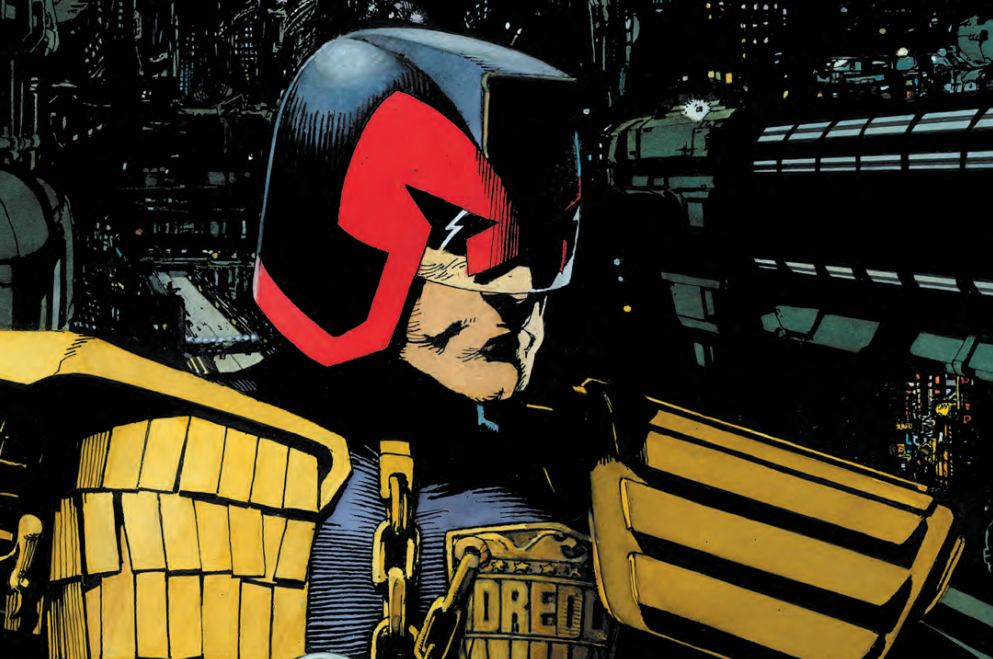
Review — ‘Judge Dredd: The Complete Case Files 43’ Is The Perfect Way Of Getting The Best Of Dredd
by Richard Bruton
Summary
These Case Files, reprinting the entirety of Dredd’s tales from 2000 AD and the Judge Dredd Megazine in order, are the very best way to get the whole Dredd experience.
That’s because they give you it all, every epic – including the majority of Wagner and Ezquerra’s monumental Origins storyline in this volume – but also everything in between the epics. And it’s that that’s so important, as those are the stories that have built up the world of Dredd, those stories of the interstitial moments, contianing all the crimes, the investigations, all the great procedural stuff, all the funny stuff, all the weird stuff. And it’s in presenting everything in the Case Files, not cherry picking the epic stuff, that really gives you the very best Dredd experience you can have.
Overall
10/10I’m going to try and tell you here why these Judge Dredd Complete Case Files, reprinting the entirety of Judge Dredd in order, are the perfect way to get the greatness of Dredd, the way to get the whole Dredd experience, and why the small stuff is so often the best stuff.

Okay then, thinks I, here’s another Dredd Complete Case Files to cover, these chronologically complete Dredd presentations of all the Dredd stories from both 2000 AD and the Judge Dredd Megazine, maybe this time I’ll just go the easy route and give you a simple preview – bit of spiel about it, loads of images, all done and dusty. Simple, yes?
And then I read it and, yet again, realised that that just wouldn’t cut it. Wouldn’t cut it at all. And that’s because these Case Files really are becoming my preferred way of reading Dredd. More than any other format, they’re the only way that captures everything great about Dredd, the only way of giving you the complete Judge Dredd experience and explain just why, after nearly half a century of stories, it’s still capable of being vital and important and fresh.
Sure, I was fully expecting to enjoy the big epic story in this current volume, John Wagner and Carlos Ezquerra‘s ‘Origins’, the massive epic adventure (longest Dredd storyline thus far in the 45+ years of his existence) taking Dredd into the Cursed Earth following a lead to do with his clone father and threading back to his very first action in the earliest days of the Justice Department. It’s one of the very best Dredd epics, a story that fills us all in on the events that led to the new fascism of the Judges, the Atomic Wars, the near end of the world, and the Judges taking over, establishing the world of Dredd that we’ve known for all this time.
And it was absolutely no surprise that I did love ‘Origins’. But every time I read these Case Files, I’m struck anew with how the long history of Dredd has evolved and developed since 1977 and how that unique way of going about things is what’s kept the character and the world of Dredd as fascinating, as engrossing and, perhaps most importantly, as welcoming to new readers, as it was right from the beginning.
And the reason is all to do with the fact that Dredd is all too easy to think of as JUST the epics. I know I do it. Ask me to name a favourite Dredd storyline and I’d probably, on any given day, give you some order of ‘The Apocalypse War’, ‘America’, ‘Day of Chaos’, ‘Trifecta’, ‘The Small House’, or whatever BIG story was in my head right now.
But, when you actually read every Dredd, as you get to do with the Case Files, those epics wouldn’t be the only best stories. Best long tales, sure. Best really big, epic, monumental, important Dredd tales, sure. But best stories? No, I know that so many of the shorter works would get the nod. In fact, the odds are that an list of the VERY best Dredd stories would contain a mix of the long and the short, the epic and the everyday. Take, for example, ‘The Graveyard Shift’, just seven parts long, from Progs #335-341, Wagner, Alan Grant, and Robin Smith doing masterful things with the day-to-day, night-to-night events of MC-1. (If you want to read and see more of that, it was recently reprinted in The Best of 2000 AD Volume 3, reviewed here.) Or then there’s the done-in-one ‘Letter From A Democrat’ in Prog #460, Alan Grant’s favourite Dredd ever, a perfect moment in six pages that eviscerates the Justice Department and takes away any idea early readers might have had that Dredd et al were the heroes of this series.
So, instead of focusing on ‘Origins’ here, I figured I’d pick a couple of the shorter tales around ‘Origins’, two that show you just how powerful and important Dredd’s tales can be and how the nature of the series, with it’s mix of all sorts of stories, has kept Dredd vital for any comics reader for the last 35+ years.

The first is a bit of a cheat though, as it’s the prelude to ‘Origins’, the five-part ‘The Connection’ by Wagner and Kev Walker, that’s rather a masterpiece in its own right.
There’s really not much to the actual story here at all, a group of Mutants from the Cursed Earth infiltrate MC-1 to deliver the mystery package that sets up ‘Origins’ and it’s up to Dredd and the Judges to track them down. That’s the long and the short of it.
But that relative lack of plot means that there’s so much time and space available for Wagner to tease things out and craft the sort of classic Dredd procedural thing that he’s perfected over the years, where we watch a case play out, each element slotting into place, often with minimal involvement from Dredd. You know, where we get to read page after page of MC-1 cop grind, just like that bit above. And damn, Kev Walker’s rainy night in the Big Meg scenes here are just so damn good…

So, what we have in ‘The Connection‘ is brilliant a 30-page slow build – a superb exercise in creating tension, playing the thing out so well, along with some perfectly dark and gloomy Walker art to establish the mood, full of foreboding as Dredd starts getting strange little visions in the sleep machines, portentous things featuring Judge Fargo.
It’s a perfect thing, a short Dredd that does a perfect job of showing us the intricate details of the Judge’s lives and their investigations and, although it might be the intro to Origins, it’s still a quite masterful piece of short crime fiction, with just a perfect downbeat ending that leads so well into the epic to come…

As for the second example of the great smaller tales, I’m going to pick out the final story reprinted here, again one by John Wagner – who is, let’s never forget, the greatest of great Dredd writers – with Colin MacNeil on artwork. ‘Cadet’ has Wagner and MacNeil revisiting the world of their classic ‘America‘ saga and the story of Judge Beeny, daughter of notorious terrorist/democracy activist America Jara and singer Bennett Beeny.
But, as with so much of Dredd, although there’s a hell of a lot of continuity here if you want to find it, the story here is perfectly self-contained thanks to the skill of Wagner’s storytelling and the way things play out.
And things play out absolutely beautifully, with Cadet Judge Beeny choosing to base her mandatory 10th-year training investigation, along with Dredd as the choice of her co-investigator, in re-evaluating the events that led to the death of her father in another Total War terrorist assault.

From the very moment of that first page and the near interrogation of Dredd by Cadet Beeny, this one is just magnificently written, the language and tone Beeny uses throwing the usual power balance way off, as Dredd finds himself strangely on the backfoot. That’s all about just how good Wagner’s storytelling, his dialogue, and his sense of control of all things Dreddworld truly is. And alongside, we have MacNeil’s moody, atmospheric artwork to perfectly capture every exquisitely set-up moment.
And again, once we move past the strangeness of the Beeny-Dredd dynamic, this is another perfectly written procedural tale, a cadet’s training supervised by an experienced Judge, the cadet running the investigation, Beeny and Dredd running down leads, following the trail, doing the legwork, doing the thinking, doing the cop work. And it’s that that’s the beauty of it, that’s the pure Dredd-ness of it all.

‘The Connection’ and ‘Cadet’ are but two examples of the simple Dredd tale done perfectly. You could almost describe them as bread and butter Dredds – the ones that don’t involve wars with the Sovs, alien invasions, or huge city-transforming moments. These are just your run-of-the-mill investigations that every Judge in the city has to do every day, every night. Get the case, run the clues, chase the leads, do the legwork, do the job.
And the glory of Dredd over the years is that there’s so much story to be told, week after week, month after month, that these sort of well-told procedural stories can sit in amongst the epics that get so much of the attention of both press and readers.
But here, in these Complete Case Files, you get the whole story of Dredd – and that whole story includes a hell of a lot of truly great short tales of everyday Judging life.

JUDGE DREDD: THE COMPLETE CASE FILES VOLUME 43
Written by John Wagner, Gordon Rennie, John Smith, Simon Spurrier
Art by Carlos Ezquerra, Ian Richardson, PJ Holden, Simon Fraser, Paul Marshall, Peter Doherty, Kev Walker, Laurence Campbell, Kris Justice, Inaki Miranda, and Colin MacNeil.
Colours by Chris Blythe, Eva De La Cruz, Gary Caldwell.
Letters by Tom Frame, Annie Parkhouse, Simon Bowland.
Cover by Arthur Ranson.
Reprints material originally published in 2000 AD Progs #1485-1519 and the 2007 Christmas Special and Judge Dredd Megazine #245-252.
Out now from 2000 AD