
An Interview With The Creators Behind ‘Hobtown Mystery Stories’
by Rachel Bellwoar
Like Twin Peaks and Riverdale before it, Hobtown might not be the safest place to visit, but as the setting for writer Kris Bertin and artist Alexander Forbes‘ mystery series, it’s got that special peculiarness that only the best fictional small towns have.
Previously published by Conundrum Press and with new colors by Jason Fischer-Kouhi, The Case of the Missing Men is the first book in the series and it was wonderful to be able to ask Bertin and Forbes about it:

Rachel Bellwoar: As a fan of the Hobtown Mystery Stories from their Conundrum Press days, what made you want to re-release the books in color and what was it about Jason Fischer-Kouhi’s style that made him the perfect fit for this series?
Kris Bertin: When we changed publishers, we knew we wanted to offer the readers something different than what we had already shared, and colour was a great way to do that. In fact, when we started the project many years ago, it was intended to be in colour but ended up black and white out of necessity, so it feels like we’re showing readers the world of Hobtown as it has always existed in our mind. Jason is enormously talented and managed to capture precisely what we saw: a world of drab greens and browns that can erupt into sickly rain slicker yellow when you least expect it. We love what he helped us achieve.
Bellwoar: Besides the addition of color, Oni Press’ edition of The Case of the Missing Men sports a new cover. How did you come up with the new design?
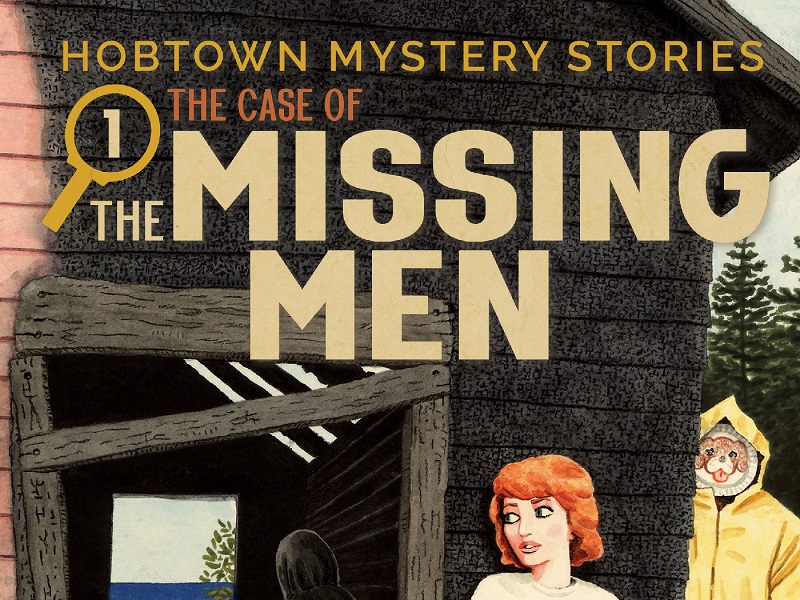
Alexander Forbes: The Hobtown covers were always meant to be reminiscent of the old Nancy Drew or Hardy Boys books in order to inspire nostalgia in the reader, only to subvert those pulp tropes with something more disturbing. For these editions, I decided to lean harder into a traditionalist approach and used watercolour to try and capture the feeling evoked by those old illustrated covers. I was happy to provide only the illustration for this edition, though; Oni’s senior designer Sarah “Rocky” Rockwell did a beautiful job creating and laying out graphic and text elements over my drawing.

Bellwoar: From creating school mascots, to devising local signs, were there any details that really helped solidify the town for you?
Bertin: Hobtown Mystery Stories is about the East Coast, especially our folklore and culture, so a lot of the detail we put in comes from the coolest, weirdest parts of it: taxidermy and folk art, carvings, masonic ephemera. We love misspelled signs, misheard lyrics, misshapen statues, and those kinds of details are everywhere in Hobtown. For me, it’s the way the different kinds of architecture—the stately Second Empire buildings, the saltbox, clapboard houses and the humble, vinyl-sided trailers in the trailer park—interact, contrast and coexist in a sprawling wilderness that makes me feel like it’s a real place, crawling with Alex’s ugly, funny little people.

Bellwoar: Did you always want to populate Hobtown with character actor faces and why set the series in the ’90s?
Forbes: A few of the characters’ faces were indeed sourced from actors, but most were sourced from our lives. Kris and I worked in and drew endless inspiration from a Halifax bar called Bearly’s for over a decade. A majority of the characters in Hobtown were based on the many odd-ball friends we made in that old dive, including all five of the missing men.
Kris and I grew up in the ’90s, and so the teen memories we’re drawing just naturally come from there. It also feels like the internet age isn’t conducive to the kind of story we wanted to tell. We also wanted to limit cell phone use, and so only one character has one—Sam Finch’s Finch Fone—and it’s a 45 lb briefcase.
Bellwoar: While it was Sam who tipped the Hobtown Junior Detective Club off to the case of his missing father, his instinct remains to work alone. How valuable is it to have a character who’s an outsider in a story like this?
Bertin: It’s a useful storytelling device to introduce an insular, idiosyncratic little world to an audience through the eyes of an outsider, but Sam isn’t a stand-in for the audience either. He’s what you’d get from a real-life Johnny Quest who adventured instead of attending school: an outsider to fun, to pop culture and domestic life, and even to being a normal teenager. But his real value to the story is that he has never experienced friendship in his entire life, and the Hobtown Junior Detective Club are the first friends he’ll ever have. As the series progresses, he’s pulled between genuine love for his new allies and the total dedication to his terrifying and domineering father.

Bellwoar: As a kid the idea of a detective club would’ve been so appealing. The Hobtown Junior Detective Club even meet in a treehouse. Was it fun getting to indulge in that childhood fantasy a bit and have the club members engage in spycraft, like mirror messages?
Forbes: Yes, childhood fantasies abound, from Sam’s inventions to the incredible toughness and bravery of the Hale brothers, to Pauline’s otherworldly visions. Even the conceit of the detective club and their ability to solve mysteries at 16 is fantastical. That stuff is fun to daydream about no matter your age. But we try to balance this whimsy against the all-too-real world of adults, which is actually scary. I suppose we’re trying to strike a balance between fun, pulpy adventure/mystery tropes with the terror of facing reality as a young adult.

Bellwoar: What are the unique challenges of designing a mystery in a town where not everything can be explained by science?
Bertin: It’s plenty of work for us, the creators, to understand and explain to ourselves what is really going on, what the characters believe is going on, and which townspeople know what and why. We have lots and lots of notes, history, bios and a story bible that’s way too big (and growing all the time). But in terms of what we share with the audience, it’s the sharing itself that’s our absolute favourite thing about the series. Seeding little hints, clues, hidden images and symbols throughout the story and just leaving the reader to make decisions about it is a joy. I love reading people’s theories and seeing how much fun they have guessing about the story.
Bellwoar: That battle between science and the unknown really plays out in the friendship between Dana and Pauline. While Dana prefers facts, Pauline is more open to the possibility that not everything is explainable. What was it like getting to develop that relationship?
Bertin: It’s fun! In terms of crafting the story, we love making the reader think the story is moving in one direction when in actuality it’s going in another, way weirder direction, one that’s impossible to predict. In Hobtown, the rigid world of facts and the squishy, ephemeral world of coincidence are both pulling and pushing our characters around, with Dana and Pauline representing those two poles. While Pauline understands the importance of what Dana does, Dana doesn’t yet understand that having a connection to the spirit world has real value, but she eventually will. The magic of it is that the case could have never been solved with only one of them, and certainly not without their friends.

Bellwoar: Besides being inventive, some of the images in The Curse of the Missing Men are downright disturbing. Where do you look to for inspiration?
Forbes: As mentioned before, we get a lot of inspiration from where we live. While Nova Scotia makes for pretty postcards, it can be an eerie place, which might be why its various inhabitants have such unsettling folktales—about unexplained psychic phenomenon, strange monsters and various small meddlesome creatures. The curses from those stories were very much real to those people, and with that in mind, when we looked around us as we started working on the series, we saw that we’re still in that dark history and that there are still curses all around us. Poverty, mental illness, corruption. The Missing Men, for instance, aren’t far from reality. Kris and I interacted with guys around our bar who, due to a life of external and internal misfortunes, truly had no one who would go looking for them if they were to disappear. I tried to meditate on these kinds of real-world horrors as I drew.
Bellwoar: Every time I read The Curse of the Missing Men I’m always struck by the potential for Halloween costumes. Have you come across any Hobtown cosplay yet?
Bertin: It’s always touching to receive letters and especially fan art, it’s our favourite thing. Someone even made us a marionette of the Mini-man of Hobtown, which left us speechless. We’ve largely been outside of the world of great big comic conventions, but it would be amazing to see Hobtown cosplay in person. If you were looking for a cheap and easy Hobtown cosplay, a raincoat and a paper plate mask would be my go-to. Maybe the closest I received was from a book club at Big Planet Comics in Maryland who did exactly that, each decorating a ‘missing man’ mask with their own horrifying dog design. It was beautiful.

Bellwoar: Thanks for agreeing to this interview, Kris and Alexander!
Hobtown Mystery Stories Vol. 1: The Case of the Missing Men goes on sale April 24th from Oni Press.

