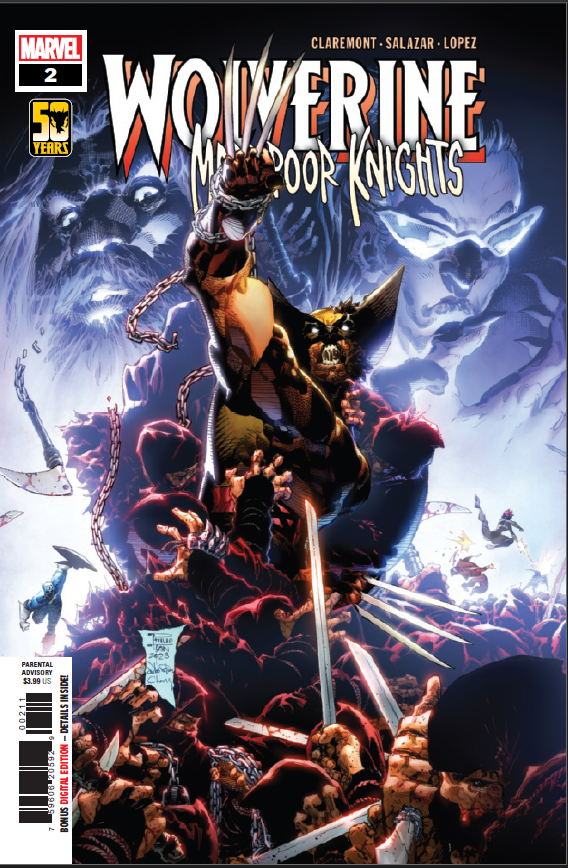
‘Wolverine: Madripoor Knights’ #2 Review – What’s This All About Then?
by Austin Gorton
Overview
With barest hint at a greater narrative purpose, Wolverine: Madripoor Knights #2 is an improvement over the debut issue. The pedestrian writing and art still leaving it struggling to standout.
Overall
4/10Marvel is no stranger to nostalgia series these days, nor is writer Chris Claremont, the majority of whose work of late largely comes in the form of miniseries set in previous eras of X-Men continuity. That said, when Wolverine: Madripoor Knights launched, there was a bit of confusion in the fan community around the idea of building a nostalgia-driven story around an issue that, for most readers, was fondly regarded chiefly because it was a showcase for an artist — Jim Lee — who wouldn’t be involved in the sequel series.
Wolverine: Madripoor Knights #2 doesn’t eliminate that concern — spoiler alert, Jim Lee still isn’t drawing it — but it does offer the barest potential of narrative justification beyond an easy cash grab while improving slightly on the first issue.

Wolverine: Madripoor Knights #2 picks up where issue #1 left off, with Wolverine joining Avengers Captain America and Black Widow in a hunt across Madripoor for a mysterious weapon about to be sold in auction. Along the way, they fight some goons pretending to be Hand ninjas and run into Jessan Hoan, aka Tyger Tiger, one of the two dueling crime lords of Madripoor (and an associate of Wolverine’s with a backstory filled with no small amount of convulsions).
Their actions lead them to be targeted by Bloodscream and Roughhouse, a pseudo-vampire and an Asgardian strongman who fought Wolverine early in his Claremont-penned solo series. Most of this is pretty standard comic book stuff.
But, in a couple places, Claremont hints at something of a character arc, and a possible purpose for this story beyond the marketing angle. Uncanny X-Men #268 (and this story) takes place at a time when the X-Men are more or less dissolved, just prior to them coming back together in the “X-Tinction Agenda” crossover.
Moreover, it is a time when Wolverine’s healing factor is maxed out and Wolverine believes himself to be on the verge of death. Between Uncanny X-Men #268 and Wolverine’s next (X-Men) appearance in issue #271, he makes a whole slew of appearances: issues of his solo series, stories in Marvel Comics Presents, a New Mutants guest appearance.
But none of them really address the change in the beaten down, misanthropic Wolverine of this era and the Wolverine who springs into action to save his friends in the course of “X-Tinction Agenda”, and proceeds to rejoin the team with little mention of his struggling healing powers going forward.

Given that twice in this issue Wolverine’s narrative captions point out how he thinks he’s dying but will keep going to protect his friends and/or that he’s been too focused on himself lately, it’s entirely possible that Claremont is using this story to retroactively bridge that character arc. It also shows how Wolverine snapped out of his relative funk in order to rejoin the X-Men and operate in more or less the same role as he did before. In doing so, Claremont would be giving the miniseries a narrative purpose to exist, something beyond a cash grab celebrating a fondly remembered issue drawn by a long-departed artist.
Of course, that could all just be wishful thinking, grasping at straws in a vain attempt to find greater meaning where none exists.

All that aside, how well this issue lands largely depends on one’s opinions on Chris Claremont’s writing. One the one hand, with the absence of Psylocke and the Bacchae in this issue, it’s much less Claremontian. There’s the usual “explain the difference between Hightown and Lowtown” narration that accompanies, by comic book law, all stories set in Madripoor. Tyger Tiger (herself another distinctive Claremont character) also shows up wearing a version of Psylocke’s old pre-ninja Outback Era armor that briefly featured in a Claremont-penned subplot back in the late 80s. Otherwise, Wolverine: Madripoor Knights #2 is largely devoid of many of the tics and tropes readers have come to expect from Claremont.
On the other hand, without those things, the issue much more of a bog standard action story. Which is fine, but leaves little to recommend it or even set it apart from similar stories of its ilk.