
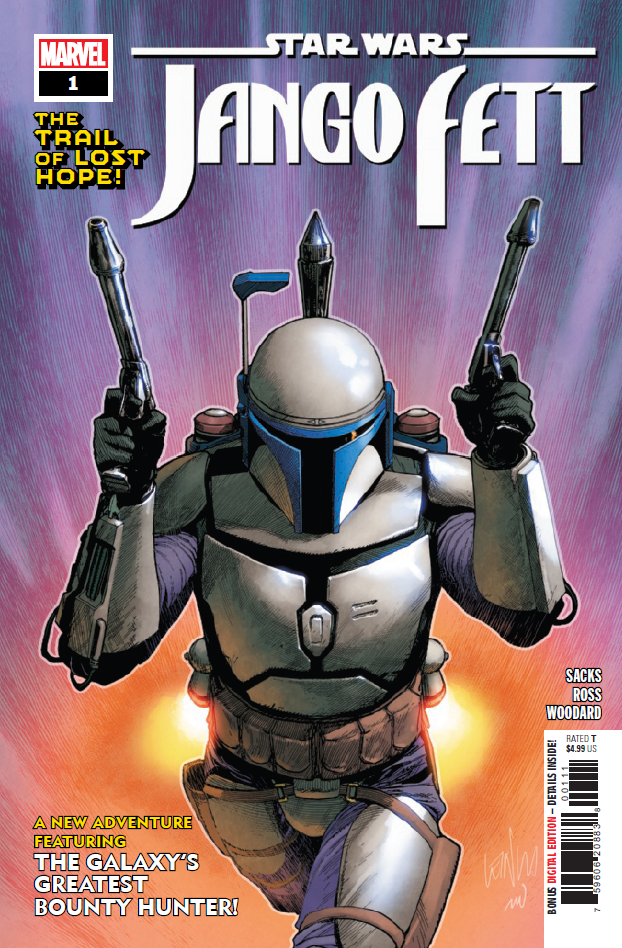
The Least Interesting Fett Stands Up — Reviewing ‘Jango Fett’ #1
by Austin Gorton
Overview
Jango Fett #1 puts the progenitor of more interesting characters in the spotlight. Amidst some pedestrian execution of a straightforward plot, it offers up a potential take on the character which might help him hold up under the scrutiny of that spotlight.
Overall
6/10In the grand scheme of Star Wars, of all the characters descended, either biologically or spiritually, from Jango Fett, Jango himself is the least interesting. Boba Fett? Everyone loves him. The clones? Rex, the Bad Batch, fan favorites. The Mandalorian? He’s the anchor of Disney’s live action TV shows, and Grogu’s best pal.
But Jango? Well, Jango is mostly notable as being the less cool — or at least, less memorable — version of all those other characters. He looked cool, then he died. Can one comic book miniseries single-handedly change all that and help elevate Jango Fett? Based on Jango Fett #1, probably not. But there is hope.

To be fair, asking any single story, let alone a four issue comic book miniseries awash in a sea of comics in 2024, to singlehandedly elevate a character to the likes of Boba Fett or the Mandalorian is a pretty big ask, and Jango Fett #1 certainly isn’t a bad comic.
Writer Ethan Sacks, fresh off chronicling the adventures of different bounty hunters in Star Wars: Bounty Hunters and artist Luke Ross, who is no stranger to Star Wars illustrations, turn in an effective if uninspiring table-setting first issue. It begins with a sequence that walks the line between trope and cliche, establishing Jango’s prowess as a bounty hunter. He walks into a joint, declares he’s there for a bounty, then gets into a fight where’s he outnumbered only to ultimately blast his way out, with his quarry in hand.
That it’s more or less the same opening as The Mandalorian does Jango Fett #1 no favors in terms of establishing a distinctive identity for this no-nonsense, hyper-effective bounty hunter wearing Mandalorian armor. Ross also struggles a bit in places, such as the climatic full page splash of Jango blasting away. Jango looks like a rag doll being carried aloft by the invisible hand of a child.

From there, Sacks settles in and starts laying out the plot of the miniseries — a MacGuffin is stolen that is key to ensuring peace on the world of Glee Anselm (homeworld of Jedi Kit Fisto and would-be retirement destination of Tobias Beckett) — as well as introducing additional characters who will presumably play a role in the story — including fellow Prequel Era bounty hunter Aurra Sing. All of this is pretty routine “first issue” stuff. Though, Ross does redeem himself somewhat via an action sequence depicted across a two page spread with twelve variable-sized panels with especially thick black borders that create the sensation of watching the action unfold via a reel of unspooling film.
If there’s any hint at an attempt to craft a depiction of Jango that defines him apart from his bounty hunter and Mandalorian-brethren, it comes in the form of a kind of blue collar weariness that permeates Sacks and Ross’ depiction of the character. Presumably inspired by his “I’m just a simple man trying to make my way in the universe” line in Attack of the Clones (a line directly quoted in the issue), they depict the title character in Jango Fett #1 as someone who just wants to do his job, get paid, and move on. But he is constantly having roadblocks thrown up that cause everything to be more difficult than it should be for him, whether it’s the bounty in the opening pages refusing to come quietly, or the promise that the hunt for the MacGuffin will be a piece of cake only for Jango to learn it’s a hotly contested item being sought by multiple bounty hunters and the warring Anselmi factions, or the fact that he has to fight off an effort to sabotage his ship before he even sets out on his quest.

It’s subtle, but there’s potential in the idea of Jango Fett as an Average Joe, someone just trying to make a living but constantly being impeded in that effort by forces outside his control, channeling big “I’m not even supposed to be here today!” energy on a galactic scale.
Here, he takes a simple retrieval job and ends up getting drawn into a planetary conflict. Later, he donates some genetic material for cash (and a son), and he ends up spawning an entire army that plunges the galaxy into war and upends a thousands-of-years-old political order (and loses his head in the process). That’s a characterization that could help set Jango Fett apart from his biological and spiritual successors, if Sacks & Ross run with it (and it takes hold outside this miniseries). It’s also enough to make Jango Fett #1 worth a read, even if the overall execution is otherwise mediocre.
