
WonderCon 2024: Jackson Lanzing, Collin Kelly, And Eamon Winkle Define ‘The Principles Of Necromancy’
by Erik Amaya
Magma Comix upcoming title, The Principles of Necromancy, is provocative from the jump: in a fantasy world bereft of magic, doctors are the closest thing the realm knows to wizards. And one doctor, Jakob Eyes, is setting out to cure death. Of course, this goes against the precepts of his order, so he has to go about his research in gruesome ways. The debut issue, due out soon, is a fine example as the doctor finds a group looking for the exact sort of “treatment” he offers to hold back an opposing force. But is the disease better than the cure?
At WonderCon 2024, Comicon.com editor-in-chief, Erik Amaya, had the chance to sit down with the creative team — writers Jackson Lanzing & Collin Kelly and artist Eamon Winkle — about their first creator-owned title in eight years, Winkle’s debut as a sequential artist with Principles, some of the features of the fantasy world, and what readers might expect from the subsequent issues.

Erik Amaya: So this is your first creator own book in eight years, but during the panel on Friday, you also said it was an idea that had been brewing for a while. So what brought this to the fore as something you had to do at Magma?
Collin Kelly: This idea had been kind of percolating, but when we first sat down with Magma, we realized they were a publisher we really did want to work with. They are so creator focused. We felt that we could really trust them with an idea that was basically so strange and weird that we’re pretty sure no one else would take the shot.
Jackson Lanzing: Truthfully, Principles of Necromancy had only been brewing for a little bit. It was effectively a paragraph on a document that we’d thought up when we were kicking around how to play with dark fantasy in a way that felt unique and new and would open up new visual territory. We’re both big fans of the FromSoft Games like Elden Ring and Dark Souls. I find roguelikes to be terribly frustrating, but the design work is so inventive and exciting and interesting. It felt like they were always taking the dark vibes out of any of the fantasy that we grew up reading and pushing it way, way, way further. And so we said, okay, “how can we create a universe where your general assumptions about dark fantasy found themselves challenged inherently?”
And the first part of that was to say, “okay, what if we have no magic? What if everything has to be applied practically?” What if everything has to be done in a way that feels surgical, for lack of a better term? And as we started to figure that out, it became really clear that “surgical” was actually the term. How could we apply the principles of medicine to a dark fantasy universe?
And that’s where Principles of Necromancy really started. It was only once we started working with Eamon that the story actually ended up going beyond a paragraph. It was really at that point we started thinking about what this really could be. How far can we take this? What do these doctors look like? What does a world look like if you don’t have wizards, you have doctors, and how far can you push that once you set yourself to not making it a historical fiction, but a historical fantasy
EA: Eamon, what made it perfect for you to make this your introduction to sequential art?
Eamon Winkle: Being also a FromSoftware fan as well as a fan of Berserk — where it’s dark, but there’s a very wonderful story behind it so that even in these very bleak moments, there’s still something to keep you going. Through the conversations that Jackson, Collin and I have had where we’re building this world, it’s just been wonderful creating these characters, creating the world and just the concept of they’re not being magic, but there’s somewhat magical things that are occurring that these people of this fantasy world are going, “This is mind blowing! What’s happening”
Lanzing: And that’s why the title, I think the interesting thing about pitching a book with the word “necromancy” in it, and then the first thing we say out loud is like,” well, there’s no magic,” right? That seems like an initial conflict of your pitch and your form. But in fact, that’s the very premise of the book; when you develop out a new art. What is to the old Arthur C. Clark adage? What is the distinction between sufficiently advanced science and magic? There isn’t one — especially to a culture that barely has the premise of surgery to say, “Okay, this guy’s going to take all of your surgical principles and he’s going to turn it on death.” The story is about a doctor who’s trying to cure death using purely medical means, but ultimately, how far do you have to push medicine until it becomes literal necromancy?
And so that is where Dr Eyes’ journey really comes from, [it] is the idea that he is looking at necromancy and saying, “This isn’t magic, this is achievable science. And if we just treated it like achievable science and we put it through its tests and we peer reviewed it and we wrote down the principles and we started from there, we could do this. Why don’t we do this?” And in achieving this sort of apparent heresy, he is trying, to Eamon’s point, to achieve something good. This isn’t a litany of suffering, this is the journey of someone trying to save the world. Just you have to crack a lot of eggs to make that omelet.

EA: It’s such a powerful starting place. You could feel the reaction of the audience at the panel the other day when they heard “a fantasy world with no magic.”
Lanzing: Magic is synonymous with fantasy, even grounded fantasy like Game of Thrones; [there,] magic is represented by dragons and red wizards and all this stuff. So we can funnel all of that into medicine.
It felt really important in terms of giving ourselves a fundamental shift from the norm, especially when you do a creator-owned book, when you’re kicking off into comics and you’re trying to do something new. I feel like it’s really important to build on a completely different foundation. Otherwise it’s very easy. There’s so many stories in this space and so much of it we’ve already consumed. It’s really important to make sure that your road is paved on new foundations.
EA: In issue #1, I noticed that one of the city men uses the word “doctor” with some disdain. Is that going to be a common response to medicine or is there such a thing as the good doctor?
Kelly: “Is there such a thing as the good doctor?” is something that we very much will explore in our third issue. The thing about doctors, I mean — I think we can all kind of look at the world right now — and unfortunately you can look at the term doctor with a little bit of derision. The medical establishment is not always necessarily built towards taking care of the people who need it the most. There is a certain amount of not only hubris, but of pride and of exclusion in terms of who you treat and why.
So that is kind of this concept that we have here. And obviously because this is a fantasy world, they don’t really know what a doctor does. So for the common population, an herbed poltice seems as effective as someone actually opening up your guts. The idea of little creatures in our blood [or] in the air that makes us sick sounds like [the thoughts] madman. Clearly those are the bad humors that work through my body. So there’s a lot of disbelief within the general population. But when a doctor shows up at your door and says, “I can cure the things that’s rotting you from the inside” — if you’ve been praying to God for a miracle and a doctor shows up, you take that miracle.
Lanzing: Well, and I think what’s cool is that it’s true that the doctors have done things. There is a demonstrable effect the same way that magic has a demonstrable effect. And so yes, I think there’s going to be a general sense, not just of derision, but a fear or respect. How different people respond to doctors [in the series] is, I think, the same way that people respond to wizards in any other fantasy world. It’s one where it all probably roots from a sense of fear. And then it’s whether or not you pivot that to respect or to derision.

EA: I also couldn’t help but notice the mention of a witch as either an herbalist or a con artist. In our own history, there was a moment when men came in and said ‘No, this is medicine, not witchery’ and pushed women to the sidelines. Has that division happened in the world of the story?
Lanzing: Oh, yes. And in fact, you’ll see evidence of that. I think we felt it was really important not to ignore that because it is such a fundamental sin of early medicine. I think biggest historical example of this is midwifery — that, effectively, we didn’t have the idea of birthing hospitals until the late 19th century because we had women who knew what they were doing, who were midwives, and then men came into this space and said, “we know what we’re doing.” And, in fact, infant mortality skyrocketed because male doctors did not know what they were doing.
What they were trying to do was dominate a profession that was fundamentally dominated by women. And so the roots of that felt really important to reflect [in the book]. Are we going to tackle that head on in the first four issues? No. What I will tell you is that it’s something we’d love to tackle down the line. What you’ll see is evidence of that in issue #3. There is very specifically a doctor that you will meet in issue #3 who’s representative of that division and representative of how women are trying to battle that in this world.
EA: Eamon, do things like Dr. Eyes’ mask or the creature we see in issue #1 just live in your head or does the imagery appear as you’re reading the script?
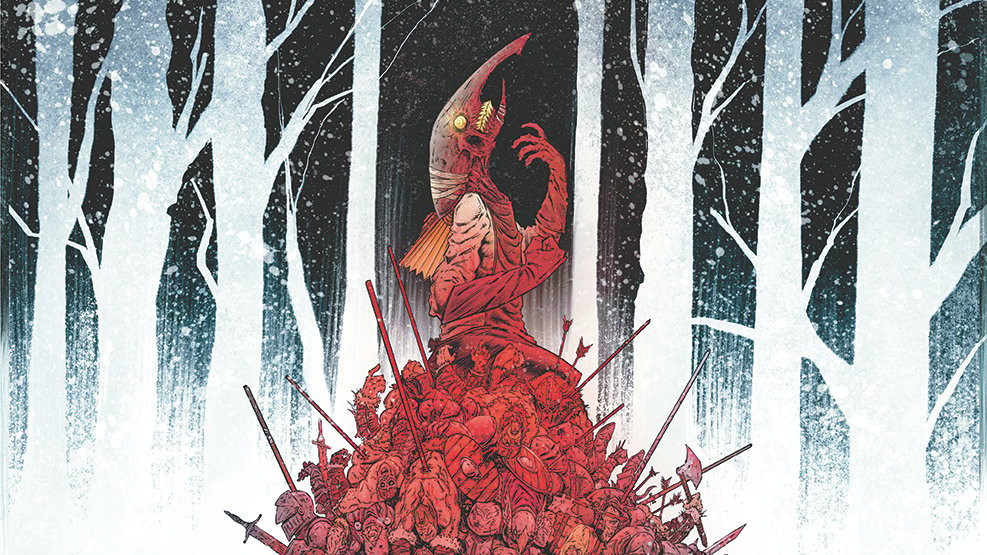
Winkle: Yes and no. The mask was a conversation. We said early on that he needs to wear a helmet that is his working attire, and it needs to be something iconic. It needs to have a shape that is interesting. I vaguely remember a night I was right about to fall asleep. I had an idea and quickly sketched out on my phone thinking “that’s it.” The next day I woke up and looked at this garbage doodle of random lines and squiggles and thought, “well, we were close.” And then from that, this horrible helmet came to be. But there were 12 different versions and that was the first. And so the other ones were just kind of like, those look nice, but this one’s a step further.
Lanzing: I think he had it from the get-go.
Kelly: This guy keeps getting it like one-and-done. He then gives us 20 other options because he’s a professional, but his instincts are so true and pure. On this concept, we have notes on maybe how to better tell stories or capture an emotional beat. But in terms of visuals, nah, this guy crushes it right out of the gate.

Erik Amaya: Beyond Eyes’ helmet, there are some gruesome moments in the first issue that struck me harder than I think they would have had I read the story when I was a teenager. Is the aim to create those sights or hit at emotional underpinnings that make it all truly horrific?
Lanzing: I think there’s a real intention on this book to get ourselves out of our comfort zone. Collin and I don’t write a lot of body horror. It wasn’t an instinct either of us have. I think if you look at our favorite movies, you’re not going to find a lot of David Cronenberg in there. But what we are discovering is that we have a real instinct for it and love to push it there — but not for the intention of shock value, never for the intention of getting your face in it.
In the case of issue one, we want you to care about Kairn, this poor barbarian who’s watching all of his people die. The rest of it is to pour into the mind of someone who is capable of visualizing this in a way that we can’t, and then see how that can grow into something that is simultaneously horrifying from a visceral perspective and, ideally, horrifying from an emotional perspective. And that emotional horror is really where this book lives.
Kelly: I think fans of our work know that one of the things we always want to do is go for your heart. We want your tears as much as we want your hurrahs. And a big thing here is — and I think what might hit you differently as an adult than when you were young — it certainly hits us differently, is it’s not the horror of the body, it’s the horror of the soul.
One of the things here is that, especially with Kairn, the eyes are the window to that soul, seeing the pain, seeing the horror. It’s not about you going through it, it’s about these characters going through it and realizing that there’s truly nothing more horrifying than hopelessness. And that’s one thing that we really find in our characters who get to see Eyes. But on the flip side, Eyes himself has replaced his eyes with lenses. So you can never see into the soul of Eyes. And that’s kind of the trick with every single issue here. We are approaching him externally from a different perspective of someone in his life who gets to see who he is as a man. And we ask the audience then to judge him. We will not place judgment on his actions. That’s up to you.
Lanzing: That is the challenge to the reader.
Winkle: It is a violent book, but it’s also the subject matter of it — especially in this first issue of it being ongoing war, the desperation of this barbarian group. And, obviously, just the act of surgery is going to be a little bit more violent. But like Jackson said, we’re not doing it in the sense of we’re trying to shock you. We’re just trying to show you this is the realism of what warfare is. And because of that warfare, what drives their desperation to then turn towards someone like Eyes and take his offer.
EA: Since each issue will view Dr. Eyes from the perspective of characters who encounter him, what sort of people can readers expect to meet in subsequent stories?
Lanzing: I think part of what’s cool about the approach that Collin suggested, hitting Eyes from outside at all times, is that issue #2 is shockingly nonviolent, comparatively.
Winkle: It’s very, very quiet.
Lanzing: Issue #2’s premise is about a little girl who meets Eyes as a doctor who saves her mother. It’s her pushing herself into Eyes’ world and saying, “I want to learn what this is. I want to be a doctor. How do you do this?” and experiencing the horror that lives in the quiet moments of his life. And, also, how he reacts to a girl — who is effectively innocent — who wants to walk his journey and forces him to, for a moment, look at what his journey has been and what he has had to do to get here. And does he want to impart that to someone else? And
Eamon Winkle: And what has he cut away from himself? And now he sees this life in this girl and realizes, “do I want her to go down the same path that I did?”
Lanzing: So I think every issue, ideally, gives you a really different experience. That’s another thing that we’re really intense about, in general, is single issue comics. We believe really strongly that it should always be the best damn comic, that if [a reader] gets issue #3, even if they can’t follow the wider story, they have a fundamental emotional experience in between that cover and that end page. So when we approach Principles, the whole premise is that how does every single issue give you some kind of unique emotional experience that then on a grand scale gives you something larger as a whole?
Kelly: In issues #3, Dr. Eyes returns to the city hospital, where the 20 grand physicians — the 20 specialists of this world — have gathered for the grand conclave to bring all their findings together. And so that particular issue is going to be [seen] through the leader of that conclave, a man we call Dr. Mind, who is effectively the psychiatry specialist.
Lanzing: The neurosurgeon, the brain master of the group.
Kelly: And then lastly, the fourth issue, we’re going to hold that one for ourselves. But there’s a character that we plant an issue #1 that is a slow-burning simmer, and the consequences of issue#1 are going to come to fruit in issue #4.
Lanzing: Yeah, close readers of issue one, I think, will be able to figure that one out, but we’d rather they get there on time.
The Principles of Necromancy #1 comes to comic shops soon.

