
Free Comic Book Day: An Interview With ‘The Night Librarian’ Creator Christopher Lincoln
by Rachel Bellwoar
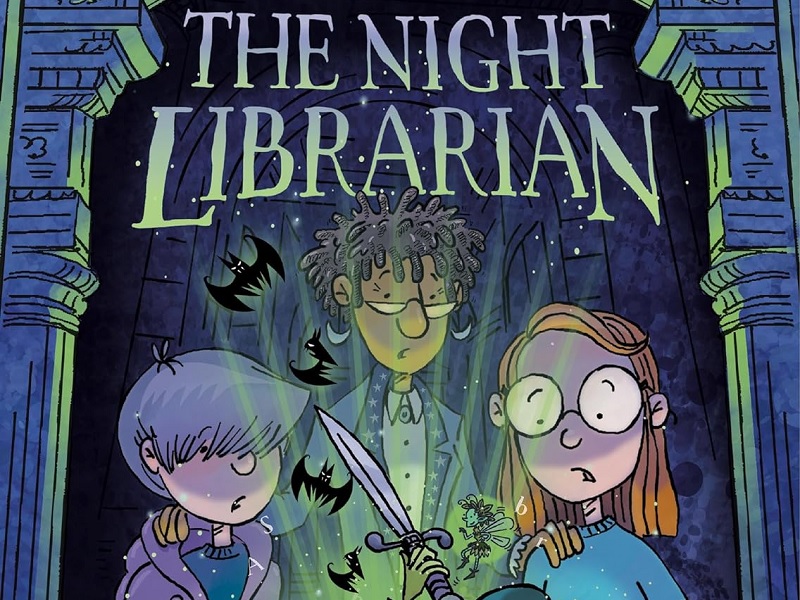
Page and Turner have spent their share of time at the library. Not once has a book come alive before. Not, that is, until Page decides to bring their father’s rare edition of Dracula to the library to be appraised. Suddenly Page and Turner are introduced to the world of night librarians in Christopher Lincoln‘s new graphic novel of the same name. For more on The Night Librarian and why Lincoln decided to set the story at the New York Public Library, check out this interview with him below (and for a sneak peek at the graphic novel, be sure to pick-up Penguin Young Readers’ Free Comic Book Day issue this Saturday, May 4th in participating comic book shops):

Rachel Bellwoar: In the “Acknowledgements” section you talk about The Night Librarian being your first graphic novel. Having previously worked in animation and advertising, what’s been the biggest learning curve in adjusting to the new medium?
Christopher Lincoln: Estimating how long the process takes, particularly inking and painting. Thank goodness for Bonaia Rosado who was able to sweep in with her colorist skills and help me complete the project on time.
Bellwoar: Most of the story takes place at the New York Public Library. Did you always want to use a real location and be able to refer to specific rooms and areas?
Lincoln: Not really. Aspects of the story bubbled up from a long ago visit to the New York Public Library with a friend who lives in the city. He’s rightfully proud of New York’s architecture, of which the Stephen A. Schwarzman building is a crown jewel. I was intrigued to find out about the miles of hidden stacks beneath the Main Reading Room and suspected many interesting and secret things could happen down there. That spark eventually made it into an outline for a novel which ultimately morphed into The Night Librarian. So, to answer your question, the real location led to the story, and it only made sense to anchor it to the real place with specific rooms and areas.

Bellwoar: The Night Librarian follows twins, Page and Turner Reed, after they lose their father’s rare edition of Bram Stoker’s Dracula. How would you describe their relationship and did you always want to play with gender expression when it comes to their character designs?
Lincoln: I thought it would be fun to imagine twins who were anything but identical—Turner thinks first and acts later, whereas Page has more of a hair trigger and acts first then thinks. As far as gender expression goes, I noticed the boys of some of my writer friends were wearing their hair long and the girls short, so that was based on observation. But it also made Page’s and Turner’s characters more interesting and gave them distinct visible differences.
Bellwoar: Throughout the library there are signs quoting from famous authors, including Art Spiegelman (Maus) and Toni Morrison (Beloved). Is that something the New York Public Library is known for or was that your own way of paying homage to their work?
Lincoln: Yes, homage. It was a simple way to honor their work. And a bit of an “in your face” to people who are bent on banning books. For copyright reasons, I must work with public domain books, and the list of well-known books in the public domain is unfortunately pretty white-centric. So, it was also an attempt to be more inclusive.
Bellwoar: Are your excited at the prospect of potentially introducing younger readers to microform for the first time?
Lincoln: Ha. Page and Turner needed to look up an old newspaper article, and the Microform Reading Room seemed like a more interesting visual place for them to search, rather than through a digitized archive.

Bellwoar: While Ms. Literati gives Page and Turner a crash course on being a night librarian, they’re often left to their own devices. Why did you want to show children being able to thrive without adult supervision?
Lincoln: It’s important for kids to have agency to solve problems on their own. Much more satisfying in a story.
Bellwoar: Page and Turner end up joining forces with a slew of characters from classic literature and fairy tales. What was it like coming up with the roster of famous heroes and was there anyone who almost made the cut that got dropped?
Lincoln: I had to make sure characters weren’t too obscure so kids could relate to what’s going on. Characters like Peter Pan, Tinker Bell, Jack from Jack and the Beanstalk, and Alice made sense for that. Jim Hawkins required a little more explanation. I really wanted to use him because of the Hispaniola scene in the Under Sanctum, and I liked the silly factor of introducing Don Quixote alongside of the Knights of the Roundtable in the battle scene. Page’s and Turner’s new literary friends came with a set of villains of their own, so that made up much of the list. I also knew I wanted to use Dracula but had no idea he’d end up being such a fun character. Same story with Hyde because he was over the top but could also hide in plain sight. Anyhow, putting villains and places like Paris’s fictional Rue Morgue on the knife edge of creepiness and silliness has always delighted me, as has making heroes all too human.
The only character I had to drop was Pippi Longstocking, a copyright issue. I switched her out for Alice, who ultimately was a better character. It still gives me a chuckle thinking about how irate she is to show up in yet another weird situation. Plus, Pippi’s and Page’s characters were a little too similar.

Bellwoar: As a kid would you have jumped at the chance to enter your favorite storybook world or would you have been more cautious like Turner?
Lincoln: I was definitely more of an observer like Turner so that would have made me cautious. But I’m sure I would have leapt right into Harold and the Purple Crayon at once. It was a formative book.
Bellwoar: On a similar note, what storybook character would you have loved to have met in real life?
Lincoln: To my parents’ consternation I was more of a comic book and movie kid than a reader. So, I would have wanted to meet The Fantastic Four or The Justice League in real life. By Junior Highschool I finally started reading science fiction for fun, so by then I would have wanted to meet John Carter, from John Carter of Mars.
Bellwoar: Would you ever consider adapting your Billy Bones books into graphic novels?
Lincoln: I would and think because of all their visual description they would make good ones. Sadly, I’ll be seventy-two when The Night Librarian comes out, and a second Night Librarian book is in the works already, so I’m not sure if I’ll have enough time to devote to a project like that. But, you never know.
Bellwoar: Thanks for agreeing to this interview, Christopher!
The Night Librarian goes on sale July 30th from Dial Books. For a preview of the graphic novel be sure to pick up Penguin Young Readers’ Free Comic Book Day issue on May 4th.
