
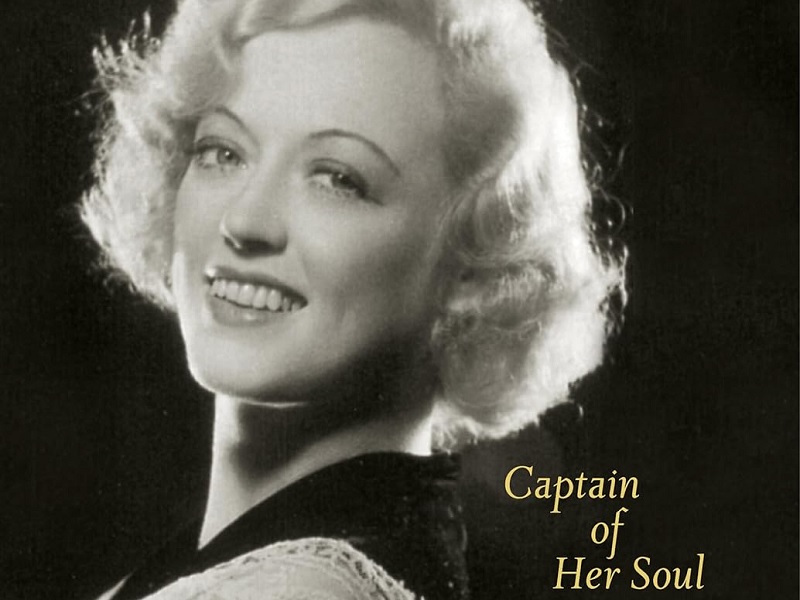
An Interview With ‘Captain of Her Soul: The Life of Marion Davies’ Author Lara Gabrielle
by Rachel Bellwoar
Who was Marion Davies? According to her biographer, Lara Gabrielle, in Captain of Her Soul: The Life of Marion Davies, she’s only the actress who, “…laid the groundwork for future comediennes like Carole Lombard, Lucille Ball, and Carol Burnett.” In other words, she’s someone people should remember today more for her roles than who she loved (even if she loved William Randolph Hearst). Davies started her career during the silent era, but would continue acting in films until the late 1930s, after which she focused more on her philantrophy work. Gabrielle’s book is magnificent and you can find out more about it (and Davies) in the following interview:

Bellwoar: Writing a biography is a huge commitment. What convinced you to make Marion your subject, and how did you first discover Marion Davies?
Lara Gabrielle: Marion Davies has fascinated me since I was about 13. I’ve been a classic film aficionado for as long as I can remember, and for my 13th birthday, I received a copy of The Times We Had, which has long been marketed as Marion Davies’s memoir. I found her story intriguing, and even at that young age, it was clear to me that she had led a remarkable life. In 2011, I created a classic film blog, Backlots, and I realized how much I loved deep research dives, finding new and obscure information, and revealing it to the world. That made me think that I’d love to do something bigger. I thought: “Who needs a biography?” Marion Davies was the first name that came to mind. I tried to think of other people, but I couldn’t shake Marion. So I sought out people, interviews, and archives that could help me tell Marion’s story in a way that hasn’t been told before. It became clear that she desperately needed to be extracted from the Hearst legacy, to have her own story and her own agency given back to her. She was an extraordinary woman in her own right.
Bellwoar: You reference these in your book but Fred Lawrence Guiles wrote a biography on Marion in 1973. Then there’s the memoir you just mentioned based on interview tapes Marion recorded that was released posthumously in 1975, and a documentary by Hugh Munro Neely (2001’s Captured On Film). What new information or perspective did you want to bring to the conversation around Marion with Captain of Her Soul?
Gabrielle: Fortunately, I have recordings of the original tapes that were used to craft The Times We Had, so I can hear Marion say things in her own words. She was extraordinarily funny–witty and dry–and had a very sweet rapport with her interviewer, Stanley Flink (whom I interviewed many times for the book). That was what I wanted to communicate about Marion–that personality and warmth. I also wanted people to see her as her own woman, independent of Hearst. Hearst was a big part of her life, but he wasn’t the only part. I also have the interview tapes that Guiles used for Marion Davies, so I gleaned material from interviews that he didn’t use, supporting other hypotheses and discoveries that I make in Captain of Her Soul.
Bellwoar: While I still think Peter Bogdanovich’s The Cat’s Meow is a good movie (and it’s what initially sparked my interest in Marion Davies), I realize now that it plays fast and loose with the facts. Do you think films like The Cat’s Meow and Orson Welles’ Citizen Kane have done more harm than good, when it comes to Marion’s reputation?
Gabrielle: If we’re talking solely about Marion’s reputation, I think those films do far more harm than good. They cast Marion in the public mind as whatever the filmmakers decide she should be, rather than who she actually was. But as you say, they do get people talking. The ideal situation would be if someone did a great biopic based on the true Marion Davies!
Bellwoar: While Marion’s relationship with newspaper publisher William Randolph Hearst certainly didn’t hurt her career, it’s not the only reason she had one. How important was it to you to get across how immensely talented Marion was?
Gabrielle: That was one of the most important goals of the book. People who are familiar with the silent era know that Marion Davies was an exceptionally talented comedienne — but the general public, if they know her at all, often thinks of her as “the woman from Citizen Kane.” That couldn’t be further from the truth. I also go a step further, and make the case that Marion’s dramatic capabilities were far better than she gets credit for.
Bellwoar: Unfortunately a number of silent films have been lost over the years. Have any of Marion’s suffered that fate?
Gabrielle: Oh, yes. In fact, around 90% of all silent films are lost. It speaks to the sheer volume of movies that were being made in the silent era, and also to the importance of preservation for the ones we have left. From 1922 on, all of Marion’s movies survive. But before that, we’re missing quite a few. Most notably, her first film Runaway Romany is lost, as is her second film, Cecilia of the Pink Roses. I hope they’ll turn up one day!
Bellwoar: Despite having a stutter, Marion managed to make the transition from silent films into sound films. Is there a film from both of those eras that you’d recommend to cinephiles who might be new to her work?
Gabrielle: From the silent era, I would recommend Show People and The Patsy as two A-list films to start with. From there, I’d recommend The Red Mill, Little Old New York, Quality Street, and The Cardboard Lover. They show Marion’s versatility and comedic timing–and also her dramatic capabilities. Marion was never terribly comfortable in the sound era, but she does some fantastic work. I would recommend her pre-codes–specifically Five and Ten and Blondie of the Follies.
Bellwoar: One of the people you dedicated this book to was film historian Cari Beauchamp, who recently passed away in December. How did it feel when you first learned Beauchamp would be quoted on the book jacket for Captain of Her Soul?
Gabrielle: Cari was very closely attached to this project, and a mentor and great friend to me personally. Of course I was very happy when I learned that she would be quoted on the book jacket, but it would seem wrong if she weren’t. She followed every stage of my research, offering advice and encouragement along the way. She was one of the funniest people I’ve ever met, and kept me laughing even through the most stressful times. I miss her every day.
Bellwoar: Would you ever consider writing another biography someday?
Gabrielle: Yes, definitely! I feel that in order to write a good biography, your subject has to choose you, if that makes sense. That was certainly the case for Marion–things fell together so quickly and easily, it felt destined to happen. No one else has chosen me as their biographer yet, but we’ll see!
Bellwoar: Thanks for agreeing to this interview, Lara!
Captain of Her Soul: The Life of Marion Davies is available now from University of California Press


