
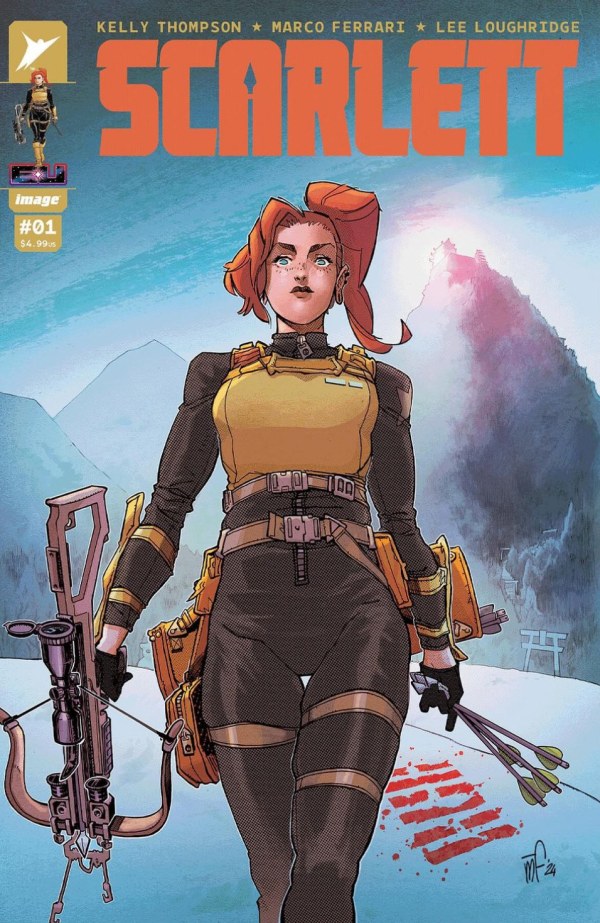
‘Scarlett’ #1 Review — A Sleek And Chic Intro To The First Lady Of GI Joe!
by Austin Gorton
Overview
Scarlett #1 is both an action packed martial arts/spy thriller and an effective study of the title character, featuring assured writing and clever art. It continues the build-up of Skybound’s GI Joe universe while always keeping Scarlett at the center of the narrative.
Overall
9/10The introduction of GI Joe in Skybound’s Energon Universe has been surprisingly restrained and methodical. Rather than drop a fully-formed Joe team into a new series, with all the favorites present and accounted for from the onset, the introduction to America’s daring highly-trained special mission force has taken more of a slow-burn approach. Each of its introductory miniseries sets up a different facet of the universe, building it out as each goes along.
In Duke, we get the beginnings of what will presumably become the core Joe team as well as Destro and the MARS Corporation. Cobra Commander showcases the beginnings of Cobra, of course, and the Dreadnoks (and, surprisingly, Cobra-La). Both series feature indirect tie-ins to Skybound’s Transformers series. That pillar building approach continues in Scarlett #1, which serves as an effective introduction to this version of its title character, while also using her as the introductory vehicle for another critical bit of Joe lore.

The debut issue divides fairly neatly into two halves. The first showcases Scarlett on a mission, in the process illustrating why Scarlett is destined for the GI Joe team. The second half then shifts, going wider as more characters (including the Skybound version of Snow Job) enter the fray and Scarlett becomes the vehicle to introduce the Arashikage clan — the ninja clan from which fan favorites Snake-Eyes and Storm Shadow hail — to the Energon Universe. Along the way, it also continues the Skybound Joe series’ trend of creating interesting new relationships between characters that didn’t necessarily exist in previous iterations of the franchise (in this case, the notion that Scarlett and Jinx, another Arashikage ninja, have a long and abiding friendship with one another that was fractured in some way).
Through it all, writer Kelly Thompson does an excellent job of keeping Scarlett at the center of the narrative, the axis around which everything else turns. As a result, plot and character go hand-in-hand. Far more than the specific beats of “Scarlett infiltrates a party, rescues hostages, runs into Jinx, etc.” the plot is Scarlett: how she reacts to things, how she handles challenges, how she interacts with other characters, all drive the narrative as it unfolds.

This is best exemplified in the first half action sequence. Playing up her super spy roots (Scarlett is the Joe’s counter-intelligence agent, after all), Scarlett sneaks into a swanky party. It quickly becomes clear, through the running commentary between Scarlett and her offsite, off-panel handler, that she’s there to identify the potential buyers involved in a hostage exchange. It also becomes clear the hostages are in the swanky mansion, and that Scarlett intends to rescue them despite the mission parameters.
What follows is a delightful bit of action in which the tension between what Scarlett is thinking and doing, and what she’s telling her handler she’s doing, is electric. It both illuminates Scarlett’s character — she’s going to do the right thing regardless of her orders — and lays the groundwork for her eventual involvement with GI Joe by showing just how disconnected she is from the “regular” way of doing things.
Artist Marco Ferrari is key to the success of Scarlett #1. He injects the opening pages with a Bond-ian chicness, switching between panels from Scarlett’s POV to wider establishing shots to provide the lay of the land. Once Scarlett springs into action, Ferrari shifts to an almost manga-inspired style, punctuating pages with speed line background to create a sense of kinetic energy.
He brings a similar energy to the action sequence in the second half of the book, as Scarlett infiltrates the Arashikage stronghold in search of Jinx. Not many artists would take as big a swing as Ferrari does here, aping both Frank Miller‘s Wolverine and the Paul Smith Wolverine/Silver Samurai fight that aped it in turn, as well as Larry Hama‘s famous “Silent Interlude” Joe issue in the span of a few pages. He doesn’t quite pull off these homages, but gets points for ambition.

More successful is a two page spread in which he does the old “draw the same figure multiple times in sequence to create a sense of movement” trick, as he renders Scarlett slicing her way through a cadre of ninjas. What elevates the technique here is the way Ferrari stages the last “step” in the sequence as the smallest of the five Scarletts and places it in the top left corner. Each subsequent figure then grows larger until the “first” and largest one is reached at the bottom right of the spread.
It’s a clever way of subverting expectation, forcing the eye to spend more time on the pages by essentially revealing the action backwards, which immediately prompts a second reading going the other direction. In doing so, Ferrari heightens the tension of the fight somewhat paradoxically by slowing it down instead of speeding it up.
By the end of the issue, the burgeoning Skybound Joe universe expands yet again, as another notable character enters the narrative for the first time. But Thompson and Ferrari have done such a successful job of centering Scarlett in the in the preceding pages that she’s not outshone by the cliffhanger arrival. Part spy thriller, part martial arts extravaganza, Scarlett #1 succeeds by asking its title character to carry the story, then doing everything it can to support her.