
Fire & Blood Files: Why Does Anyone Want Harrenhal Anyway?
by Austin Gorton
Warning: Spoilers for House of the Dragon season 2, episode 5 follow.
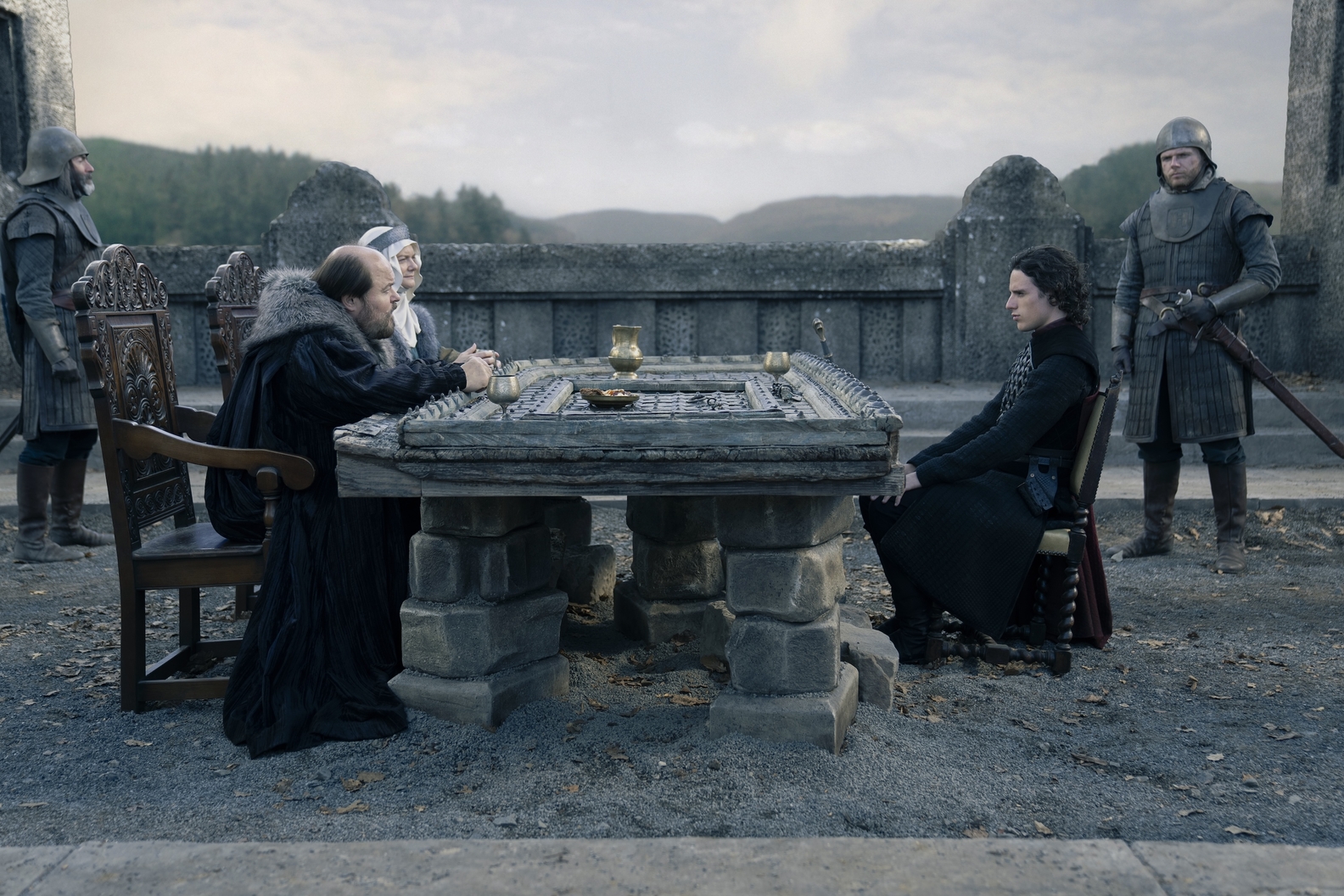
In “Regent”, the fifth episode of House of the Dragon‘s second season, Jace (Harry Collett) flies to the Twins, ancestral seat of House Frey, to arrange passage for the northern army loyal to his mother. In exchange for that passage and their fealty to Rhaenyra, they ask for Harrenhal in return. Meanwhile, Jace’s uncle/stepfather Daemon (Matt Smith) — the current Lord of Harrenhal, for all intents and purposes — spends most of the same episode dealing with the fact that Harrenhal is a dilapidated wreck.
The roof is shot, it’s always wet, there’s bats (and bat poop) everywhere, and there’s no money. It’s also haunted by one or more witches, causing to Daemon to flit in and out of reality, going from “spending quality time” with his deceased mom to eating dinner, in the blink of an eye. All of which begs the question: why does anyone — the Freys, Daemon, Aegon (Tom Glynn-Carney), anyone — even want this broken down nightmare castle anyway?

To answer that, it’s worth looking at the history of Harrenhal a bit. The castle was built by Harren the Black, whose father, Halleck Hoare, was the King of the Isles and Rivers before Aegon’s Conquest. Harren intended for the castle to be the biggest and strongest in all of Westeros. It took forty years, countless deaths (some say the bones of the dead were mixed into the mortar of the walls), and the clearing of three thousand year old mystical Weirwood trees to complete.
When finished, the castle was believed to be impregnable (at least when fully staffed). Harren the Black took up residence inside it on the same day Aegon Targaryen came ashore at what would later become King’s Landing. Shortly thereafter, once it was clear Harren had no intention of bending the knee, Aegon flew Balerion the Black Dread to Harrenhal and roasted Harren alive inside it. The dragonfire was so hot it melted the stone of the towers.
After that, Harrenhal became something of a hot potato in Westeros, passed from House to House, with each befalling some calamity that led another family to try and make a go of it. Because Harrenhal is so big, it is expensive to maintain and difficult to protect effectively. It’s history gave rise to the feeling that it was haunted, and with each new ownership change, the sense that it was cursed grew.
And because it wasn’t the ancestral seat of a notable house (the Tullys, a relatively minor Riverland house at the time, supported Aegon against Harren the Black during his conquest, and became Lords Paramount of the Trident as a reward, but they kept their seat at Riverrun). So why does everyone in this season of House of the Dragon seem to be fighting over it?

In some cases, the answer is logistical. Because Harrenhal is so big (its main hall was the site of the Great Council that chose Viserys as the heir of King Jaehaerys in the opening scene of the series because it was the only place big enough to accommodate all the necessary lords and their retinues), it’s the best place to garrison a large army of Riverlanders. This is what prompted Daemon to go there in the first place, to use it as a base of operations to rally Riverlander support for Rhaenyra and host the ensuing army he intended to build.
In some cases, the desire is strategic. Harrenhal is the closest significant Riverland stronghold to King’s Landing, making it the perfect place to stage an assault on King’s Landing or to move forces into the west or the Reach. This is what makes it so attractive to the Greens – if their army is at Harrenhal, it pushes the war further away from King’s Landing and helps shore up their southwestern support. Control Harrenhal, and they can control the Riverlands, thereby effectively cutting Rhaenyra off from her support in the North and the Eyrie.
And in some cases, it’s all about status. For the Freys — ever the upstart vassals bristling under the yoke of their overlords, the Tullys — gaining possession of Harrenhal, for all its problems, would represent a significant and speedy climb up the social ladder. It wouldn’t immediately make them the Lord Paramount of the Riverlands or anything like that, but it would be a lot harder for the Tullys to, in the eyes of the Freys, look down on them if the Freys are in charge of the largest castle in Westeros and a key strategic military asset. The Freys being in control of both the most direct military passage out of the North (their current seat, the Twins) and out of the Riverlands (Harrenhal) would make them powerful in a way that rivals any of the Great Houses. That’s appealing enough to the Freys to put any concerns over ghosts aside.

Ultimately, it’s those two elements — its military value and its role as a status symbol, both driven in part by the very size that make it so hard to manage — that continues to make Harrenhal a sought after property despite its (many) flaws. The promise of military primacy or the ability to quickly jump up a few rungs on the feudal ladder are alluring enough to overcome the fact that it also comes with a bloody history that may or may not be fueling a curse on its owners, at least one possible barn owl-turned-woods witch-turned ad hoc maester, and a to-do list that reaches all the way to King’s Landing.
