
Snap Into Marvel: Copycat Wants To Steal Your Opponent’s Abilities!
by Austin Gorton
Real Name: Vanessa Carlysle
First Comic Book Appearance: New Mutants #98 (as Domino) December 1990, X-Force #11 (as Vanessa) April 1992, X-Force #19 (true form) December 1992
First Multimedia Appearance: Deadpool (2016) played by Morena Baccarin.
Powers: Copycat is a genetic metamorph, meaning she doesn’t just copy someone’s appearance but their genetic makeup as well, so she can copy superhuman abilities.

Comic Book Chronicles
As evident from her litany of first appearances, Copycat’s inception is convoluted even by superhero comic book standards. New Mutants #98 is famous these days for debuting three characters. In descending order of popularity, Deadpool, Domino, and Gideon. Domino segued her debut into membership on the New Mutants, then led by her old mercenary buddy Cable. A few issues later, New Mutants was canceled and relaunched as X-Force. Eleven issues after that, “Domino” was revealed to be a woman named Vanessa. A shapeshifter, Vanessa had been hired by the mysterious Mister Tolliver (an arms dealer with a grudge against Cable who later turned out to be his son from the future), the same person who sent Deadpool to kill Cable in Deadpool and “Domino’s” first appearance. Eventually, the real Domino, held captive by Tolliver, escaped, Tolliver seemingly died, and Vanessa escaped into the wind.

But writer Fabian Niceiza, using their shared employment history and debut comic book as background, established that Deadpool and Vanessa were exes. Shortly after the Domino ruse was exposed, Vanessa’s true form was revealed to be include pale blue skin and an elfin look, and she began using “Copycat” as an alias. She also began a relationship with Garrison Kane, a former partner of Cable and Domino’s and a member of the same Weapon X project that produced Wolverine and Deadpool (original X-Force readers might remember Kane as the guy with metal arms who shoots his hands at people). The Kane/Vanessa relationship drew the ire of Deadpool (which led to the first on-page encounter between Wolverine and Deadpool), but eventually Kane left the picture.

While Vanessa and Deadpool proceeded to enter into the kind of extended “will they/won’t they, but with punching” dynamic common to superhero relationships, they never quite reached the same “OTP” status as their cinematic counterparts. Eventually, the pair were drawn back into the web of a revived Weapon X project (alongside Kane), with Vanessa sent to recruit Deadpool, and then Deadpool was ordered to kill Vanessa. He ultimately refused, but in the end Vanessa seemingly died at the hands of Sabretooth. Unbeknownst to Deadpool, however, she survived, though once she determined Deadpool was okay, she went off on her own. Barring a few flashback appearances, that’s been the last anyone has seen of comic book Copycat to date.
Fit & Finish

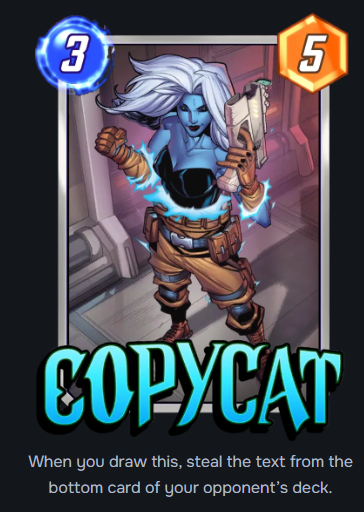
Curiously enough given how significant a role she plays in the first Deadpool film, none of Copycat’s initial cards feature her cinematic version. Then again, that version of Vanessa is more of a straightforward love interest, with no abilities or much in the way of action sequences to her name. Instead, her main Marvel Snap card focuses on her shapeshifting ability while highlighting her “true” blue form.
Form & Function
Like Morph and Mystique and as the name suggests, Copycat is a shapeshifter, meaning she has the power to replicate other characters’ appearance and abilities. Rather than simply give her the same text as either of those cards, Second Dinner tweaks the “copy” ability. In the same way that playing Morph on turn 3 gives you knowledge about your opponent’s hand, Copycat provides the same kind of information, but without having to be played. This alone makes the card valuable, as it provides information without having to be played. And in nod to Copycat’s more mercenary nature, she doesn’t merely copy the abilities of your opponent’s card (like the heroic Morph does), she steals them (in the comics, her ability simply allows her to copy other people’s powers, but this minor change for the game is a clever one). This means if your opponent gets to a point that they draw their last card, it’ll be a dead one, because Copycat will have stolen the ability (and, of course, if Copycat steals an ability that doesn’t fit your game plan — like when facing a Destroy deck — you simply don’t have to play her, another benefit of her over Morph).

All these facets of her ability — the fact that she provides info without being played, allowing you to hold the card if the copied ability is bad, and doesn’t just copy but steals the ability from your opponent — sets her up to be the top card of the season. Granted, she doesn’t gain the copied card’s power (like Morph does), but at 3/5 she offers power upside for her cost (and at three power, she’s another candidate for Surfer decks). The one thing really holding her back is Arishem. The best immediate spot for Copycat (aside from Surfer, which never lacks for cards) is a Mill deck. But that’s an archetype that has been effectively neutered by Arishem (it simply has too many cards to effectively mill). Arishem play is slowly dying down after it’s initial surge, but if it remains above a 50% play rate, it could well dampen the enthusiasm for Copycat.
