Talking Boom! Studios’ ‘Hello Darkness’ With Writer Jude Ellison S. Doyle
by Rachel Bellwoar
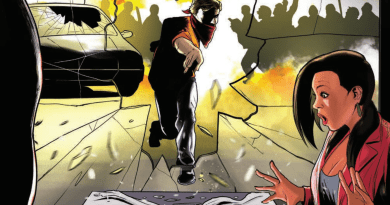
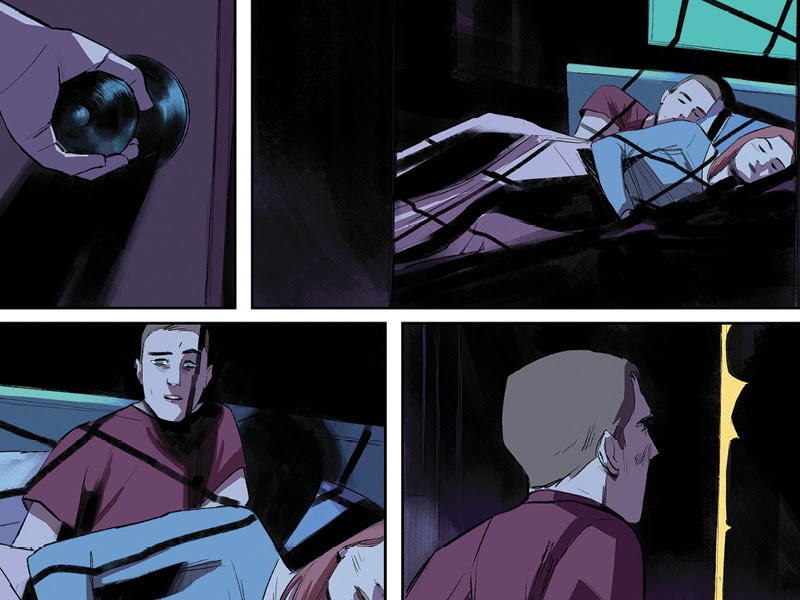
The same creative team that brought you The Neighbors, writer Jude Ellison S. Doyle and artist Letizia Cadonici, are reuniting on “Contagious,” a new story for the first issue of Boom! Studios’ anthology series, Hello Darkness. With colors by Alessandro Santoro and letters by Becca Carey, find out more about why the kids are not ok in the following interview with Doyle below:

Rachel Bellwoar: As big fans of The Neighbors at Comicon, did Boom! Studios approach you about doing another story together and do you have any other collaborations in the works?
Jude Ellison S. Doyle: I handed the script in not knowing who the artist would be, and I was just so thrilled and honored to learn that Letizia was open to working with me again. I love how she draws people. All of her character designs are perfect to me. She always cuts right to the core emotion of the panel. So any time she wants to work with me, I’ll do it. Alessandro Santoro (colors) and Becca Carey (lettering) are also back from The Neighbors. So I think the Neighbors vibe here is really strong, with these four people and some creepy children.
Bellwoar: While it’s easy to see how recent events may have inspired “Contagious,” how is the pandemic in this story different than the one we’re experiencing with Covid-19?
Doyle: What the children of Glenbury are experiencing is a social contagion. One of them gets it, then a friend gets it, then a classmate gets it, then a neighbor gets it — it travels along the lines of communication between kids in the town. That’s all we know, except that when the contagion reaches a new child, their grown-ups die. The contagion is more of a problem for the adults than it is for the kids, in that respect. The kids seem fine.

Bellwoar: “Contagious” might be very different told by one of the adults. Why did you decide to have one of the kids act as narrator?
Doyle: I think we dehumanize kids — even those of us who are parents, who claim to love our kids, can fail to see them as real people. Kids are so often spoken about, or spoken to, or spoken over, rather than being listened to and respected. In “Contagious,” children have become a source of fear for the adults — they’re monsters, they’re threats, they’re something to be controlled. That is less interesting to me, as a viewpoint, than the perspective of the kids, who are also frightened, but who are afraid of something that might be lurking inside themselves. I think that at a certain point, in “Contagious,” we hopefully realize that if the adults were actually listening to their kids, the situation would look extremely different.
Bellwoar: With horror there are all kinds of rules about how much to show and how much to leave to the imagination. Were there any rules you held yourself to while working on this story?
Doyle: “Contagious” is such a strange, whispery story. So much of the terror is coming from rumors and no-one really knowing what’s going on — even on the last page, we can’t be entirely certain. So it felt right to just have brief splashes of something really terrible and then leave the reader scrambling to make sense of it — which is how it feels when something terrible happens in your own community. All the worst events in my home town had a million rumors and stories and “real explanations” surrounding them. No-one can look at a tragedy without trying to make it make sense.

Bellwoar: Instead of supernatural creatures or magic, a lot of the horrors in “Contagious” could happen in real life. Did you intentionally set out to erase some of that distance for readers?
Doyle: I did want it to feel close to home. There are things about raising a kid in the United States that terrify me — like, my daughter started having active shooter drills at her pre-school when she was four. It’s just kind of understood that COVID is not entirely over, and that schools are Petri dishes, so some kids and teachers are going to get sick, and some are going to get disabled, and some are going to die. But you have to send your kids to school, so it gets normalized. A kid we knew was in the intensive care unit with extreme pneumonia recently, and it’s now become pretty common to know a story like that. I didn’t want to get heavy-handed about it, but when you get flashes of what the schools look like, with the armed policemen standing next to the teachers in case one of the kids tries something, you’re hopefully put in mind of that climate — of how many ridiculously deadly things are happening to and with and around our children, and we just keep going.
Bellwoar: Overall would you say small towns make better settings for horror than urban environments?
Doyle: I think I’m just biased because I’m a small-town person! Both are scary, but they’re very different fears. I lived in New York for about seventeen years, and in big cities, the terror is indifference — you’re surrounded by people, but none of them know you or care about you, as in the (apocryphal) story of Kitty Genovese being killed in front of her apartment building while all her neighbors just watched. That coldness and anonymity can be terrifying. You feel like you’re stranded on an alien planet, even though you’re the farthest thing from alone. In a small town, where everybody knows everybody, “the community” is almost its own organism. It’s a real being, with its own needs, and you have to stay on its good side, because you don’t want “the community” deciding that you are a threat. Nearly everything I’ve written for Boom! features “the community” as a character in the story, usually a problematic or scary character, because that’s the shape of my particular fear.
Bellwoar: Thanks for agreeing to this interview, Jude!
Hello Darkness #1 goes on sale July 24th from Boom! Studios.