
Fire & Blood Files: Who Are The Free Agent Dragons?
by Austin Gorton
Warning: Spoilers for House of the Dragon season 2, episode 6 follow.
As of the sixth episode of House of the Dragon‘s second season, Rhaenyra Targaryen (Emma D’Arcy) and her Blacks have entered into full-on “dragonrider recruitment” mode. The first effort to pair a rider-less dragon with a less-than-pureblood Targaryen rider ended in, well, fire and blood. After seemingly winning Seasmoke to his side, loyal Queensguard knight Ser Steffon Darklyn (Anthony Flanagan)ultimately paid for his seeming hubris with his life (alongside one adjacent Dragon Keeper who, in a grisly moment, slit his own throat rather than burn to death). But by the end of “Smallfolk”, hope for Rhaenyra and Jace’s (Harry Collett) plan is found: Seasmoke has taken a new rider.
Though the crew at Dragonstone don’t yet know who it is, viewers have a pretty good idea who Seasmoke’s new bud is. Which means, as Jace suspected, that maybe non-Targaryens can ride dragons, and that maybe Seasmoke just had his eye on someone else, as opposed to objecting to the purity of Steffon Darklyn’s blood when he rejected him. If dragons will take a non-pureblood Targaryen rider, as the conclusion of this episode suggests, then Rhaneyra might finally have a leg-up. But just how many riderless dragons are available as potential mounts, and who are they?

One of the dwindling few advantages the Black side of the Targaryen Civil War has over the Greens is the fact that their homebase is also home to a bunch of dragons. Dragons enjoy heat and tall places, two things the volcanic Dragonstone has in abundance, having long made it the home of rider-less Westerosi dragons (the affinity for places high up in the air may also explain why a dragon turned up in the Eyrie this episode; more on that below). The known dragons on Dragonstone can be divided into two categories: the “wild” dragons, who have never been ridden, and the dragons whose previous riders have died but who haven’t yet taken a new rider. Across those two categories, they are six named dragons currently residing on Dragonstone.
Of the six, Seasmoke is the one who has received the most screentime thus far. Previously the dragon of Rhaenyra’s first husband and Corlys’ son Laenor, Seasmoke has been riderless since Laenor’s “death”, something which changed as of this episode. The fact that Laenor didn’t actually die but had his death faked to get him out of his marriage to Rhaenyra so she could marry Daemon and he could run off and have fun in Pentos is an invention of the show. While it works within the context of the skewed perspective of the book (which is written by a fictional Westerosi historian using secondhand texts hundreds of years after the events) and helped the series sidestep the deployment of another instance of the “Bury Your Gays” trope, the Laenor death fakeout has always suggested complications when it came to the question of Seasmoke ever taking another rider.
Because the dragon/rider bond is meant to be for life, and exists on an almost supernatural level, it seemed questionable that Seasmoke could be tricked into thinking Laenor was dead. But dragons have also been shown to have agency of their own. What “Smallfolk” seems to suggest as a workaround is that even if Seasmoke knows Laenor is still alive, Laenor is very clearly done with Seasmoke and, tired of waiting and feeling lonely, Seasmoke decided to go out and find himself a new rider, “bonded until death” be damned, thank you very much.

The other two “tamed” dragons on Dragonstone are Vermithor and Silverwing. Vermithor is the dragon to whom Daemon sang his little Valyrian dragon lullaby at the end of season one. Previously the mount of the Old King Jaehaerys (Viserys’ predecessor), Vermithor is over a hundred years old and nearly as large as Vhagar, but has been rider-less since Jaehaerys death. Silverwing, who has yet to appear on the show, was the dragon of Jaehaerys’ sister-wife Alysanne. Mimicking the relationship of their riders, Vermithor and Silverwing are also close, often “coiling” together. According to Fire & Blood, during a “royal tour” Alysanne and Silverwing visited Winterfell, and Alysanne rode the dragon north to the Wall. Despite the repeated urgings of her rider, however, Silverwing refused to fly over it, something which disturbed Alysanne to no small measure. Eventually, Alysanne grew too old to ride Silverwing, and is said to have wept when she climbed off Silverwing for the last time. Silverwing remained riderless for the remaining seven years of Alysanne’s life and past her death.
On the flip side of Seasmoke, Vermithor, and Sliverwing are the wild dragons: Sheepstealer, the Cannibal, and the Grey Ghost. A coal-black dragon, the Cannibal — named by the smallfolk on Dragonstone due to his propensity for eating dead or newborn dragons as well as dragon eggs — is the largest and oldest of the wild dragons on Dragonstone. Some claim the Cannibal lived on Dragonstone even before the Targaryens came to Westeros, which would make him the oldest living dragon on House of the Dragon. The Grey Ghost, named for his grey-white coloring that enabled him to hide in the clouds and the mist, is a shy dragon who tends to avoid people and enjoys fish. He was often seen flying low over the Narrow Sea to snatch up fish from the water.

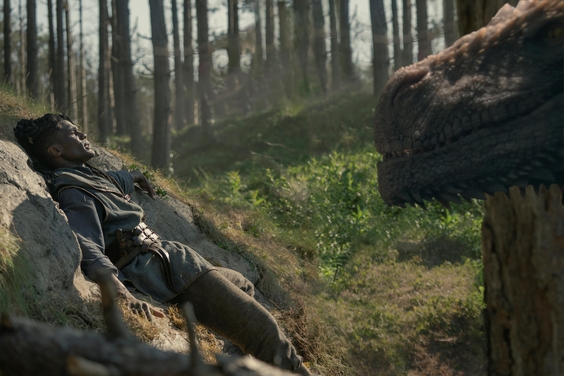
Sheepstealer, so named because he, uh, likes to eat sheep, is a muddy brown dragon who generally gets along well with people — as his name suggests, he is prone to pilfering sheep, but he has never been known to harm a shepherd. Based on the sheep bones and white fluff Rhaena and little Joffrey trip over during their scenic walk in “Smallfolk”, the series seems to be teasing the idea that Sheepstealer has made his way to the Eyrie. This would be a deviation from the source material (which records no mention of Sheepstealer being spotted off Dragonstone at this time). But it’s easy to see how a dragon with a taste for mutton could be drawn away from the rocky Dragonstone and end up in another mountainous terrain with perhaps a more abundant supplies of sheep (though George R. R. Martin would disagree with this notion, having recently penned, seemingly in advance of this episode, a blog post asserting that dragons are not nomadic and stick to their “lairs”).
Ultimately, this relatively deep pool of “reservist” dragons represent a significant tactical advantage for Rhaenyra — assuming enough of them can be made to take a rider. As of “Smallfolk”, Seasmoke seems to have proven the theory Jace made in the previous episode. But in his rejection of Ser Steffon, Seasmoke also reminded that dragons — like people — can be fickle and dangerous creatures.