
Talking ‘Roxy’ With Some Of The Creators Behind Rebellion’s Contemporary Romance Anthology
by Rachel Bellwoar
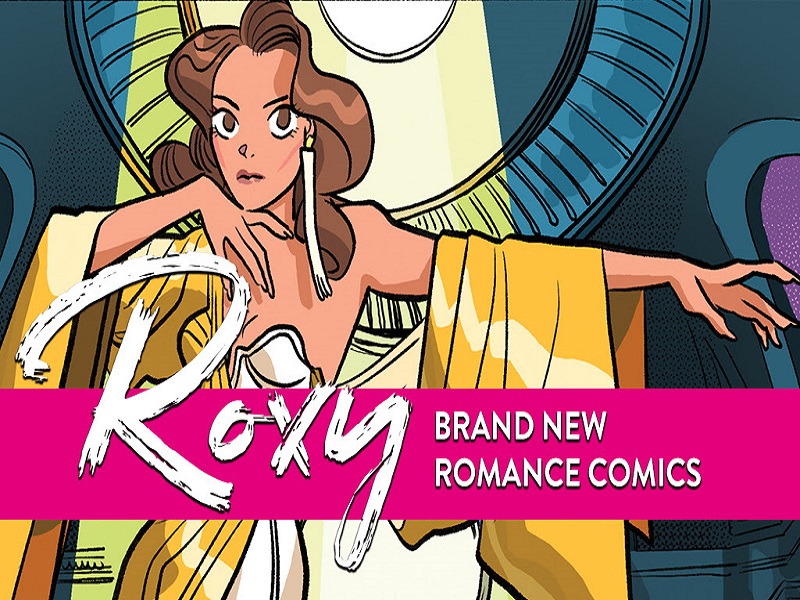
“The name on everybody’s lips is gonna be… Roxie.” Yes, that’s a quote from the musical, Chicago, but it also could be referring to the romance comic anthology, Roxy (with a y), from Rebellion Publishing. The Kickstarter campaign is officially live and here’s what some of the contributors had to say:

Bellwoar: Can you talk a little about the story you worked on?
Sarah Gordon: “Flowers For Agatha” is a short exploration of what might happen if you ran into The One Who Got Away again years after they got away… but in this instance The One Who Got Away is a bit dead now. But that’s okay because you’re a witch and you can do stuff about that.

Alex de Campi: My story is a revamp of an old 1960s Roxy serial called “The Getaway Girls,” about four swinging supermodels who solved mysteries/had adventures while looking fabulous (yay!) while pining in desperate heterosexuality for their suave and oblivious manager (boo). We kept the glitz, kept the Ealing comedy vibe, and just kinda updated the characters to make them feel more like the London I know. Plus, I love fashion, I love romance, and I love a good heist, so this story was like paradise for me.
The meet-cute for the story’s central romance was very much based on the story of Cassandra Peterson (Elvira) and her partner, T Wierson. Structurally, too, the story was a chance for me to experiment with thought bubbles as a narrative device, which was a blast—and super helpful for getting a sense of character across in such a compressed amount of pages.
Sterric: “Banmoor” is a fun twist on the haunted house genre and period romance. It explores both the power dynamics between the aristocracy of the regent era and their servants, as well as the tension of exploring your heritage as a way of processing generational trauma. Oh and it’s hot while it’s doing all that! (Who doesn’t like some good-old ruffled petticoats and ripped bodices?)

Bellwoar: Did you have any input on who your collaborators were, and what has it been like working with them?
De Campi: When I was first approached to write the story, the editors didn’t have an artist in mind yet. I’d just finished my second collaboration with Erica Henderson (Parasocial, a follow-up to our bestseller Dracula, Motherf**ker!).
I knew Erica would absolutely slay the fashion angle AND have a lot of fun with the heist and humor parts, and so I asked if the Roxy team could approach her. She said yes, and as with all our collaborations I lettered the story, and there it was! Working with Erica is effortless. We keep each other in line, and there’s just a lot of trust there.
Sterric: Working with Mags Visaggio was an absolute pleasure. Her script was great and left out just enough for me to find a lot of creative freedom to play with the layouts. I aspire to her level of professionalism and hope we’ll get to work together again in the future!

Sarah Gordon: I cartooned for this piece, so on this occasion both the words and the pictures are all my fault. I loved working with Jonathan Stevenson as editor though. He was a great sounding board for my ideas, which was extremely helpful as I am a newbie to the genre. Thank you, Jonathan!

Bellwoar: What was your creative process behind creating a one-shot story for an anthology? Is it different to when you tell longer comic stories?
De Campi: Ha, twenty pages is a luxury! I’m used to writing for the Prog (2000AD), where I get 5 or 6 pages. My working stage goes: outline, then page breakdowns, then script. For an anthology story with a limited page count, the breakdown stage kind of merges with the outline stage because it becomes really important to figure out exactly what happens on each page.
And as with any short story, the trick is creating the illusion of space—if you’re too economical and everything’s just plot, plot, plot, there’s no rhythm, no fun. You have to fit in little digressions and moments of quiet as well as the big exclamation moments so the story feels like it takes up more space than it does.
Sterric: I really find myself taking more risks with these kinds of short stories. It’s the perfect number of pages to try out new ideas and to allow myself to indulge in complex designs. I love ruffles but there is no way any main character in any of my longer format comics will ever wear them.

Bellwoar: Have you done a lot of work in the romance genre before?
Sterric: I have! My first graphic novel was also a romance horror mashup! It featured a lesbian romance between the big bad wolf and the hunter from Red Riding Hood. (De Vloek van Rood published in: Dutch (2021, Scratch books), Portuguese (tba, Darkside Books))
Gordon: Nope. It’s funny, I read romance but, although there have been elements of it within some of my other work, this is my first official romance story.
Honestly? I had a great time. I’d definitely work in this mode again if I’m given half a chance.
DeCampi: I wrote a bestselling romance/thriller novel (The Scottish Boy) and a supernatural romance/thriller (Heartbreak Incorporated), and wrote/edited/lettered a four-issue, 48-page weekly romance anthology series through Image, Twisted Romance, that got nominated for an Eisner. So, yes, you could say I have a passing familiarity with the genre.

Bellwoar: What is one way mainstream comics could benefit from paying more attention to romance comics?
Sterric: I think we’re really missing out by seeing Romance as a purely separate genre. Usually we tend to avoid calling a comic romance if other genres are also featured. I think we should allow romance to mingle a bit more closely with horror exploring the tension between our own anxiety around sexuality. I think a really good recent comic to combine these two genres is #DRCL Midnight Children by Shin-ichi Sakamoto. As a whole I think there is still a lot we can learn from Japanese artists when it comes to creating more diverse and niche romance comics.
Gordon: Have you read Always Never by Jordi Laferbe? That book had me welling-up within five pages. I haven’t been caught that off-guard by a comic in a long while.
Have you seen how popular Lore Olympus is with a readership well beyond the reach of a comic from what we think of as the current typical mould? It’s reaching a crazy number of readers.
I’m pretty sure you know about Heartstopper and how that’s going down with audiences outside of the core comic readership now it’s got its own series.
Romance is fun. We could all do with a little more fun in our lives right now.
De Campi: The ability to create satisfying, rich emotional arcs, wielding sentimentality like an assassin’s knife, and understanding the importance of a well-earned HEA are all things that romance writers excel at. I think if more comics writers were better at emotional beats and conflicts, they wouldn’t have to resort to large-scale destruction or “edgy” (so dull) violence to impact their readers.

Bellwoar: Thanks for agreeing to this interview, Sarah, Alex, and Sterric!
The Kickstarter campaign for Roxy is LIVE now and runs until August 8th from Rebellion Publishing.
