
Talking ‘Herne And Shuck’ With Writer, David Barnett
by Rachel Bellwoar
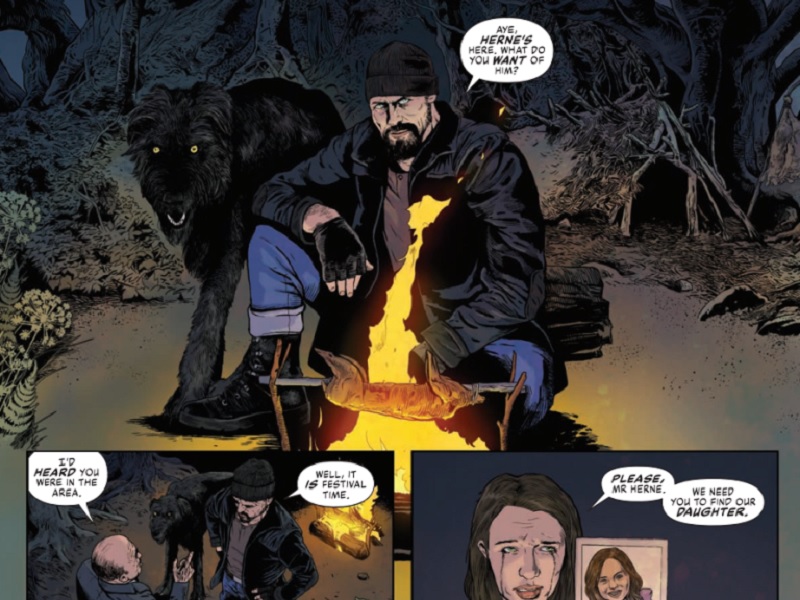
It all started when Herne was hired to rescue a kidnapped girl. Pretty simple, right? Except then Herne learned what his clients wanted to do with Caris and suddenly, to avoid a Wicker Man situation, Herne and his trusty dog, Shuck, had to change course. Now Herne and Shuck are back in “Suffer the Children,” a new strip by writer, David Barnett, and artist, Lee Milmore. For more on what they’ll be getting up to, check out this interview with Barnett below:

Rachel Bellwoar: What drew you to want to create a folk horror story in the first place?
David Barnett: Around the same time as I came up with the idea for Herne & Shuck, I was writing a folk horror novel, which is being published by Canelo on September 26th and is entitled Withered Hill. I’ve always been fascinated by this particular sub-genre of horror, exemplified by the 1973 film The Wicker Man, and folk horror is definitely having a moment right now, from the forthcoming film adaptation of Andrew Michael Hurley’s Starve Acre, to Becky Cloonan and Tula Lotay’s sublime DSTLRY comic series Somna, to a wealth of novels and TV series. So I wanted to use the tropes of folk horror — leaning heavily into British folklore — and give that a bit of a more thrillery, 2000 AD twist. Hence we have Herne, who’s kind of a magician for hire, but sometimes not too bright, and Shuck, a demonic black dog who can talk. This gives us the chance to explore dark folk horror themes but also lighten proceedings with a very character-led dynamic.
Bellwoar: It’s been almost a year since Herne and Shuck’s last appearance in the Prog. Is it difficult trying to account for both new fans and old fans alike when picking up the story again?
Barnett: The first two stories, “The Crawly Man” and “Maxwell’s Demon,” were in the three-part Tharg’s 3rillers slot, so had to be self-contained, but also dropping hints and laying the groundwork for a broader arc. You don’t really need to have read the first two stories to enjoy the longer-run we’ve got with “Suffer The Children;” there are a couple of casual, conversational recaps to bring new readers up to date. But anyone who has read the first two instalments, or is moved to seek them out, will obviously have a fuller experience of Herne & Shuck’s world.

Bellwoar: True to how “Maxwell’s Demon” ended, “Suffer the Children” sees Herne, Shuck, and Caris arriving in Glastonbury to try and find the organization that will protect Caris from being sacrificed. What made you choose Glastonbury as their next destination, and have you ever been there yourself?
Barnett: Glastonbury is obviously a hugely important site in the English folklore landscape, drenched in myth and redolent with stories. It seemed like a nice backdrop for the start of this story, to both anchor the characters in the real world and also against a recognisable folklorish landscape. I have been to Glastonbury the town a few times, and spent most of the Nineties attending the Glastonbury Festival, but wild demonic dogs couldn’t drag those particular stories from my lips.
Bellwoar: From the glimpses we’ve gotten into Herne’s past, he hasn’t always been the most reliable person (which is why he never seems too confident about the reception he’s going to get from old acquaintances). Will there be any flashbacks this time around – maybe to how Herne and Shuck first met?
Barnett: This longer, eight-part run gives us the luxury of filling in a bit of Herne & Shuck’s past, so there will be flashbacks aplenty, including the doomed exorcism that caused a rift between Herne and his ex Jordy, and yes, we find out exactly how Herne & Shuck met… in fact, that is absolutely pivotal to this story. It’s been fun to flesh out the world and the characters.

Bellwoar: Luckily the Lady of the Woods doesn’t seem to hold any grudges with Herne. Did you always want to give her two looks (the one she adopts with strangers and her more casual appearance with friends)?
Barnett: Yeah, it’s another chance to subvert expectations a bit… a lot of folk horror tropes are well worn, including the “spirit of the forest”/Green Man sort of figure. We thought it might be nice to bring her up to date a bit, wearing one face for her “day job” but relaxing when with friends. Lee did an amazing job bringing both her aspects to life on the page.
Bellwoar: Thanks to Caris being a Summoner, Herne and Shuck has had its share of monsters, starting with “The Crawly Man.” Where do you start when deciding what a demon should look like?
Barnett: Oh, that’s all down to Lee’s dark and twisted imagination. After working with him on the first two Herne & Shuck stories, and seeing how amazingly he visualises what I’ve got in my head, I trust him implicitly. We have a really good working relationship and I thank my lucky stars that Tharg selected him to draw Herne & Shuck, his art brought to brilliant life by Quinton Winter’s colours and Annie Parkhouse’s letters really adding depth to the different characters and their speech patterns. I think by now I just write stuff like, “Caris summons a big old demon, Lee, you know the sort of thing” and he nails it every single time. And there are lots more monsters to come in this run!
Bellwoar: I can’t wait to see them! Thanks for agreeing to this interview, David.
Herne and Shuck: Suffer the Children started July 24th in 2000 AD Prog 2392.

