
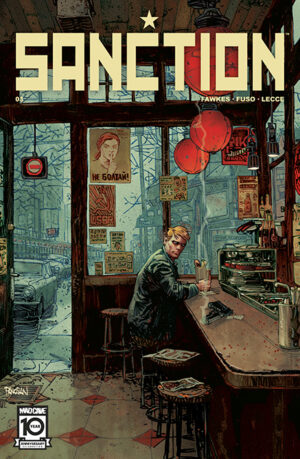
‘Sanction’ #3 Review — Nothing Bad Ever Happens In Leningrad
by Austin Gorton
Overview
By effectively sidestepping some of the traps the previous issue seemed to lay, Sanction #3 kicks the book into another gear as the villain — both the literal and thematic one — looms larger.
Overall
7/10After a second issue that felt a bit like a tipping point for the series, Sanction #3 proves to be the most critical issue yet. Thanks to a few significant plot and thematic developments, this is the issue where the pieces start to come together and the overarching vision of the series comes into focus. Not surprisingly, it’s also the series’ best issue yet.

The previous issue concluded with a cliffhanger seemingly setting up one of the most cliché plot twists in modern storytelling, as Dimitrovich’s girlfriend Sofia is threatened by the mysterious killer at the heart of Dimitrovich and Smirnoff’s investigation.
Thankfully, writer Ray Fawkes not only swerves out of that skid, but does so with aplomb. In the opening panels of Sanction #3, Sofia is not only revealed to be alive, but also to be the one who called the police to the pharmacy in the first place, after the killer instead dispatched her boss. Despite the dark subject matter at hand, the way Fawkes is messing with reader expectations is almost comical. It immediately sets a promising tone for the rest of the issue.
From there, the issue follows two tracks, both of which prove illuminating. As Dimitrovich (the story’s avatar for the traditional investigative plot beats) draws closer to the killer, the depths of the system working against him are underscored by Smirnoff (the story’s avatar for the abiding influence of institutionalism) as he carries out a soft coverup of the pharmacy assault and continues to liaise with Soviet officials further up the chain of command. With these two threads in direct parallel to each other in a way they haven’t been in previous issues, the thematic arc of the series snaps into place.

That is, it’s made clear here that the villain of the story isn’t the killer Dimitrovich is chasing. It’s the system Smirnoff is facilitating and that Dimitrovich is indirectly combating simply by refusing to handwave away all the deaths the killer is perpetuating. This also provides the justification for the story’s setting in Cold War-era Leningrad.
Repeatedly throughout Sanction #3, the looming specter of the Soviet state is invoked. It’s said that Leningrad is free of violent crime, therefore, the death of Sofia’s pharmacist boss couldn’t have been at the hands of a psychopathic murderer, but rather, an accident. But not an accident of the pharmacist’s doing, because that would shake the people’s faith in a state-appointed professional. The self-serving notion that the murders Dimitrovich is investigating can’t be murders because murders don’t happen in Leningrad is invoked.

Whether the now-clear notion that the real threat of the series is the Soviet state and not the killer will prove to be enough justification for the relative lack of information regarding the person actually killing everyone — who despite getting a few lines of dialogue in this issue remains largely unknown and inscrutable in terms of his motivations and characterization — remains to be seen, especially with just two issues left in the series.
It also undermines the cliffhanger ending of the issue a bit, albeit likely intentionally and with the same kind of cheekiness present in the opening reveal that Sofia survived her run-in with the killer. As Dimitrovich and Smirnoff are directly threatened by the killer in Sanction #3’s closing pages, the question of if and how they survive almost doesn’t matter after the thematic work the issue has done. Because even if they do, the Soviet state is still out there, ready to tell everyone the sky isn’t blue, the snow isn’t white, and the two detectives were never attacked, because that kind of thing doesn’t happen in the great city of Leningrad. .

