
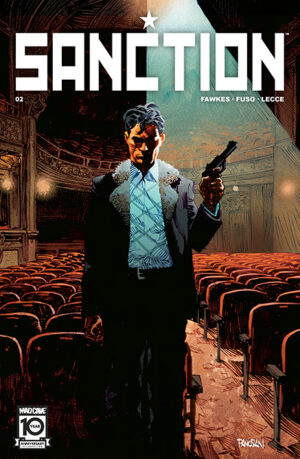
Improvements Are Offset By Setbacks: Reviewing ‘Sanction’ #2
by Austin Gorton
Overview
Sanction #2 improves on its debut by building its supporting cast and having some visual fun, yet it also stumbles in places, and risks veering into cliché territory by the end. The end result is a somewhat maddening issue.
Overall
6/10Sanction #2 is a maddening issue. On the one hand, the story of Soviet-era cops Dimitrovich and Smirnoff and their murder investigation moves forward in some critical ways, complemented by more assured storytelling from writer Ray Fawkes and artist Antonio Fuso. In other ways, key information is still being withheld, the art is struggling, and the story is falling back into clichés. The end result is an issue that is both exciting and frustrating — sometimes both over the course of a page turn.

To start with the good, the supporting cast of the series gets some much needed fleshing out in here. It’s established that Sofia is indeed Dimitrovich’s girlfriend, and she gets to exist as a character beyond her narrative utility: she has a job, and a boss who is most likely stealing from the pharmacy where she works.
Meanwhile, Smirnoff gets pulled into a meeting with assorted police brass to go over the monthly case numbers; though most of the characters introduced here fall into stock types and/or don’t even get named, it helps makes the police station setting feel bigger than just Dimitrovich, Smirnoff, and their direct superior. Seeing the pressure being put on the investigators from the top down also helps soften Smirnoff’s edges a bit; showing the pressure he’s under to close cases fast provides a more sympathetic rationale for his approach than “laziness”.
Fuso also has some fun in a few places. In one instance, he uses the lighting of a cigarette as a page transition, going from Smirnoff getting his cigarette lit at the station to Dimitrovich lighting the cigarette of a witness he’s interviewing at a theater. It’s a clever bit of layout that injects some fun into a dark story.
Similarly, when Dimitrovich asks the witness about the dress the victim was wearing when she was killed, Fuso cuts to a full page spread of the killer heading out towards his next target, the dress in question highlighted via an inset panel. Again, it’s a clever bit of construction that links the two events visually while underscoring the stakes of Dimitrovich’s investigation.

Yet for all these improvements, Sanction #2 still stumbles in places. It remains unclear what the overall point of the setting — Leningrad in the late ’80s — is, aside from possibly creating some relatively unique obstacles for the detectives (from a western perspective, the presence of Soviet officials in the police meetings feels ominous, yet at the same time, the general idea of “the suits” pushing the ground-level investigators to close more cases is a fairly universal one).
Also, while Fuso is being clever with the layouts, a page depicting the monthly meeting between Smirnoff and his superiors is littered with historical anachronisms to a distracting degree, featuring a phone designed for conference calls, a table littered with water bottles, and flatscreen monitors that all combine to look more 2017 than 1987.
It’s possible this is meant to be a visual clue that we’re dealing with parallel but separate timelines, a la True Detective and Westworld Seasons 1, but it’s not clear how that could be the case given the way the rest of the issue is structured. And the best thing that can be said about the issue-ending cliffhanger is that it’s so cliché, it almost becomes surprising simply because the story is going there now instead of closer to the end of the series, where the plot beat in question typically falls in similar stories.

The central mystery — both the intentional one Dimitrovich and (to some extent) Smirnoff are investigating as well as the (probably unintentional) one of the story’s setting are enough to keep interest up. It’s also nice to see the cast of the book expand, particular as Sofia becomes more of a character in her own right. But some sloppy art and an unfortunate veer into cliché plot beats is not heartening.

