
Dances With Films Festival: An Interview With ‘Burns And Song’ Writer-Director Tendayi Nyeke
by Rachel Bellwoar
Risimu (Fulu Mugovhani) wants to leave the past in the past, but on the morning her husband (Baxo Mfindi) has a job interview and her daughter (Mongi Majola) needs a ride to her entrance exam the past comes rearing its ugly head in writer-director Tendayi Nyeke‘s film, Burns and Song. It is the first pilot from a South African director to screen at Dances With Films Festival, where it recently made its world premiere. For more on the film, check out this interview with Nyeke below:
Rachel Bellwoar: Was Burns and Song always conceived as a pilot and why do you feel this story would benefit from being told as an ongoing series?
Tendayi Nyeke: Burns and Song was developed as a series pitch, but I was eager to film the pilot to really have the freedom and space to create the seed of this world and have the characters in pilot form to prove it out. I wanted to show a story from a small country, Zimbabwe, that few people outside the place may have heard about on my terms. It was my way of introducing the lore and world of Burns and Songs as I saw them as a base for further development with possible creative partners.
Bellwoar: This first episode takes place over the course of one morning. What made you want to keep the timeline restricted?
Nyeke: The story of Burns and Song is about a woman who has successfully run from a traumatic part of her past for over a decade. She almost starts to believe that that part of who she is and what she did has disappeared as a distant memory or, in the case of the pilot, a nightmare. It remains in her subconscious. But I wanted to show how quickly your world can unravel, how a life you so carefully constructed over a long time can implode in a moment, especially when you are working hard to keep a secret concealed. I think every human being can relate to that. The day itself is inspired by a real-life experience I had in my childhood. I was excited to start my first day of high school, but the day was so fraught that I saw my parents scrambling to make the day work. 12-year-old me always wondered what was going on with them, and in some ways, this episode is a reimagining of that day for me.
Bellwoar: Burns and Song opens with an original song by producer Dikelo Mamiala. Had Mamiala composed the song for the opening or did the opening change after you heard the song?
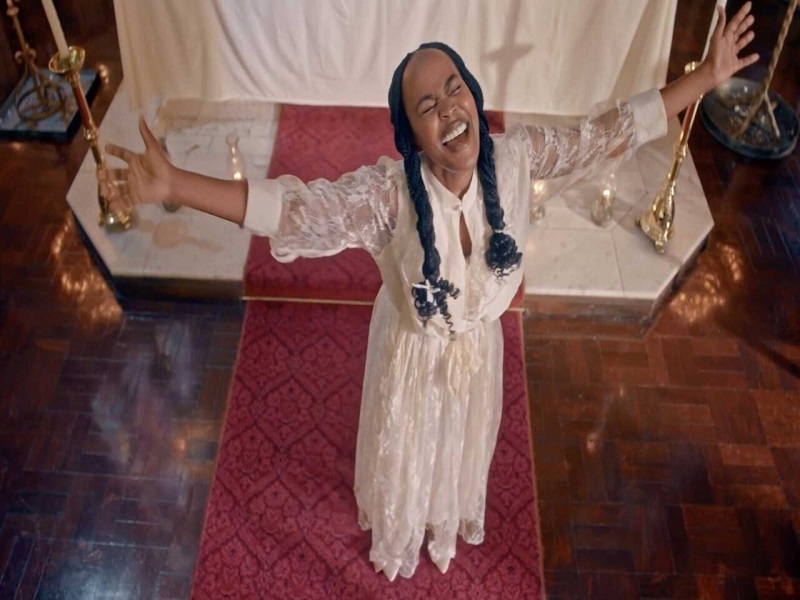
Nyeke: Quick correction the song is written by myself, writer, and director Tendayi Nyeke. I specifically wrote the song for the opening. The episode always opened with a song. I wanted to show our hero in a moment of bliss, the moment where she was truly connected to the purest part of her, which was the last time she sang. I wanted the song to capture what “future Risimu” would
experience (a sense of feeling lost and overwhelmed) but what “past her” had always held onto for strength (a higher power and connection and vulnerability with loved ones). This vulnerability is something she loses by the time the song ends in the pilot, and we see why. I imagine the series finale will end with a reprise of this song, but perhaps an evolution of it will reflect her
evolution.
Bellwoar: Initially, the way the opening scene is shot, it seems like Risimu is alone until the other parishioners are revealed. Why did you decide to set this scene in a church?
Nyeke: This scene is meant to capture the moments in our lives when we are truly connected to the best parts of us. When we exercise our unique gifts and how they can take you to euphoric heights where we float above everything else. In these moments we feel the freest, most beautiful, and connected to something greater. These moments feel personal and individual but can move others that witness us in these moments. I’ve often heard performers, athletes, and scientists speak of entering the zone where everything feels blocked out, even if they are doing their thing in public. They experience this quiet pocket of perfection that feels like it’s just for you, but that can invite other people in. I wanted to show that Risimu’s gift of song moves her just as much as it moves spectators. Her gift is as much for her, as it is to share with others. I wanted to show that her choosing to no longer sing shuts off this beautiful part of her which isn’t just a loss for the listener, but a devastating loss of this beautiful part of her where she found individual joy and expression.
Bellwoar: Risimu and her partner, Tendero, are introduced as a strong couple. They’re interactions (like going from an intimate moment to asking if the bacon was left out to defrost) are very relatable, too. Did you always want to show what a loving couple they can be before putting them under a lot of pressure?
Nyeke: Absolutely. I wanted to show that even in loving relationships, there is complexity, especially when there are secrets between the individuals. Both Tendero and Risimu have parts of their pasts that they are hiding and so are only able to connect to limited parts of one another. But there is enough to make a marriage work, to a point. But if they are to survive what life is about to throw at them, they will need to feel safe enough within themselves and each other to expose what they have kept in the shadows to see if their relationship is really as strong as it appears to be.
Bellwoar: One of the reasons Tendero is stressed is because he has an important job interview. How did you come up with the character of Gombe (Hakeem Kae-Kazim), a businessman who talks in hashtags to sound hip?
Nyeke: Gombe represents powerful people in my home country who know how to connect with people across generations—the youth, the older, the rich, and everyone else. But they do this so they always have a one-up on people so they can control them. It’s implied in the pilot that this businessman is connected to the brewing political unrest in the country, and these are things I grew up seeing and see even now. I wanted to start to explore what drives people like this.
Bellwoar: While we’re never told in the pilot what’s haunting Risimu, the publicity text mentions a ngozi. Can you talk a little bit about what a ngozi is and do they traditionally take the appearance of the people they’re haunting?
Nyeke: Ngozi in the Shona culture is a vengeful spirit that torments individuals or their descendants because of a crime that was committed against them while they are living. Perhaps before the spirit was a Ngozi, they were an individual that was murdered, and so their spirit cannot rest until it finds restitution from the perpetrator or someone in their family line. In Shona culture, a Ngozi can take any form, depending on the situation. I chose the Ngozi that is haunting Risimu to look like her to hint at what she might have done in her past. You’ll have to help us get the rest of the series made to find out exactly why.
Bellwoar: Thirty-three minutes isn’t a lot of time but I love how you make the most of background noise, like a news broadcast on the radio, to provide more details and context. Were those fun to record?
Nyeke: I love having layers of storytelling that mirror life. You get glimpses into what is happening outside your house when you leave the radio or TV on and the news is playing during breakfast time. You could be waiting for a meeting to start, and a live stream playing on social media gives you another layer or a world beyond your own. I love expanding a story world in this way, and it’s a really fun way to bring an audience into a context they might be unfamiliar with.
Bellwoar: What do you love the most about the horror genre?
Nyeke: I have a photographic memory and tend to dream about what I watch, so I try to limit my horror consumption (or I won’t sleep!). But horror is a remarkable medium to explore the human psyche, our fears, feelings of shame, dreams, and everything in between. It is a visually dynamic media that asks you to use sets, blocking, camera language, and color in the most intentional way possible to convey complex emotions. It allows a story teller unexpected ways to explore their own curiosities. I’d love to make more.
Bellwoar: Burns and Song ends with a lot of unanswered questions. How far ahead have you planned out what would happen next?
Nyeke: It’s a pilot, right? So we wanted to set up questions that will be dug into over a nine-episode limited series. At this point, we have a Series Bible that we would love to develop more. So, I know how the series ends, but there is definitely a big story to tell here, and I can’t wait to complete it.
Bellwoar: Thanks for agreeing to this interview, Tendayi!
Burns and Song made its world premiere at Dances With Films Festival on Saturday, June 22nd.
