
Talking ‘Mary Shelley’s School For Monsters’ With Writer Jessica Maison
by Rachel Bellwoar
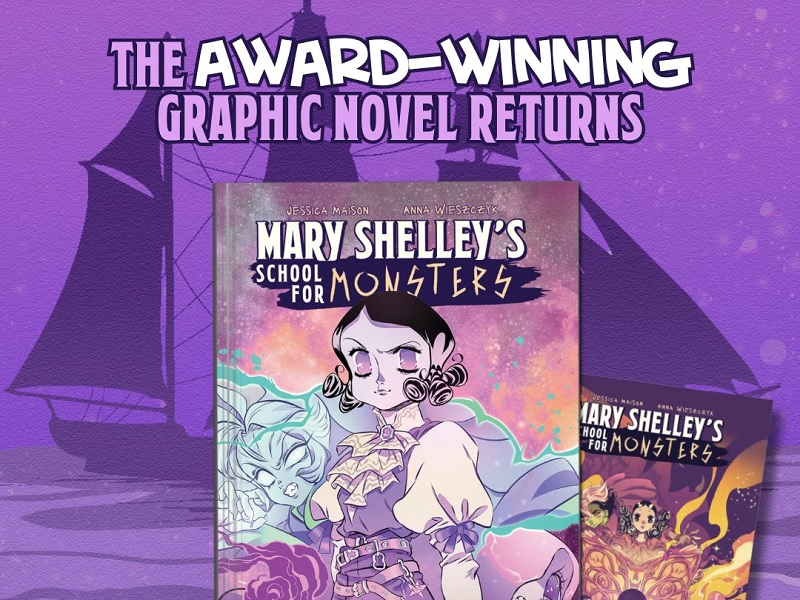
Shel may not have written Frankenstein like her famous counterpart, Mary Shelley, but she does help rescue monsters for a living in writer Jessica Maison and artist Anna Wieszczyk‘s graphic novel series, Mary Shelley’s School for Monsters. With letters by Matt Krotzer (Joel Rodriguez lettered volume one), volume two, The Killing Stone, was recently funded on Kickstarter and here’s what Maison had to say about the series:

Rachel Bellwoar: What do you admire the most about Mary Shelley and where did the idea to write your own story inspired by her work come from?
Jessica Maison: What I most admire about Mary Shelley is that despite never knowing her mother or maybe because of it, she crafted a timeless story that revealed how dangerous and destructive creating life is when you don’t involve women. She revealed how powerful science fiction and horror literature can be when it’s elevated to tackle the social issues of our time. It never dies when done well, and she did it the best.
The image of a young Mary Shelley reading her mother’s books by her grave has always struck me as a very powerful one. Here was a young woman whose mother, a trail-blazing feminist author, died shortly after giving birth to her. Mary connecting with her mother in this very physical and supernatural way is very profound and heartbreaking. I have two daughters and am a writer so thinking of her in that graveyard trying to get to know her dead mother through her written words really gut-punches me. I spent a lot of time thinking about her reading in that graveyard. I definitely wanted to write a story that started there. I wanted my story to be inspired by that young version of Mary Shelley before she wrote Frankenstein, before she loved Percy [Bysshe Shelley], and before she became a mother. I finally asked myself the question that started this whole series—
What if a young Mary came in contact with a mad scientist, like the one from her acclaimed novel but also into the dark arts? She has a life-altering encounter with him that splits her into two entities – one that remains human, and one that lives on as a supernatural entity. For the human, Mary Shelley, this encounter becomes a repressed memory that shows up in her novel Frankenstein. For the monster-version, Shel, Dr. M becomes a great evil she must escape and battle time-and-time again.
So, the inspiration of this story comes from both a love of monsters starting with the monster from Frankenstein, but also from my connection to the younger Mary Shelley before she became the writer and woman the world knows and loves.
Bellwoar: In volume one, Shel was learning to trust her team better. How is she doing as headmistress in volume two?
Maison: She’s still working things out. Shel is an imperfect leader but has a big heart. In volume two, The Killing Stone, she is holding onto a grudge from her past. This is going to cause issues with one of the newest students at the school, Nari – a Onryō. Shel is going to have to resolve her grudge before she can join the rest of the crew on their mission to track down the infamous Tamamo-no-Mae. In every book, we will dig a bit deeper into Shel’s past trauma. It turns out being split into two entities does have some negative fallout.
Bellwoar: Due to the nature of her work, Shel is often called off campus to help monsters. Will we ever see a volume of Mary Shelley’s School for Monsters set entirely at the school?
Maison: I don’t think we will see one set entirely at the school in this first round of books. In Vol 2., they do spend more time at the school. In Vol. 3 and 4, bigger chunks of the action will most likely occur on campus. If all continues to go well, I do think I’ll do a spin-off, stand-alone where we focus on a mystery that needs to be solved on campus with different characters but that is a while off.
Bellwoar: Dr. Moreau is the Big Bad of this series. Why did choose him over a more literal Victor Frankenstein?
Maison: Dr. Moreau is a much crueler and more horrific scientist than Victor Frankenstein. Frankenstein is a scientist who took things too far and pays the consequences while he attempts to set things right. He is still cruel to his creation but not to the whole world around him. Dr. Moreau is a true villain. He remains on his scientific course with no remorse. That’s the big bad energy I wanted for Mary Shelley’s School for Monsters. In my alternate version, the human Mary Shelley has only a brief encounter with Dr. M, and that experience inspires her character, Victor Frankenstein. However, the Dr. M that Shel, the supernatural version, comes to know is a true monster, not just a misguided scientist. He tortures monsters, practices mind-control magic on them, and definitely makes horrific hybrids. He will continue to do all these things and worse until he achieves his end goal, which is not exactly clear yet, but will eventually be revealed.
Bellwoar: Whereas Frankenstein and Medusa are pretty much househould names, I love that this series is also bringing attention to monsters from other cultures, like Papa Aglebemu in volume one and now the Japanese yōkai in volume two. Were there any monsters that were new-to-you before working on this series?
Maison: I was familiar with most of the monsters in both volumes but that is because I’ve had a lifelong obsession with folklore, mythology, and monsters. Papa Aglebemu is the one exception. He was new to me, and I’m so happy I discovered him. I really want to explore monsters from all different cultures in this series. There are so many cool and creepy creatures to get to know, some misunderstood and some not. You can get a peek into that obsession over at my Monster of the Week substack. What I’ve learned writing this series and my substack is there is no end to monsters. Whenever I think I’ve read about every type possible, a new one pops up.
Bellwoar: You also don’t stray away from the monstrous side of monsters. It’s easy to sympathize with monsters like Frankenstein. La Llorana less so. Was that a challenge you always wanted to confront head-on?
Maison: La Llorona is a very challenging character to sympathize with, but you’d be surprised how many people do. People who know La Llorona love her story and are excited to see her brought to life in a series. We all want to be scared by her but, underneath that, we want her to find her spirit children and be freed from her curse. Her story is so heart-breaking. You can’t help but weep with her and understand her rage at some level.
I have been fascinated with La Llorona for a long time. She’s such a great version of the White Lady, Woman in White, or a Boogeyman character. What I especially love is that so many cultures have some version of her. Our fears and stories really connect us and transcend our differences.
Part of why I write this series is that I feel good monster stories reveal so much about human nature. They often reveal the true monsters are us. I have always been interested in why we create a monster and what their story is trying to explain or cover up. I knew right away that my first story would involve La Llorona because what she did as a human was truly terrible. It’s hard to make excuses for it. However, her story also doesn’t address the evil the father of the children perpetrated against his family when he abandoned them and left them on the streets. He is never punished. In fact, he is rewarded with a new wife and life. The story doesn’t address how the community let this woman down. No one fed her or gave her a place to live with her children. She was shunned. She was left in a desperate state and did a horrible thing. Then, the legend punishes her for all eternity to search for her drowned children and hurt other children she comes across. That’s complex and heavy. I wanted to dig a bit deeper into that version of the folktale and make La Llorona redeemable while talking about how we let some people off the hook for their evil deeds while we punish others excessively. The ones we let off the hook are often male, and the ones we punish excessively are often women.
Bellwoar: Necro is a lot cuter than, say, the Necronomicon in The Evil Dead. How did you come up with your concept for the book of the dead?
Maison: I knew right away when I started this story, I had to have a living, breathing Necronomicon. The book was going to be the catalyst for Shel’s whole existence. I was very much inspired by Evil Dead and the book from Hocus Pocus. However, I wanted to make this book something adorable. I love cats and dogs but decided to do more dog than cat for Nercro’s behavior. I loved the idea that Necro has been around for thousands of years and is so powerful. She’s met every creature and monster, but yet gets super excited each time she meets a new one. If any type of spirit deserves immortality, it’s a dog. Many evil men have searched her out and used her powers for evil. She’s got a little trauma. So, when Mary Shelley shows her love and tries to save the book from Dr. M, Necro falls in love with her just like the most loyal dog would. Necro is the entity that accidentally splits Mary Shelley into two entities and binds Shel to her. Necro is the glue that holds the whole school together. When I write Monster of the Week posts that are about monsters, they are mostly told from Necro’s perspective.
Bellwoar: You’re also founder of Wicked Tree Press which is publishing Mary Shelley’s School for Monsters. What kinds of books would you love to publish in the future?
Maison: I am looking to publish horror and sci-fi comics with unique takes on figures from folklore and mythology. I do like there to be commentary on social issues in the stories we publish, but it’s not a requirement and can’t be too heavy-handed. I recently watched Wild Robot and am definitely interested in finding a story like that one as well.
Bellwoar: Thanks for agreeing to this interview, Jessica!
The Kickstarter campaign for volume 2, The Killing Stone, recently wrapped but you can order volume 1, La Llorona in the Machine, now from Wicked Tree Press.


