
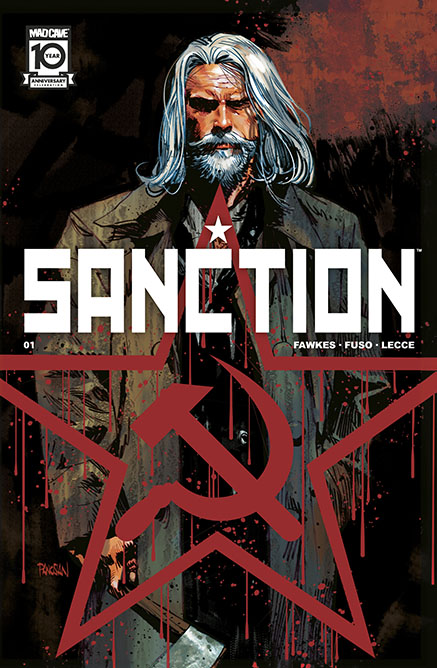
‘Sanction’ #1 Review: An Intriguing Mystery From Behind The Iron Curtain
by Austin Gorton
Overview
Sanction #1 succeeds thanks to visually establishing a unique setting quickly and the familiar-yet-unique relationship between its lead characters. Yet there’s room for improvement as the supporting cast are more narrative devices than characters and little rationale for its unique setting is given.
Overall
7/10Sanction #1 opens like so many other mystery or crime stories: a dead body discovered by beat cops, who call in a seasoned detective to begin the investigation into the crime. However, Sanction #1 swerves almost immediately in two different ways: one, the story is set in Leningrad — the heart of the Soviet Union — in 1987. Two, the detective who gets called in takes one look at the body and immediately peaces out. Instead of taking the case, he punts it to a subordinate detective. In doing so, the series sets out to tell a mystery built on the tension between the familiar and the unique, a story that often zags when you expect it to zig.

The two detectives at the center of the story are Smirnoff and Dimotrovich. On the surface, they appear to have a vibe not unlike that of Morgan Freeman and Brad Pitt in Seven; the seasoned veteran and the young hotshot making their way through a bleak society. But wrinkles in that dynamic quickly emerge: Smirnoff is technically Dimotrovich’s superior; he passes things off because he doesn’t want to deal with what he believes to be a boring case involving a prostitute (also because, as his superior later says, he’s “work-shy and arrogant”). Yet Smirnoff claims he passes off the case to Dimitrovich because his subordinate is something of a wide-eyed idealist who spends too much time searching for the truth behind every investigation instead of just closing the case. Dimitrovich needs a slam dunk win, and Smirnoff is going to give him one.
But it’s also established that Dimitrovich’s problems are not for a lack of skill, as he is shown to be a good detective. He deduces from a quick examination of the crime scene which opens the issue that there’s more to the case than Smirnoff may have thought. He then follows a lead which causes him to spot patterns consistent with an earlier unsolved case he worked. Meanwhile, Smirnoff is getting dressed down by his superior for sloughing off the case in the first place, just as Dimitrovich is starting to think there’s a reason the cop known for closing cases fast was initially handed the investigation.

Thus, writer Ray Fawkes establishes the dynamic between the two detectives quickly and effectively. Dimitrovich is clearly the hero of the tale, but there’s also more to Smirnoff than being a lazy bum passing off work to subordinates. The connection to one of Dimitrovich’s older unsolved cases and the implication that Smirnoff was meant to get the case because he’s “work-shy” further underscores the tension between them, making their character traits part of the plot as well.
Similarly, artist Antonio Fuso quickly establishes a unique visual identity for the story. I have no point of reference as to the accuracy of his backgrounds, but he places the characters in a setting that is visually distinct from an American urban backdrop. Buildings are consistently squat and utilitarian, punctuated periodically by towers featuring the onion domes that so often serve as visual shorthand for “Russian.” Major Egorov — Smirnoff and Dimitrovich’s commanding officer — is strikingly distinct from the typical “chief” in these kinds of stories thanks to his decidedly militaristic uniform. Fuso is aided in establishing this distinct sense of place by colorist Emilio Lecce, who casts everything in a light blue sheen, evoking a sense of the thin, cold air of the early days of January over which the first issue takes place.
One particular artistic technique in service of the setting does grow a bit distracting, though. In order to capture the feeling of being out in the cold air, Fuso draws in the warm air escaping each speaker’s mouth whenever they’re talking outside. As a result, more than a few panels are filled with what look like floating globs of white, half-formed speech bubbles missing their letters, or scraps of paper flying through the air. While realistic and displaying an admirable attention to detail, it leaves too much of the issue feeling visually cluttered.

Relatedly, as effective as Fuso and Lecce are in creating a setting that feels unique and less stereotypically Russian, the setting represents another flaw that Sanction #1 struggles to overcome. By the end of the issue, it’s not terribly clear why this story is set in 1987 Leningrad versus any other time or place. Specificity in setting is important — a good story should feel like it can only be told in the time and place in which it’s set. But at this point, it’s not clear what the time and place mean aside from the fact that there aren’t a ton of mysteries set in Leningrad in the late ’80s. Fawkes script struggles in places as well, particularly in the handling of Sofia. She’s the only living female character of note, yet seems to exist solely as a sounding board for exposition from Dimitrovich. Indeed, the cast in general outside the two leads is pretty sparse.
That said, there’s plenty of room left in the series for the meaning of the setting to become clear, and for the supporting cast to be fleshed out. For now, Sanction #1 does what it needs to do: introduce the mystery, introduce the characters, and establish the dynamic between them of a seasoned veteran looking to skate by doing as little as possible and a well-meaning try-hard who refuses to give up on a mystery. The tension between Smirnoff and Dimitrovich is, at this point, the most engaging part of the story. Will that tension be sustainable as more of this world and the details of the case come to light? Is it enough enough to carry a story that is, at its core, at least 50% composed of beats so familiar they walk right up — and in some instances go over — the line to cliché? Only time and future issues will tell. For now, it’s enough to make Sanction #1 an entertaining kickoff to an intriguing story.

