
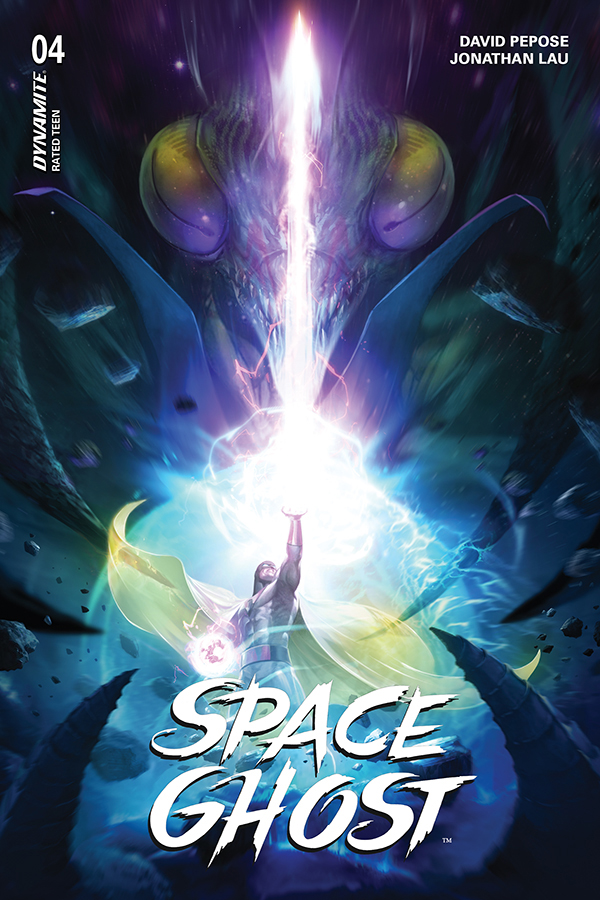
Space Ghost #4 Review: Smart Storytelling Trumps Grimdark
by Austin Gorton
Overview
The introduction of Zorak in Space Ghost #4 indulge the series’ worst impulses, but some smart storytelling choices keep it from overwhelming the issue.
Overall
7/10After setting a new series high in terms of quality in the previous issue, Space Ghost #4 both continues to build on the series’ strengths while also indulging in some of its more problematic tendencies. The end result is still an entertaining issue, but one which suggests the book hasn’t fully left behind its insecurities.

This is the series’ introduction of Zorak, the bug-like foe of Space Ghost. Continuing the Batman parallels, the issue essentially establishes him as Space Ghost’s Joker, the foe who Space Ghost fears above all others. It does this in two ways, one more effective than the other. The first three pages of the issue detail Zorak’s escape from prison, and it’s here that the book reverts to the kind of over-the-top grimdark storytelling that defined the first issue.
Zorak is depicted like a horror movie monster, drawn in shadow as he dispatches guards before appearing in full via a 3/4 page panel, with the rest of the page taken up by a panel of blood splatter. Artist Kevin Lau draws the hell out of it, but the end result channels the series’ earlier “this isn’t the Adult Swim or Hanna-Barbera Space Ghost!” desperate energy.
More effective in selling the idea of Zorak as a big threat is Space Ghost’s reaction to the news of his escape, specifically his unrelenting refusal to let Jan and Jace accompany him in his efforts to recapture the villain. This is effectively like Batman not letting Robin faceoff against the Joker because he’s just too evil. It works to sell the threat of Zorak far more than a dozen blood-soaked panels could.

If it’s no surprise that Jace and Jan, despite Space Ghost’s insistence, ultimately end up in the one place he doesn’t want them to be (face-to-face with Zorak), well, you’ve probably read a comic book before. But this unsurprising plot beat still works because of how writer David Pepose executes it.
After Space Ghost departs to track down Zorak, Jace and Jan receive a distress call from a Galactic Federation facility. Unable to reach Space Ghost because his search has led him into conflict with the robotic Titanor, they head out on their own to help. Pepose uses the dueling narrative — the Space Ghost/Titanor fight and Jace and Jan’s mission — to both disguise the fact that Space Ghost’s charges are running headlong into an encounter with Zorak, and establish a credible means for that inevitability.
Jace and Jan don’t head out to knowingly face Zorak to prove themselves, or stick it to Space Ghost, or any of a half dozen other cliché reasons they could have. They also perform their due diligence in trying to contact Space Ghost before setting out on their own, but the mechanics of the plot doesn’t allow them to connect. These are not dumbass teens acting because the plot demands it, they are simply budding heroes who want to help people in need, do their best to do so within their given restrictions, then make the call to put the needs of others ahead of following Space Ghost’s rules.

It’s a smart, character-driven means of bringing the story to the point everyone knew it was going to go, one which doesn’t sacrifice the intelligence or maturity of the characters (especially in Jan’s case, after the previous issue did so much to establish her as a smart and observant character) for the sake of the plot. It also, in a roundabout way, makes the earlier dalliance back into grimdark all the more frustrating, because it’s clear these creators are capable of telling well-constructed, serious stories with these characters without resorting to those kinds of juvenile “take me seriously!”-isms. Thankfully, there’s enough of the “good” storytelling instincts on display in Space Ghost #4 to keep it from being a wash.
