
Fire & Blood Files: What’s Going On In Daemon’s Trippy Vision?
by Austin Gorton
Spoilers for House of the Dragon Season 2 follow
One of the standout moments in House of the Dragon‘s second season finale, “The Queen Who Ever Was,” is Daemon’s (Matt Smith) trippy final (?) Harrenhal-induced vision (particularly given the sense that the episode was more about setting up stuff that is going to happen than it was stuff that actually happened). Game of Thrones has done this sort of thing before — notably in Daenerys’ (Emilia Clarke) Season 2 journey through the House of the Undying, when she saw her dead husband and baby and the Iron Throne covered in snow and/or ash. House of the Dragon, in its short life, has played with the concept of prophecy and its impact on the characters even harder, between the reveal of “Aegon’s Dream” that motivated his conquest and Helaena’s (Phia Saban) status as a Targaryen “dreamer”. However, Daemon’s vision in “The Queen Who Ever Was” is really the first time the series has offered audiences a prophecy from the perspective of the character experiencing it. Given the way his vision is both prophetic and packed with Easter Eggs, it’s worth taking a closer look at it.

Before the vision begins in earnest, however, the episode gives us a ridiculously deep cut of book lore. Look closely as Daemon approaches the weirwood tree, and you’ll see a figure with antlers on his head scurry behind it. This is one of the Green Men, a group who keeps watch over the Isle of Faces. The island in the middle of the God’s Eye, the largest lake in Westeros, on whose shore Harrenhal sits (as seen in the shot when Rhaenyra (Emma D’Arcy) and Addam (Clinton Liberty) fly into Harrenhal in this episode). It is also the place where the Children of the Forest — the wood nymph-like beings who helped Bran (Isaac Hempstead-Wright) reach the Three Eyed Raven in Game of Thrones — and the First Men signed The Pact, an agreement which ended a long war between the two. Faces were carved into the weirwood trees on the island so the gods could witness it, giving the island its name. In more modern times, the Green Men, considered apocryphal/figures of myth by some, are the guardians of the Isle of Faces (a place where it is said no man can go), though no one is quite sure what they do, exactly. The stories suggest they have antlers and green skin, though more likely they simply wear headdresses adorned with antlers, which is what the person in this scene seemed to be doing.
The appearance of a possible Green Man segues nicely into the first notable image in Daemon’s vision, that of his great grandson Brynden Rivers aka Bloodraven (named for the wine stain birthmark on his face). Brynden Rivers is a greenseer (someone who can see the future), and eventually becomes the Three Eyed Raven, the same person who will later be played by Max Von Sydow on Game of Thrones and mentor Bran, setting him up to become the new Three Eyed Raven. This is, perhaps, a nod to a fan theory arguing that Daemon may have preceded his great grandson as the Three Eyed Raven himself (they tend to live a long time) — something Daemon’s visions throughout the season could also be suggesting.

After Bryden, we see a literal three eyed raven (or crow, as the animal/symbol is known in the books; the show changed the bird to a raven). This is sort of a visual shorthand for “trippy-ass vision,” as such a bird often popped up in Bran’s visions early in Game of Thrones. Next, there is an image of White Walker leading a group of wights (aka Ice Zombies). Curiously, the Walker is not The Night King (Vladimir Furdik), though perhaps the series simply couldn’t get the actor back and/or approximate his look on someone new well enough.
From there, we get a shot of dead dragons lying on the ground. It’s unclear if this is meant to be an image of a specific future event. It’s hard to tell which dragons are in the shot; book readers are certainly aware of upcoming events that could lead to this outcome — it’s hardly a spoiler to say some more dragons are going to die in this civil war being fought with dragons — but there’s little to suggest which specific event this is. More likely, this is simply here to represent the general notion of the war taking its toll on the dragons and/or the Targaryen line. Next, a booted figure walks across a battlefield littered with bodies, followed by Daemon falling into a black abyss; the latter seems to suggest its Daemon walking the battlefield.

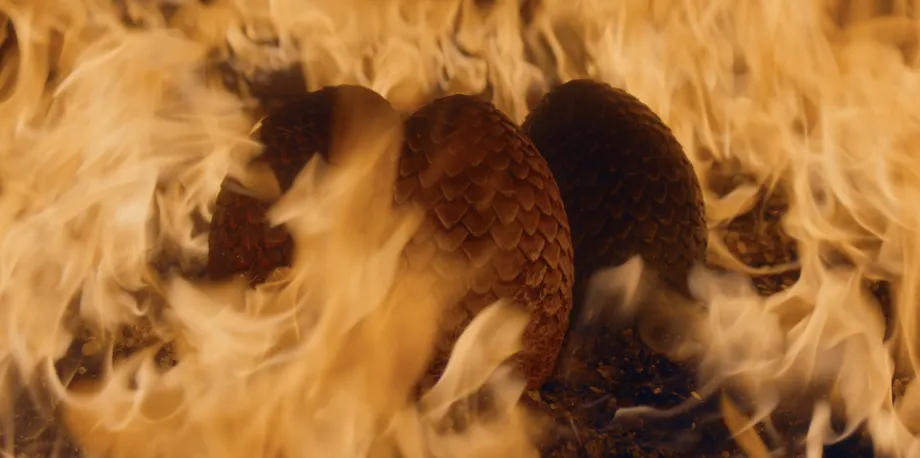
Then we get a shot of the red comet which opened the second season of Game of Thrones, and was pointed to by nearly everyone as justification for one thing or another (it heralded the rebirth of dragons, Stannis’ right to rule, the ascension of Joffrey, etc.). This leads into a shot of dragon eggs surrounded by fire, which are almost certainly meant to be the eggs Daenerys hatches, given the shot is followed by one of Dany holding her newborn dragons. From there, we jump back to something closer to the present, a shot of Rhaenyra sitting the Iron Throne. The connection between her and Daenerys implied by the proximity of these shots is interesting to consider. Both are would-be queens looking to upend the social orders of their respective times. Are we meant to consider how things went for Daenerys as a cautionary tale for Rhaenyra?
Finally, the vision segues from a series of prophetic images to a straight up psychic phone call between Daemon and Helaena. She tells him “it’s all a story, and you are but one part of it. You know your part. You know what you must do.” At first, it seems like this could just be the stated wisdom being delivered by a representation of Helaena, but the way the vision ends and cuts to her in King’s Landing seems to suggest that was in fact Helaena communicating with Daemon directly. It almost seems like, by touching the weirwood tree, Daemon’s mind was transported onto a kind of psychic plane, which is also a place Helaena can go to and from which her prophetic dreams hail.

Prophecy or a psychic connection on that level is unlike anything either series has done before. The closest prior example being the way Bran is able to indirectly affect the past by observing it; contributing to the “creation” of Hodor and being sensed by his future father outside the Tower of Joy. The immediate impact on Daemon, at least, is clear: this sequence is the punctuation mark on his season-long, hallucination-filled journey. Once and for all, his aspirations to rule in his own right are ended as he’s accepted what his part in the story truly is. Less clear is whether this vision is also meant to say something bigger about the future of House of the Dragon specifically, the history of Westeros more broadly, the nature of prophecy in this narrative beyond its impact on Daemon, or if it’s just a fun Easter-egg-laden way to cap off his arc for the season. Only time — or possibly Helaena — will tell.
