
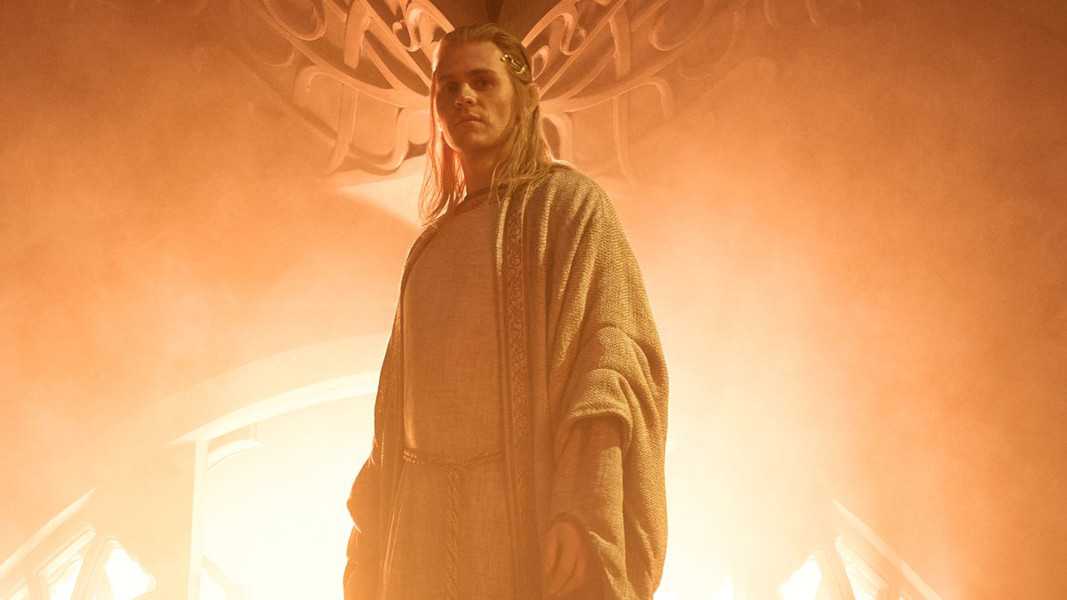
Lore Of The Rings: Did Sauron Mean To Repent In ‘Rings Of Power’?
by Erik Amaya
The history of Middle-earth is vast but also incomplete. Where other fantasy realms have completely charted histories, author J.R.R. Tolkien never finished working out the finer details of his lore. In that gap lives a lot of choices in terms of transmedia adaptation. These are often in display on Prime Video’s The Lord of the Rings: The Rings of Power television series. In Lore of the Rings, we’ll take a look at some of the choices made in the series and how they line up (or diverge) from the Professor’s intentions, notes, and ideas.
Season 2 of Rings of Power opens with a curious prologue: Sauron (played in the scene by Jack Lowden) asserting his claim as the new Dark Lord following the defeat of Morgoth at the end of the First Age. In his speech to the assembled Orcs, he claims the world will be theirs as he sets things to right. The Orcs, led by Adar (Sam Hazeldine), reject Sauron’s plan (and eventual taunting) and stab him repeatedly. But since he is a Maia spirit, he cannot be so easily undone. He eventually takes on a new form, the Man known for a time as Halbrand (Charlie Vickers) and resumes his scheme to bring all of Middle-earth under his dominion.
Those watching with the lore in mind — or those who asked Vickers directly about this, like I did over at Rotten Tomatoes — will be surprised by several aspects of the scene. First, its location, somewhere in Forodwaith, would suggest Sauron held control of Angband after the War of Wrath, the final conflict with Morgoth at the end of the age. But also implied here is the idea that Sauron never meant to repent.
In the lore, Sauron presented himself to Eönwë, a Maia present for the War of Wrath, following Morgoth’s defeat. Seemingly contrite, Sauron offers himself up to his colleague, who in turn orders him to return to Valinor for the judgement of the Valar as he was not empowered to accept Sauron’s surrender. Sauron declines the invitation and instead flees to the East to rebuild his strength.
That course of action may also suggest Sauron’s true intentions, but Tolkien left within it the implication that he still meant to repent in his own way. While Morgoth had nothing but malice toward the world, Sauron was more interested in controlling it and aligning it to his perceived vision of order. It was that desire to perfect an imperfect creation that made the Maia, then known as Mairon, susceptible to Morgoth’s influence and might in the earliest days of the world. And Sauron’s sense of order continued to influence his decisions. Some will even ague his flight to the East was an attempt to show the Valar that his aims were good even if Morgoth’s were wholly evil.
Never mind that Sauron also led legions of werewolves and vampires. That’s for another discussion.
Although his subsequent actions in the Second and Third Ages reveal Sauron as another force of malice and corruption, like Morgoth before him, the notion that he meant to set up an ordered world as proof of his redemption remains. So much so that it influenced Vickers portrayal of the character in Rings of Power‘s first season.
“Tolkien talks of him having fair motives until his intentions become the sole object of his will and he is just hellbent on achieving what he wants,” the actor told me in 2022. “We know he’s in the spirit of repentance. Tolkien talks about that. The question mark is whether or not this repentance is genuine.”
In that light, Vickers suggested everything Sauron tells Galadriel (Morfydd Clark) once she learns his identity could be genuine. But at the same time, he is a master manipulator and just parroting all the things he believes Galadriel wants to hear. Vickers made a definitive choice in his performance, but also enjoyed the ambiguity that still remained for viewers going into Season 2.
But the question remains, did Sauron mean to repent?
Based on the Season 2 prologue, I’m inclined to say no. Although Season 1 introduced the idea that Morgoth was abusive to Sauron, he is still continuing his former master’s designs to some degree. Sauron’s sense of order fundamentally includes corrupting everything the Valar fashioned in Middle-earth in the eras before the First Age. That vision includes a supremacy of Orcs and fell beasts instead of the domain of Men intended by Eru Ilúvatar, the Elvish conception of the Christian God in Tolkien’s cosmology. Even if Sauron swears his actions are meant to prove his work is ultimately benevolent, it may be evidence of the manipulator manipulating himself into believing he can create good after thousands of years spent enjoying abject cruelty.
Look at the way he immediately sways Celebrimbor (Charles Edwards) into his heart’s truest desire or the manner in which he brings that Warg into his service to get revenge on the Man who beat him in Adar’s holding cell. No matter the justification, Sauron revels in these corruptions and that speaks to the heart of the character.
Of course, the presence of a Christian God in the legendarium and the ambiguity in Sauron’s aims leads to a different question: could he be redeemed? While we know the ultimate answer, it is an interesting philosophical debate. And to the dread of many Tolkien fans, it seemed this might be an avenue Rings of Power would explore. But with the Season 2 prologue it seems clear Sauron is, all together, evil.
