
Lore Of The Rings: Did The Valar Judge Míriel In ‘The Rings Of Power’?
by Erik Amaya
The history of Middle-earth is vast but also incomplete. Where other fantasy realms have fully charted histories, author J.R.R. Tolkien never finished working out the finer details of his lore. In that gap lives a lot of choices in terms of transmedia adaptation. These are often in display on Prime Video’s The Lord of the Rings: The Rings of Power television series. In Lore of the Rings, we’ll take a look at some of the choices made in the series and how they line up (or diverge) from the Professor’s intentions, notes, and ideas.

The religion of Númenor is one of the most surprising elements in the deeper lore of Tolkien’s legendarium. Despite being a devout Catholic, the Professor shied away from any direct invocation of his faith within the realm of Arda (the Elvish name for the world). Even Eru Illúvatar, the Elvish conception of God, is a distant creator force whose Abrahamic connection is downplayed, in part, because he wanted to create a pre-Chrisitian British mythology. Within Arda, this leads to some curious quirks. Both in terms of Elvish myth and history, the Powers who fashioned the physical world to Eru’s design, the Valar, are physical entities with direct relationships to the Elves. They know exactly who and what Ulmo, the Lord of Waters, is, for example. But for the Men of Númenor, this connection is obscured across successive generations. Among them, none who saw the Powers go to war against Morgoth at the end of the First Age live to recall just how real and awesome they were. Additionally, the force of their accounts dwindled even among the long-living Men of the island.
Also, Tolkien tended to shy away from such matters and only really outlined cults dedicated to the Shadow.
Nevertheless, those Númenóreans who stayed true to their bonds with the Elves and the Valar became known as “the Faithful.” So what was their faith? The lore describes at least one temple dedicated to Eru directly. Others suggest the seafaring race would favor Ulmo and his subordinate Maia, Ossë, who was said to be responsible for raising the island upon which Númenor sits as part of the Valar’s gift to Men following the final push against Morgoth. This is doubly interesting as Ossë had a brief fling with Morgoth’s philosophy in the earliest days of the world. He soon returned to Ulmo’s side, but a faith based around him would be just as tempestuous as the sea and open to the words of a Dark Lord. Provided, of course, Númenóreans worshiped Ossë directly.
For The Rings of Power, this question of religion is particularly thorny because the production may not have access to figures like Ulmo and Ossë. As part of Amazon’s deal with the Tolkien Estate, they are free to use any name or concept published within The Lord of the Rings and its appendices. Any idea outside of the book can be approved on a case-by-case basis, but as the estate is generally protective of the material published in The Silmarillion, it seems anything within it — including the first published account of Númenor’s fall — is, to borrow a phrase, forbidden knowledge. So in lieu of naming Ulmo and Ossë directly, the show uses “the Valar” as a collective term for the Powers the Faithful worship and submit to for judgement.
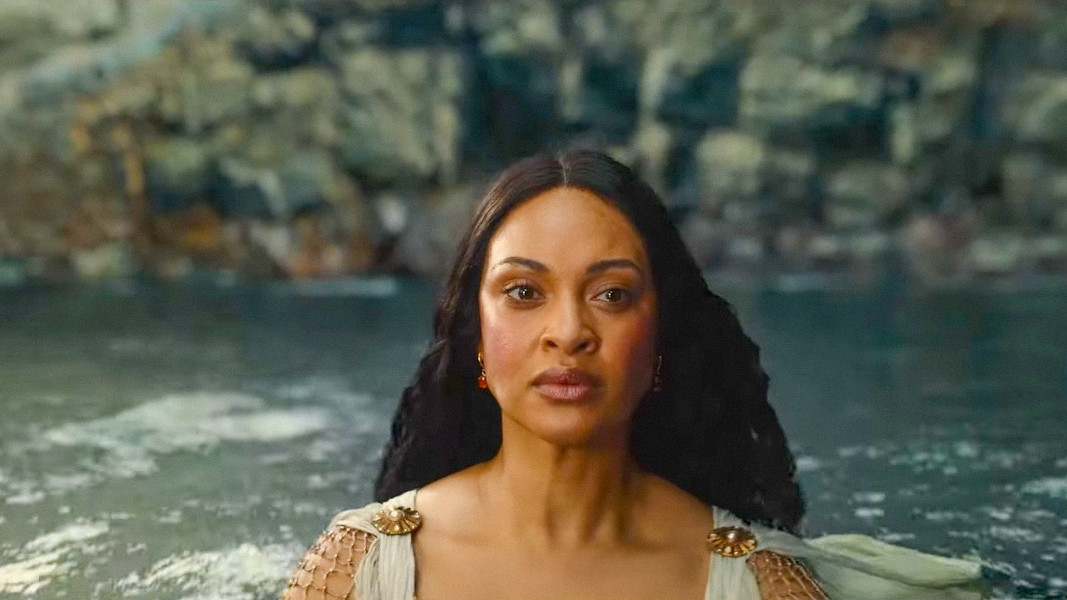
Which, of course, brings us back to this week’s query. As seen in the most recent episode, both Elendil (Lloyd Owen) and Tar-Míriel (Cynthia Addai-Robinson) submit to the Valar when the former is tried for an act of sedition before the court of Ar-Pharazôn (Trystan Gravelle). In a move meant to be cruel, Pharazôn’s chief adviser suggests the best way to punish one of the Faithful is to making them live (or die) by the letter of their faith. And, as it happens, we learn just how faithful Elendil really is despite Season 1 establishing him as a Man embittered because the Sea took his wife and the Sea is always right. The events of the first season renewed his faith and now he believes with such fervor that he will accept the judgement of the Valar in regard to his actions. Such is his conviction that both his daughter,Eärien (Ema Horvath), and Míriel cannot dissuade him from jumping into the Sea and facing a sea worm.
But in a surprise move, Míriel takes Elendil’s place in the water and submits herself for judgement as, ultimately, he was acting in her stead from the moment Pharazôn took the scepter and was declared king. And while she was always depicted as Faithful — a choice of the show’s creative team as Tolkien could never decide on her loyalties — this attempt to save her trusted captain also proves the extent of her belief in the Valar.
Did they deem her worthy, though? The answer is, as it happens, important to the future of Númenor and the series as a whole.
Following the creation of the world and the Awakening of the Elves, the Valar became less concerned with goings on in Middle-earth. They left it in the Elder Days after Morgoth ruined the symmetrical Arda they fashioned. Soon, they established a new home in Valinor on the continent of Aman. The Undying Lands, as they came to be known, is a place of nearly unending peace and tranquility for Valar, Maiar, and Elf (aka Eldar) alike. But it also means those in Middle-earth are left to their fates and, ultimately, the will of Morgoth through the First Age. This unofficial non-interference pact ended when Elrond’s father, Eärendil, sailed to Valinor to plead for their aid. After the raising of Númenor, though, the Powers once again went into seclusion in Valinor, although Tolkien suggests certain animals act in their stead, as do the Istari — but more on them another time.
So, it is entirely possible that the sea worm Míriel encountered is itself an agent of the Valar. And if that is the case, then her survival is their judgement; she lives because her case was just. Of course, that will soon mean trouble as Pharazôn allowed this to occur in public and it no doubt renewed the faith of some who were among his devoted allies. Tolkien has words to say on this as well, which includes the most sinister phrase in all of his writing: “he took her to wife.” Of course, it remains to be seen if the series will follow this particular avenue or present a potential union between Pharazôn and Míriel as the best way to maintain the peace between the King’s Men — those loyal to Pharazôn — and the Faithful. No matter what transpires in the remaining Season 2 episodes, though, the Valar’s judgement brings Númenor that much closer to what Míriel glimpsed in the Palantír.
Before we get to that, though, it is important to consider just how much foresight might be involved in the Valar’s judgement. They have some inkling of how the world will unfold, but not all the details. For them, ensuring the Queen’s survival may still lead to a greater doom for Men or a greater glory. If Rings of Power can only represents the Powers in the form of Eagles or sea worms, then their actions remain as mysterious to the viewer as any Númenórean who stood on the cliff that day. And like so many real world religions, the mystery of faith is just as key to what the Faithful in Númenor believe.
Judgement was pronounced for good or ill and, likely, it will force the Valar to pay attention to Númenor even if they refuse to act for some time yet.