
Never Alone, Forever Lonely: Reviewing ‘Teenage Mutant Ninja Turtles’ #2
by Scott Redmond
Overview
The Splinter Clan’s journey to finding themselves once more continues with Teenage Mutant Ninja Turtles #2 where the resident ‘party dude’ finds out that some lives aren’t the party they seem. An interesting look at fame, loneliness, and the paths we choose in life wrapped up in the usual TMNT wrappings.
Overall
8.5/10Fame isn’t always what it’s cracked up to be. Especially when it coincides with losing your family along the way.

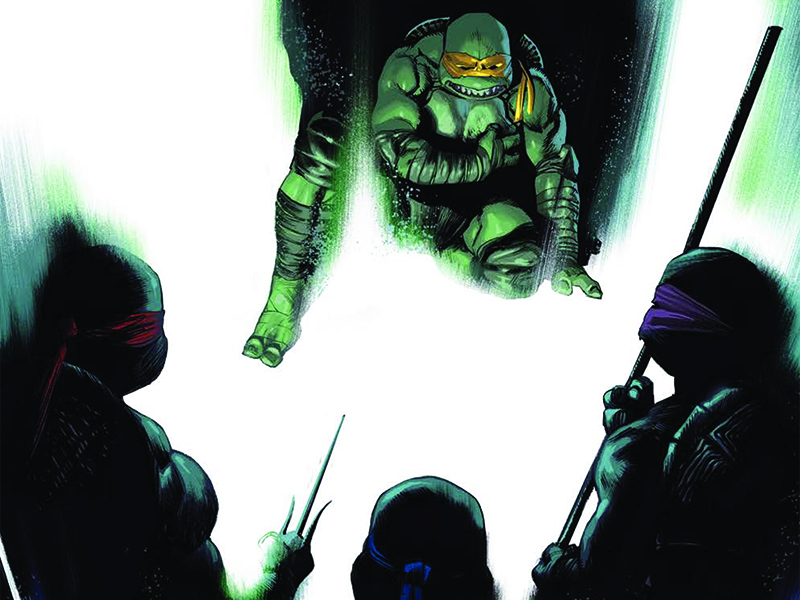
Michelangelo might have left the streets and sewers of New York City far behind, but that world isn’t finished with him in Teenage Mutant Ninja Turtles #2. The second issue of this flagship revamp comes from Jason Aaron, Rafael Albuquerque, Marcelo Maiolo, and Shawn Lee.
Splitting the Turtles apart so that they can be brought back together is an intriguing concept. It allows the new book to stand fresh from the previous run and allows new readers to come on board. We’re all in the position of asking questions and seeking answers on (mostly) even ground. It also functions as a way to inject some potential drama and new stakes into things.
All that being said, this issue wasn’t as much of a slam-dunk for me as the first.

Don’t get me wrong, I still enjoyed it. Aaron has an interesting take on the Turtles and is finding a good way so far to marry the continuity born of the last run with his desire to tap into the classic era. A darkness and gritty feeling are clear through the whole thing, right there alongside the particular brand of heart that grew in this modern version of the franchise. Mikey’s situation on TV could only be born out of the strides that were made in the 150 issues of the last series.
Especially since we saw him spend a lot of time dabbling in the media through the tail-end of that run. Not to mention that with the walls of Mutant Town falling, it’s natural that mutants became more of a curiosity and popularity in various realms.
I think a lot of what bogged it down just a bit for me was the family stuff. It felt a bit heavy-handed with the drama building up (including Mikey fighting visions of his bros and real Raph) that happened off the pages. We know that they all drifted apart, but right now the way Mikey is acting seems to point to something more than just brothers growing. In contrast, Raph’s story felt more like a natural thing of people exploring and drifting.
Then again, this could be a thing where from each brother’s perspective, the split came about differently. I might be ready to eat some proverbial crow by the time issues three and four roll around.

Different artists handling each character’s story is a nice situation. It brings a different additional tone to everything. Albuquerque handles the glossier yet darker tone of this story quite well. The last issue was a prison story, and this one sort of is too. More like a prison to one’s own ambitions and the culture of fame than an actual prison. Which those two things, are in reality nothing alike, even if the comparison works here.
There is an emphasis on the setting and the individuals around Mikey, really creating a depth of loneliness felt in every panel. Even as there are shiny lights and TV sets, we can tell and feel that this character basically exists within this space rather than living. Albuquerque is always able to gel the rougher texture needed for stories with the softer shinier edge that comes with many comic book stories. Creating that duality that exists within the world around us constantly.
Fight scenes are fluid and smooth, while feeling very tight and confined here. As they should, since the fights are happening within an apartment. Even a penthouse apartment is a small space for a fight and Albuquerque harnesses that energy to keep things tight and close.

I’m not all that familiar with Maiolo’s work on the coloring side of things. What I can say right away though is that it pairs with Albuquerque’s work flawlessly. A lot of heavier tones and shades add to the weighty feeling of the story. Allowing the more vibrant beats breathe and pop comparatively, while not letting up on the proverbial gas with the dark gritty feeling. It almost has a monochrome type of energy, despite there being actual colors at play.
Most especially want to point to the lighting situation in the apartment scenes. It’s night and the place are dark, and it sure feels that way. This isn’t a TV/movie dark where things are naturally lighter because of set things and choices made. No, there is an authentic feeling here to the tone choices, as it feels dark and ominous. Framing the fight in really heavy tones and keeping us all as off guard as the character in the middle of the fight.
One constant with the TMNT-verse is the power behind the words on the page. Primarily speaking about the actual words on the page and how they are delivered, which is Lee’s domain. Lee is one name that bridges the gap between the creative and volume changes since IDW began their Turtle adventures.

Visual presentations that allow the words to flow easily while exuding every bit of emotional, tonal, or personality riddled energy as possible. Giving characters their distinct voices, making sure every shift or change is felt, be it big or small.
Teenage Mutant Ninja Turtles #2 is now available from IDW Publishing.

