
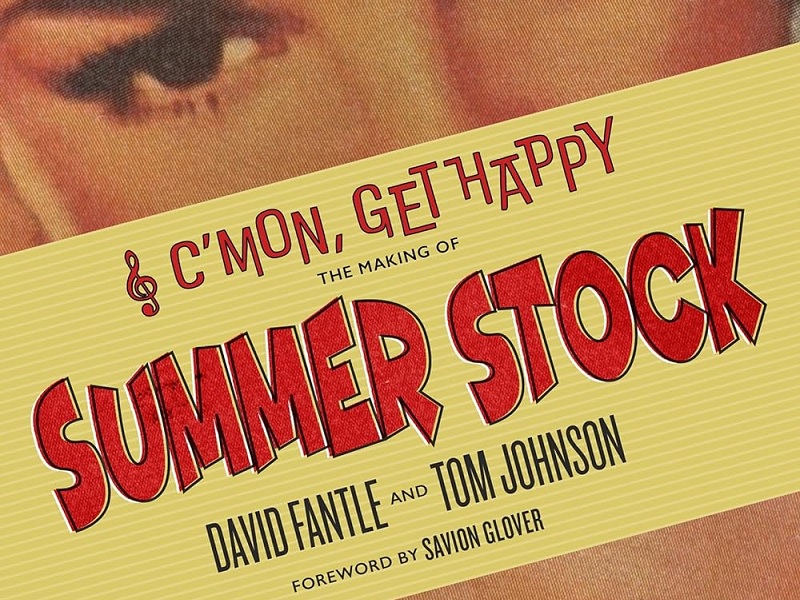
Book Review — ‘C’Mon, Get Happy: The Making Of Summer Stock’
by Rachel Bellwoar
In their introduction to C’Mon, Get Happy: The Making of ‘Summer Stock’, David Fantle and Tom Johnson defend their decision to write a whole book about Charles Walters’ Summer Stock over any of Judy Garland, Gene Kelly, or (for that matter) Walters’ other films. And maybe it might come as surprise, seeing as there aren’t also books devoted to On the Town or Easter Parade. The truth of the matter is that every film deserves to be covered with the thoroughness and care that Fantle and Johnson have researched this musical – Garland’s last for MGM.

Summer Stock is the farthest thing from a flop but even if it were the most obscure film in any of these creatives’ output, there would be stories to be told in how it came together. The beauty (and one can imagine difficulty) in devoting an entire book to one movie is how detailed the analysis can go and there isn’t a rock Fantle and Johnson haven’t turned over, even if they can’t always provide a definitive answer. Like the question of why Nina Bieber was named dropped in reviews and credited when none of the other chorus members were. It’s a curiosity that a passing entry on the film wouldn’t have time or space to explore, but Fantle and Johnson try to shine some light on the mystery.
Those interested in production history and behind the scenes stories will find a lot to absorb. For instance, Fantle and Johnson pick apart the easy answer to blame Garland for all of the film’s production delays. They share the crazy story of how the screenplay was improvised by Sy Gomberg over the course of several meetings as he was trying to save his job after getting fired and Kelly and Garland’s close working relationship after Kelly’s first film, For Me and My Gal, where Garland helped him adjust to film acting.
They show what a small world Hollywood could be (Sylvia Sidney’s third husband was Garland’s personal manager) and help readers learn the difference between an MGM musical produced by Arthur Freed and one produced by Joe Pasternak (Pasternak produced Summer Stock).
They also go over how Kelly choreographed the squeaky floorboard-newspaper dance number. Watching it, for example, you don’t even think about how Kelly got the newspaper to rip but, as it turns out, it took a lot of trial and error to get right and was more of a challenge than one might realize.
Even for those readers who haven’t seen Summer Stock there’s a good chance they’ve seen a clip of Garland singing “Get Happy” in a fedora and tuxedo jacket (no pants). It’s arguably one of Garland’s greatest numbers and yet it was a late addition to the movie, filmed after production had wrapped, and for composer Harry Warren and lyricist Mack Gordan an upset since “Get Happy” wasn’t one of their songs.
Fantle and Johnson are very transparent about their research and never hesitate to question sources (and, sure enough, they can’t always be taken at face value). If you have any passing interest in Golden Age Hollywood or MGM musicals in particular, this is a book to look up.
C’Mon, Get Happy: The Making of ‘Summer Stock’ is available now from University Press of Mississippi.

