
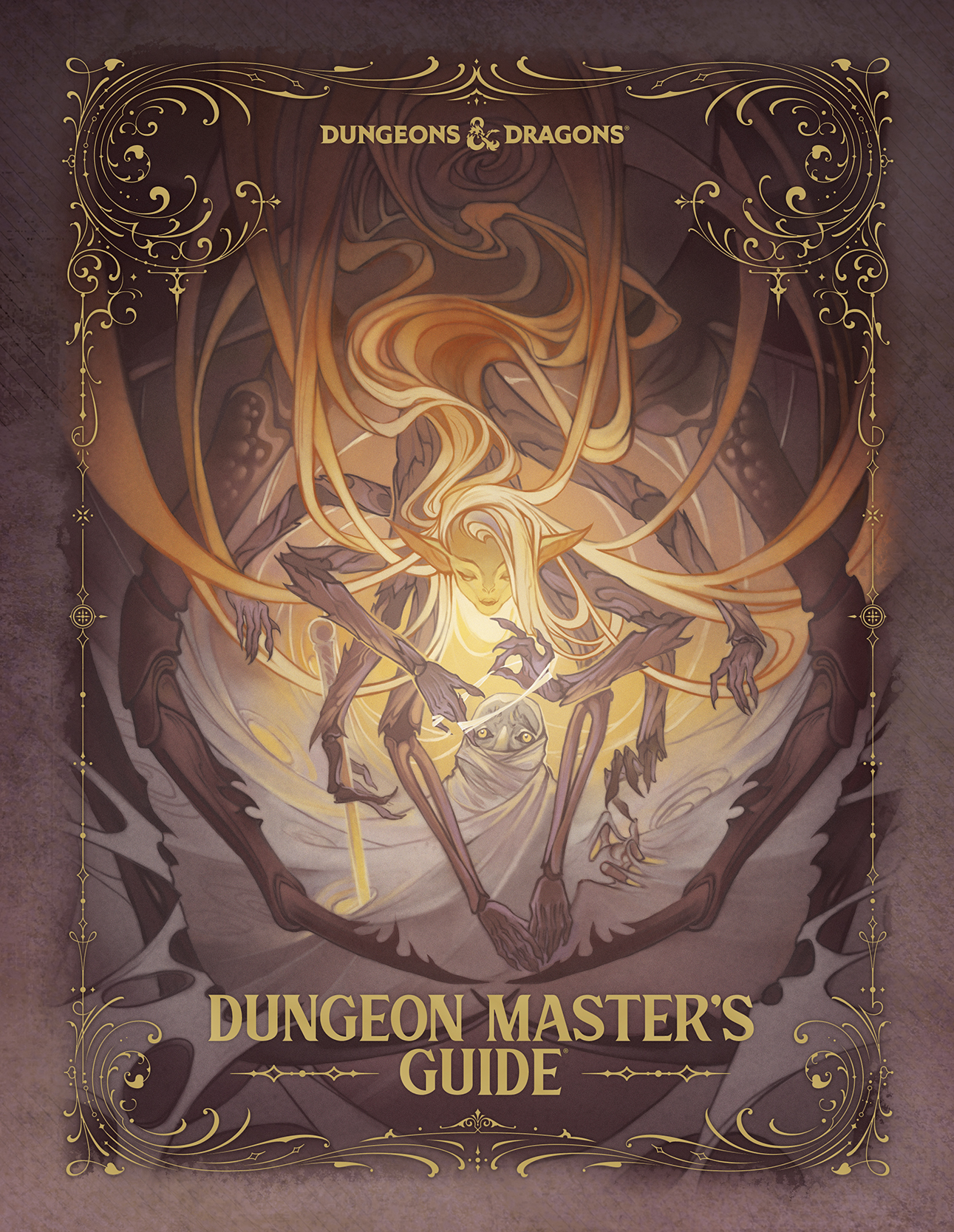
Previewing The Upcoming 2024 ‘Dungeons & Dragons’ Dungeon Masters Guide
by Anton Kromoff
Welcome to the table,
The release for the upcoming Dungeons & Dragons 2024 Dungeons Masters Guide (DMG) is drawing ever closer. I’m honestly delighted (double delighted even) about all this new D&D offering has in store for us.
For starters, I have been playing, running, and appreciating Dungeons & Dragons all my life. I did slip away from the Forgotten Realms and lands beyond for Pathfinder during the 4th edition days, but the 5th edition saw my return to the system and settings as my players (new and old) wanted to try the books and what they had to offer.

Here I sit, ten years later, with a shelf lined with almost every officially published offering save one (it’s the Rick & Morty book) on my gaming shelf, each organized and displayed above my massive collection of other D&D publications.
Talking about the DMG is a strange thing for me at times. The reasons for this are as follows:
A. I rarely, if ever, use the term “Dungeon Master.” 95% of the games I run do not take place in a dungeon and I hardly consider myself a “master” of anything. So the turn of phrase just does not feel like it applies to me. I like “Storyteller,” as that is what I feel like I do at the table, I tell a story.
I know that can be an unpopular opinion that somehow enrages the dark corners of social media, but you can’t please everyone all the time, and I’m probably okay not pleasing that corner in the first place.
B. I don’t often find the need to use a Dungeon Masters Guide. I like them. The 2014 version has some cool stuff in it and there are some rad items, but 90% of the games I have run in the last ten years, week in and week out, sometimes multiple times a week, have been on a VTT.
That’s a virtual tabletop, Mr. Editor, and those others who may not know that particular abbreviation.
Playing on a VTT allows for easy googling, access to the D&D Beyond, and other resources to find quick rules if there is an issue that need to be contested. Normally my party is very chill and does not contest much of anything. If they do, the ethereal marauders help them find answers quickly.
C. I have been running games the majority of my time on this planet. I don’t need to know how to build story notes or tie plot points together. The tables and carts are other places, and most of the magic items and equipment my party finds are home-brewed and designed specifically for their characters and the world they are playing in.
There is not often enough lore or setting information to draw me to the book as in other offerings. At large, it’s a book of numbers and crunch that, while I love it, is more mechanical resource-based than anything else. So I pick it up and read it far less than I do just about everything else that has come out for 5th edition making it less front of mind.
That last one (reason C up there), that’s kind of a strange thing when you consider that I have run hundreds, if not thousands, of hours of TTRPG gaming sessions in the last decade alone. I don’t reach for the book that is made specifically for the person running the game. This is important to consider when I tell you this next part.
I’m very much looking forward to the 2024 Dungeon Master’s Guide.
Between GenCon and press conferences, I have had multiple opportunities to preview what is coming in the upcoming 2024 DMG. It honestly has me very excited.

First and foremost, the attention to intentional layout and design in the 2024 D&D books has been nothing short of perfection. At times, TTRPG books can be daunting, even for someone like myself who enjoys charts and math and game crafting. The D&D team here has considered not only veteran gamers, but also those who may be new to the table and looking to try their hand at storytelling and world building.
The new 2024 DMG is broken into eight chapters that, if the Players Handbook is any indication, will be easy to follow as you flip into the role of the Storyteller and, as my players say, “simulate the universe” for your friends.
The first chapter onboards you with The Basics. It gives the reader an overview of the role of “Game Master” (it’s still so weird to type that), and the language and terms you are going to need to be most familiar with.
From what I have seen so far, it’s a really solid overview of the language and key roles someone running a game would need to have ready. Based on the way the 2024 Player’s Handbook goes about things, I would assume that this is going to be akin to the way a book of recipes goes over what knives, sauce spoons, and stand mixers do what in your kitchen before it gets into the deeper intricacies of the kitchen magics that still very much elude me.

The second chapter dives into running the game itself. Knowing the importance of rules, action economy, when and why to have your party make skill checks, and how combat works will all live in this space.
From there we move into chapter three. This is where the DM’s toolbox lives. As someone who loves to homebrew, building my own magic, monsters, and maladies to fit the table, the DM’s Toolbox seems to be setting up those who run the game for success. This chapter will provide a slew of rules that allow storytellers to build their own curses, contents, and gods providing not only examples of these things but also step by steps to create things that fit your game.
An addition of this kind is such an important feature. It gives the storyteller a level of control they have always had, but presents it in a way that I have seen all too many not realize. If the information provided is correct, and I find myself trusting the people over at D&D with my whole heart, then this is the kind of thing I would have spent countless hours pooling over as a kid rather than having to backward engineer this or that for my table.

Chapter four is focused on adventures. It contains five short adventures that not only provide an opportunity for play, but also show Storytellers how to build out their own adventures and create stories for their tables. The example adventures range in challenge rating for players from level 1 – 7. They are dialed in and easy to create with the framework provided by the DM using the tools provided in this book.
The fifth chapter is based on campaigns, showcasing how to lay out the premise, draw the players in, plan multiple adventures. Then, when the time is right, how to bring that campaign to a close. The campaign setting is going to be the classic Greyhawk setting, a really fun move that brings the core of the lore back to one of the very first D&D worlds.

From campaigns, we jump into chapter six, Cosmology. This provides insight into gods, lore, and the moving world surrounding your campaign setting.
We then dive into chapter seven, treasure! The Magic Items Chapter is incredibly big, with over 100 pages that are dedicated to treasure. There was a lot of attention to making magic items that expand upon what was in the 2014 5e DMG, as well as more common magic items.
It is exceptionally cool that some magic items that have stories tied to the 50-year legacy of D&D, including items carried by the kids in the classic Dungeons & Dragons cartoon. My hope is we get more on Warduke’s sword, shield, and helm.

Chapter eight is where you will find one of the coolest new additions to D&D, the Bastions. Bastions are essentially a way for players to build their home base and manage them without the need for a storyteller to be around. You can take a Bastion turn and generate resources or effects that may aid you down the line. It’s a really cool addition to the game I am very much looking forward to exploring with my players.
We then get into the Lore Glossary, an invaluable tool in my opinion as it provides those new to D&D or those who have only explored small aspects of a game or world a better understanding of the lore and landscape. Then, after the Lore Glossary, there is a section for Maps.

I’ve also seen the “DM’s” screen, with revised information and some brilliant art for the 50th anniversary. There was a lot of care that went into putting that together. So much that they even put the more searched information on the outside panels of the screen so that a Storyteller who uses a laptop can have an easier time finding things quickly if their laptop is set up behind it.
I can safely say the quality of life improvements to the 2024 DMG are going to make this an actually useful tool in the Dungeon Master’s arsenal. I really can’t wait to get my hands on the final version of it. It comes with two covers, with the retailer’s exclusive cover featuring a very mellow-looking version of Lolth the Spider Queen.

Until next time, D&D Beyond Master Tier & Local Game Store Early Access to the DMG is on October 29, 2024. D&D Beyond Hero Tier Early Access is November 5, 2024, and DMG Wide Release is November 12, 2024, and the DM Screen Release is also November 12, 2024.
Also, I don’t know if you know this but the book up there in the images is the Book of Vile Darkness, the book Vecna keeps tucked under his ribs. That alone is super cool, but that skull wand … that is the Wand of Orcus.
As a collector of Orcus stuff, that is huge. I have a replica of that thing hanging in my office over my WizKids Orcus mini. I love everything I am seeing coming out of this book so far. The new D&D 2024 content is making me so happy because you can really see what I have been saying for a while, the team at D&D is working their very best to make sure that they are putting out something amazing for the players and it shows.

