
Talking ‘Madame Choi And The Monsters’ With Patrick Spät And Sheree Domingo
by Rachel Bellwoar
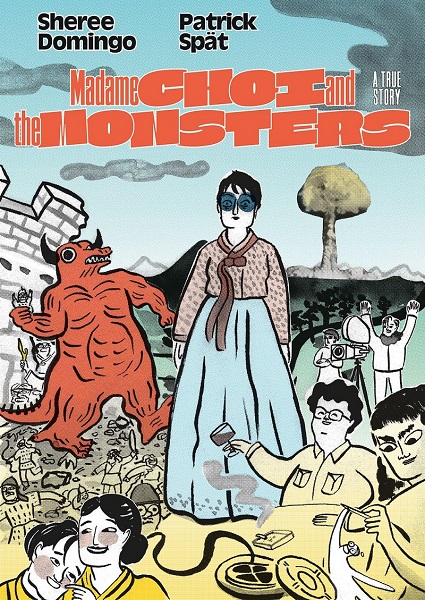
She was a major South Korean actress. He was a successful South Korean director (and her ex-husband). In 1978, Choi Eun-hee and Shin Sang-ok were kidnapped by North Korea’s Kim Jong-il and eventually forced to make a number of films for him, including the giant monster movie, Pulgasari. In their latest graphic novel, Madame Choiand the Monsters, writer Patrick Spät and artist Sheree Domingo shine a light on the true story and you can find out more about it in the following interview:

Rachel Bellwoar: When did you first become aware of Choi Eun-hee and Shin Sang-ok’s story?
Patrick Spät: In 2019, I saw a pixelated version on YouTube of the monster movie Pulgasari, which Madame Choi and Shin made – had to make – for the dictator’s son Kim Jong-il in 1985. I especially liked the ambivalence of this film, which, depending on how you read it, contains subtle criticism of the North Korean regime. Afterwards, I researched the history of the making of the film and then I was really hooked: a kidnapping, seductiveness through power, a blatant love story and Bulgasari, a monster who is also quite morally ambivalent.
Sheree Domingo: Before Patrick sent me his script and invited me to bring this story to life, I hadn’t heard of it. It was the monster that inspired me to create this comic. Throughout history, monster stories often emerge during times of upheaval and uncertainty—consider Frankenstein during the industrial revolution or Godzilla at the onset of the nuclear age. Perhaps it’s this tension associated with monsters that fueled my desire to breathe life into Bulgasari.
Bellwoar: While this graphic novel is about both of them, the title is Madame Choi and the Monsters. Why did you want to center Madame Choi’s perspective?
Domingo: From the outset, we wanted to approach the comic from a feminist angle, addressing toxic masculinity through Madame Choi’s viewpoint. Too many stories are told from male perspectives.
Spät: And storytelling wise, you have more cliffhangers if you don’t have an omniscient but a personal viewpoint: the reader only knows as much as Madame Choi does. What’s new for her is new for the reader as well. We also hope that this will help the reader empathize with the discomfort and the horror that Choi feels.
Bellwoar: If Shin hadn’t gone looking for Choi do you think Kim Jong-il would’ve had him kidnapped as well, or is it known whether that was part of his original plan?
Spät: As far as we know it was Kim Jong-il’s plan all along to kidnap them both: Choi as well as Shin. In South Korea, and even throughout Asia, Choi and Shin were the most famous movie stars of their time. And because the film fan Kim – who regarded himself as an artist – was almost infatuated with his plan to turn North Korea into a world-leading film nation, he needed both: the actress Choi and the director Shin.
Domingo: In the 1970s and 1980s, Kim’s agents were active everywhere, not just in Hong Kong where Choi and Shin were abducted. There are even documented cases of people sunbathing on Japanese beaches being kidnapped by North Korean agents, either for ransom or due to their perceived value to the regime.
Bellwoar: For readers who may not be familiar with their films, is there a good place to start or one that’s a personal favorite?
Domingo: That’s a tough question since they made over 60 films together. I think Pulgasari, the aforementioned monster movie, is a good entry point. Despite its cult status, it offers a unique interpretation of Bulgasari and serves as a clever critique of power dynamics. Interestingly, Kim Jong-il was either oblivious to or uninterested in the film’s subtle criticism.
Spät: I’d recommend their South Korean classics A Flower in Hell (1958) and The Houseguest and My Mother (1961). These films are not only interesting regarding their social criticism and the progressive mindset for their time but also because of advanced film and cutting techniques. And Madame Choi is an awesome actress.
Bellwoar: Where did the idea to tell your own version of Bulgarsi (the myth Choi and Shin remade as Pulgasari) come from, and did you always want to structure the book this way – switching back and forth between real events and fiction?
Spät: The legend of Bulgasari is a centuries-old Korean myth about an iron-eating and ever-growing monster. Since this monster plays such a huge role in Choi’s and Shin’s personal story, it was clear for me that it has to be included into the comic. Even more so, because it’s just fun to write a comic script with a monster in it! But it really took some time and thinking and much coffee to come up with the idea to have these two interwoven story lines that mirror each other at the content level and that also mirror the film technique of using back and forth jumping cuts with all the cliffhangers and parallel story lines. In the end, I literally used scissors, cut my script pages into pieces and rearranged them.
Bellwoar: Today Bulgarsi (the original South Korean film) is considered lost. How did you come up with your own take on the monster?
Domingo: Yes, the original 1962 South Korean film, Bulgasari, is still missing. Some historians believe that Kim Jong-il, a film enthusiast who owned over 15,000 film reels, may have had the original stolen from Seoul. He likely knew the film’s plot intimately. In our comic, we use the lost film reels as a starting point to offer our own interpretation of the monster. The most intriguing aspect was exploring Bulgasari’s morally ambiguous nature: it helps the weak but also acts destructively and uncontrollably. Like many monsters, it transcends the binary of good and evil.
Bellwoar: Perhaps the most maddening part about what Shin and Choi were put through is how patient Kim Jong-il was, waiting years before explaining his intentions or asking them to film anything. What was it like to try and capture that frustration visually?
Domingo: We knew we had to condense those long years of waiting while still capturing the pain of the experience. In the text, Patrick included Kim Jong-il’s recurring phrases like “all such things need time.” Visually, we show the changing seasons, with Choi Eun-hee almost resigned to her life in North Korea, bordering on lethargy. However, moments of despair break through, particularly when she inquires about her children. Until her escape years later, they believed she had left them willingly.
Bellwoar: Can you talk a little about the color palette you chose for this graphic novel?
Spät: We exchange ideas a lot when we work together. Creating a comic is like playing ping-pong for us. The color palette also emerged that way: We wanted to have three colors in total, that connect as well as separate the two different story lines.
Domingo: In the fictional section with the monster, we use red and pink; in the historical narrative with Choi and Shin, blue is predominant. Yellow serves as a link between the two. The monster’s color also evolves over time, starting as a white rice figurine and transitioning from light red to bright red/pink.
Bellwoar: Given the secrecy that exists around North Korea (it wasn’t until Choi and Shin recorded his voice that anyone heard Kim Jong-il speak), did that create any hurdles for your research? For instance, is it known that Kim Jong-il had a shark tank in his house or was that creative license?
Spät: Even the Covid lockdowns, during which we made this comic, weren’t the biggest obstacles; North Korea is in a quasi-permanent lockdown. It’s hard to get objective facts. So, we researched many stories from North Korean refugees. And of course we researched Choi’s and Shin’s personal accounts and the tape recordings they secretly made during their conversations with Kim Jong-il. And yes, he really had a big shark tank in his house – in one of his many houses to be precise. Kim also had a movie theater all for himself and a big room with all kinds of slot machines, arcade games and video games like Nintendo which he loved to play with.
Domingo: Also Kim’s high heeled shoes are not made up by us. More complicated than these facts is Kim’s character: Of course you can read him as one of the “monsters“ as the plural (“… and the Monsters”) in our comic’s title suggests. But nevertheless, we’ve tried to portray him in a more subtle way because, according to various reports, he was known to be both irascible and cruel but also intelligent and humorous – all of which makes him even more monstrous. The focus of this story is on the protagonists, and not so much on North Korea itself. For the rest: we worked together with a Korean expert in cultural studies, Choo Young-Rong. She lives here in Berlin as well and she helped us to get things right regarding Korean history, customs, and daily life. She even checked the look of 1970s police cars and the castle’s historical architecture.
Bellwoar: Thanks for agreeing to this interview, Patrick and Sheree!
Madame Choi and the Monsters goes on sale November 26th in the US and is already on sale in the UK from SelfMadeHero.
