
Talking ‘Daisy Goes To The Moon’ With Artist Rick Geary
by Rachel Bellwoar
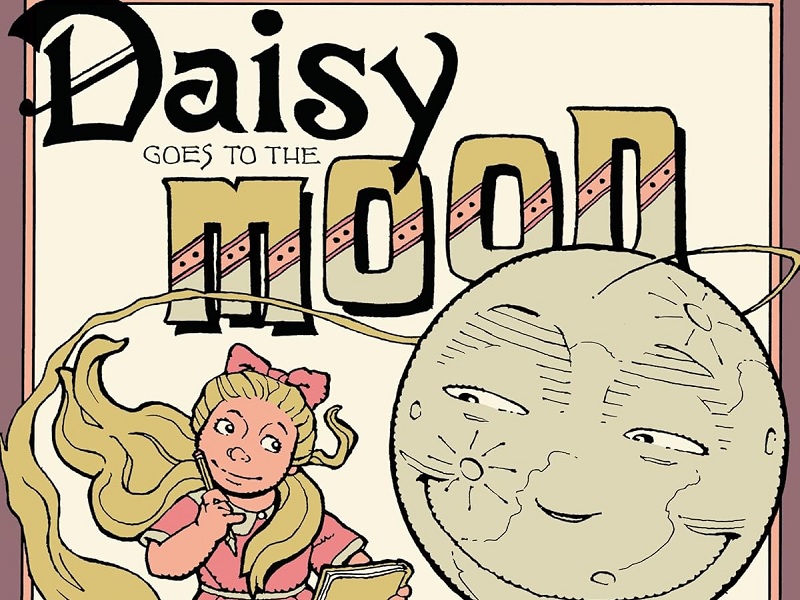
Many an adult has tried to remember what it was like when they were young and write with a child’s voice. Daisy Ashford actually kept the stories she wrote as a kid and published them as as an adult. Since Daisy was a kid during the tail end of the 19th century, those stories are not only authentic in their voice but a time capsule to a different era. In 2009, Mathew Kickstein released a book inspired by Ashford called Daisy Goes to the Moon and now that book is being adapted into a graphic novel by artist Rick Geary. For more on Daisy’s journey to becoming a graphic novel, check out this interview with Geary below:

Rachel Bellwoar: How did you and Mathew Klickstein first connect and were you familiar with his novella, Daisy Goes to the Moon, beforehand?
Rick Geary: Mathew called me out of the blue and more or less recruited me for the project. I had never heard of Daisy Ashford or Mat’s novella so I had a lot of catching up to do.
Bellwoar: In taking on this project were you also able to read Daisy Ashford’s original stories (which Klickstein’s novella is inspired by) or did you really want to stick to his take on the material?
Geary: After agreeing to take on the project, I read Daisy’s little book The Young Visiters and saw that Mat’s book perfectly captured the tone and spirit of the young author. My goal was to retain that spirit in adapting it to the comic form, and fortunately its straight-faced absurdity fit right in with my own sensibility.
Bellwoar: Ashford wrote these stories when she was a child and published them as an adult with the help of Peter Pan‘s J.M. Barrie. Do you know who their intended audience was – children or adults?
Geary: I really don’t know what the intended readership was for Daisy’s novella, but it seems that all ages would be charmed by it.
Bellwoar: Like your book series, A Treasury of Victorian Murder, Daisy Goes to the Moon takes place in Victorian times. Did that knowledge of the period help when working on Daisy?
Geary: My deep dive into the Victorian era was certainly a good background and starting point for my adaptation. Although most of the story unfolds at a far remove from any recognizable time or place, the character of Daisy, as a typical Victorian child, was one that remains a constant throughout. She’s high-spirited and up for adventure, but at the same time a rather spoiled brat.
Bellwoar: There’s always this reaction that children’s stories and true crime wouldn’t have anything in common, but at one point in Daisy a character gets their face eaten off by a moon monster and it couldn’t be treated more casually. Was it fun to subvert expectations in that way?
Geary: I’ve spent much of my career alternating true crime projects with work on children’s books and comics, and I believe that they’re not really that far apart. Kids are more in touch with their nightmares than grownups, and I tried to capture this in the offhand way that Daisy’s more gruesome episodes are depicted.
Bellwoar: True to how a child would write, there are some very sharp transitions in this story. Were those challenging to work out?
Geary: The sudden transitions were there in Mat’s book and were part of the dreamlike effect I wanted to retain. A challenge but a fun one.
Bellwoar: In Klickstein’s novella, were there many descriptions for how the characters looked and dressed or were you able to make a lot of those choices for yourself?
Geary: Actually, Matt’s book doesn’t contain much physical description of the characters or the settings, so I was pretty much free to use my own imagination.
Bellwoar: One thing you realize early on in Daisy is that Daisy is a creative speller. How important do you think it is that that those spelling mistakes be retained?
Geary: Both Matt and I were in agreement that Daisy’s “creative” spelling and grammar should be retained in the adaptation. They are essential, I believe, to the childlike point of view in both Daisy’s original work and Mat’s recreation.
Bellwoar: At times Daisy recalls Alice’s Adventures in Wonderland (1865) and The Wonderful Wizard of Oz (1900). Were those books already the cultural touchstones that they are today in their time or were those references Klickstein added in?
Geary: The parallels with Alice in Wonderland and The Wizard of Oz, while not explicitly stated, were certainly an undercurrent in Mat’s novella. It doesn’t seem, though, that they were an influence on the original Daisy’s work.
Bellwoar: Thanks for agreeing to this interview, Rick!
Daisy Goes to the Moon goes on sale January 14th from Fantagraphics.

