
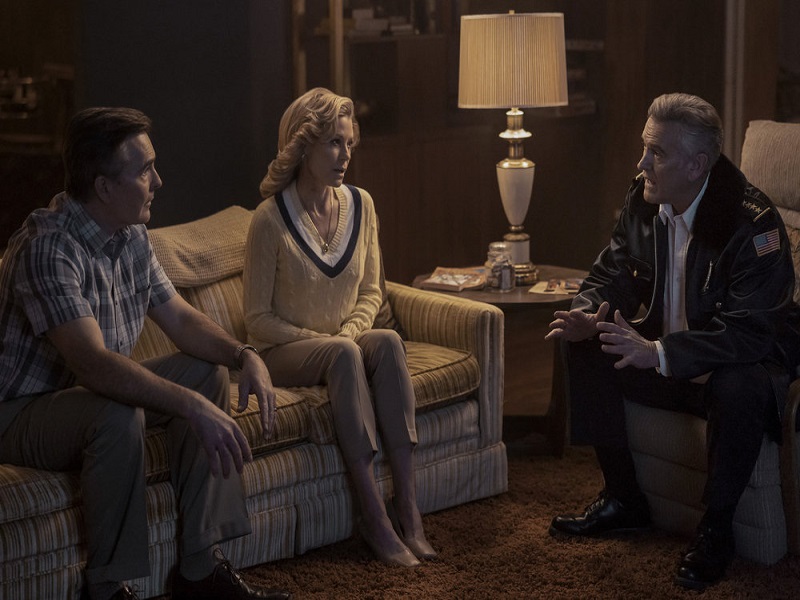
Talking ‘Hysteria!’ With Production Designer Victoria Paul
by Rachel Bellwoar
Satanic Panic has hit small town Michigan in Peacock’s new series, Hysteria!, and here’s what production designer Victoria Paul had to say about working on the show:

Rachel Bellwoar: Having recently worked on shows where you had to imagine a post-apocalyptic world (Twisted Metal) and recreate 1940s America (A League of their Own), what made you want to go to the ’80s next with Hysteria!?
Victoria Paul: First and foremost, what attracts me to any show is the script. [Matthew Scott Kane] had written a world that was authentic in its characters and place. It was specific, grounded and real. Then into this world, he injected evil and horror and eeriness. It’s a brilliant stew, and a real treat as a designer. So the great material, along with the chance to visit the ’80s visually, was irresistible.
Bellwoar: Which do you enjoy more – the restrictions of having to be period accurate when dealing with a past that really existed or the freedom of designing a world from scratch?
Paul: As a designer, the same sort of rules apply to creating a world from another era or creating a fantasy world that doesn’t exist. The difference is that in a period show, we know how that world functioned and what it looked like. In an imaginary world, we need to invent the history and functionality. For example, in Twisted Metal, we knew from the story when the world imploded — 2002. So nothing — cars, appliances, technology, clothing — could be post 2002. The jerry-rigged look of the vehicles was a result of that; car parts from diverse makes and models and other years were cannibalized to keep vehicles running. And that ethic, of a mismatched, patched-together society, is the primary design driver of that show.
Bellwoar: Without saying a word, I love how the opening scene of Hysteria! manages to impart so much information about where and when this show takes place just by showing us Faith’s yard. What was it like working on that scene?
Paul: The opening shot was conceived by our director, Jordan Vogt-Roberts, from the very start of pre-production. As an intro to our world, it was his very specific vision. All of our teams — set dec, props, graphics — were involved in creating this shot, working closely with camera. The specific items speak to the era and the place — Michigan in the late ’80s. It perfectly encapsulates the themes of the show – the innocent sunny feel of that era suddenly assaulted by true evil.

Bellwoar: From a certain type of light bulb to a toaster, was there anything ’80s-specific that proved especially elusive to find in 2024?
Paul: With any period show, the most difficult items to find usually have to do with the technology of that era — appliances, phones, TVs. That kind of item is usually disposed of when a new product comes into use. Often when you do find them, they’re pristine and look like a museum piece. For Hysteria!, we wanted things that had a patina of life, dressing and props that felt well-used and real, not shiny and precious. It involved a lot of digging by props and set dec, and aging by our scenics.
Bellwoar: As the adults in Happy Hollow start having encounters with the Devil, everyday objects are suddenly made to feel menacing. Is that something you had to consider, when choosing different props?
Paul: Much of the menace comes from parents projecting their own anxiety and psychosis on the normal world around them. When Linda, Dylan’s mom, goes to his basement bedroom as her worry about him begins to mount, she’s suddenly overwhelmed by the evil she sees in his music posters, and is completely terrified as the hanging lamp goes on the fritz. She’s smashed into her own coffee table as that sequence ends – it’s as though her own home has been infected with evil. Another trick we did with several props was create oversize versions of them, so they could literally loom large in the foreground, giving them an eerie visual weight — a clock in the police station, a fingernail being painted with black nail polish, a cross used during the exorcism.

Bellwoar: Where Dylan (Emjay Anthony) and his friends see heavy metal, the adults in Happy Hollow see a Satanic cult. What was it like coming up with sets and symbols that could be misconstrued, depending on the audience?
Paul: One of the important props in the show – the flyer that Dylan and his bandmates make to advertise their garage show – has a pentagram that the kids use as a heavy metal icon, to show the kind of music they play. Where the kids see references to their favorite metal bands, the parents who find the posters see Satanic imagery that the teens never intended. The goofy line included by Spud, “Witness Pure Evil,” is seen as truth by the frightened adults. This flyer and the misunderstanding it creates start the Satanic Panic in the town.
Bellwoar: Dylan and his friends aren’t exactly working with a massive budget. Did that force you to get creative, in terms of what they could realistically achieve in trying to sell their peers on their fake cult?
Paul: The set that epitomizes this the most is Spud’s garage. Creating the DIY vibe of that set was really fun. Our thought there was everything in this space was found or an outcast — leftover bits from Spud’s Dads “man cave” (imagined by us as a phase that lasted a couple of weeks), a “stage” of old plywood up on cinderblocks, a car seat from dad’s old chevy, a band banner painted on a sheet, and a pentagram made of strings of old Christmas lights. A similar feel pervades the “Cult Initiation” scene in Dylan’s basement – lots of candles from their homes and the local drugstore, some fake blood from a Halloween store, and their cheesy robes.
Bellwoar: With characters like Faith (Nikki Hahn) and Jordy (Chiara Aurelia), who aren’t comfortable expressing who they are at home, what was it like designing their bedrooms?
Paul: Although they’re both “hidden” at home, it manifests in different ways. As I saw it, Faith’s bedroom was totally decorated by her mother, Tracy. The room has been the same since Faith was a little girl – this is Tracy’s version of the perfect girls bedroom. The only nods to Faith as a teen are the addition of some bags, scarves and other accessories. The palette and furniture are all Tracy’s choices and look just like the rest of Tracy’s house.
Jordy’s room is more a reflection of who she was, before Tracy created a rift between Jordy and her parents. Her room has more saturated color – she’s an artist; she paints and draws. She chose her comforter and curtains when things were ok between her and her mom. Now her room is decorated with her drawings as well as posters related to her love of Victoriana. What’s missing, since her parents came to not trust in her, are any references to music, which is central to her. No posters, no cassettes, no magazines – nothing. No make up or nail polish. The clothing we see her in at school is carefully stashed, some kept in her locker at school, her backpack, or at Spud’s. There’s really not much of the real Jordy in this room.
Bellwoar: Thanks for agreeing to this interview, Victoria!
Season 1 of Hysteria! is streaming on Peacock.

