
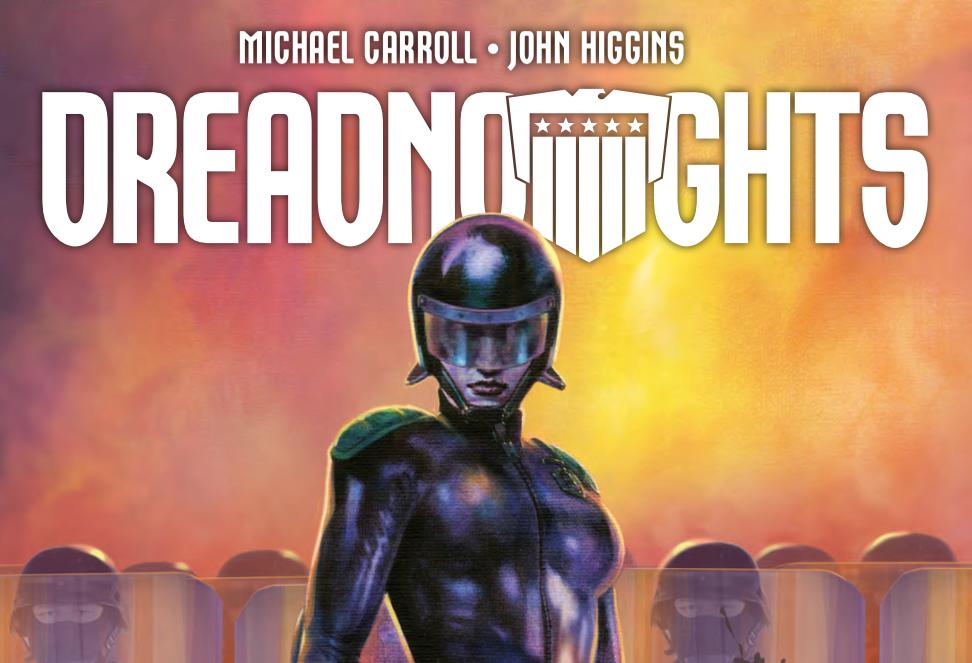
Review — ‘Dreadnoughts Book 2: The March Of Progress’ Is The Early Dreddworld Tale Of Democracy Falling
by Richard Bruton
Summary
In Dreadnoughts, Mike Carroll and John Higgins take us back, through the lens of the Judges, to the very near future to see one possible way America falls… it is nasty, it is brutal, it is quite brilliant… but it’s now horribly prescient. Couldn’t happen here? Well, time will tell. In the meantime, this is essential reading, hard-hitting, political, yet a fabulous couple of tales bursting with action and incredible artwork.
Overall
10/10When Dreadnoughts burst into the Judge Dredd Megazine with Mike Carroll and John Higgins showing us the world of Dredd as the first Judges hit the streets, it was a bludgeoning series that dealt with huge ideas – the surrendering of democracy by the USA, a capitulation towards a fascist dictatorship that we know full well from reading its results weekly in Judge Dredd. But it tackled these huge issues personally, close-up, showing us, quite brilliantly, what it would mean on the ground for all involved, citizens, law enforcement, the judiciary, politicians, by remaining tightly focused on a single new Judge rolling out on the streets of Boulder, Colorado.

>
Nothing’s changed with this second Book, we’re still in the earliest days of the Judges, just 11 years out from today, and the horrific ideas that it portrays, of an America walking into fascism and throwing away democracy really seems that little bit more understandable these days, doesn’t it?
After all, in the history of Dredd, all it took was a swing to the right, public disaffection with the way things were going, eventually heading towards the atomic wars, caused by a power-mad, unpredictable, and dangerous President. But of course, that sort of thing could never happen in modern America, could it?

Anyway, Drednoughts Book 1 was an incendiary look at the (Jack) boots on the ground, Carroll and Higgins doing brilliant work as they took us right into the societal change with Judge Glover as she dealt with a child kidnap, giving us something tight and thrilling, a perfect police procedural, all alluding to the bigger picture of a country undergoing horrifying changes.
All of that continues here in Book 2, as we follow Glover on another case, this time following the fallout from a crime blitz that leads to anti-Judge riots against the excessive use of force, something the Hemlock Cartel are all too keen to exploit.
The case is played out as a perfect police procedural thing, Glover and the Judges on one side, working the case, coming under threat from the Cartel, all culminating in a showdown where things get way too personal and way too close for comfort for Glover as we see her past coming back to haunt her.

.
‘The March Of Progress’ just rumbles along, the brilliance of it coming from that subtle mixing of the immediate of Glover’s actions and the overarching political changes going on in the background. It gets over so much to make you think about, but Carroll and Higgins never let up with the action, beautifully choreographed by Higgins’ artwork and brought to life by that gorgeous colouring of Hurst.
Once ‘The March Of Progress’ is done with, with possibly the end to Glover’s tale, Carroll, Higgins, Hurst, and Bowland take us into another situation, another of these prototype Judges roaring into another backwater American town to dispense this new and controversial Justice. ‘Nothing To Fear’ is just a four-parter, practically a vignette compared to that larger storyline of Glover’s, yet it still manages to do all that important and clever thing of showing us how the situation of the fundamental shift in American democracy being surrendered translates into individual moments, individual locales around the country.
It’s also jam-packed full of marvellous moments of dialogue (‘A few hundred innocent lives lost to potentially save hundreds? There’s no contest. It’s social chemotherapy.’). Tell me that isn’t a line that shocks as much as it impresses. And seeing it on the page, putting it in context, with Higgins and Hurst making it look this damn great… well, this is why Dreadnoughts is such an essential read..

.
I mean, just look at that page above from Glover’s tale in ‘The March Of Progress’ , how beautifully constructed it is, the way we have that left-hand side full page length panel that gives us a setting, a background, an awareness of what’s going on, before we drill down into the detail in the five-panels where Glover and Vine, a public defender right at the other end of the political spectrum to the Judges, trade barbs. It’s a page of exposition, giving us the story driver that sets everything that follows up, but Higgins’ perfect pacing and the way every panel looks so good never let you feel you’re simply being talked to. Quite brilliant storytelling going on, just as it is all the way through Dreadnoughts.
Now, if Glover’s tale is police procedural with a political bent, ‘Nothing To Fear‘, the short story of Judge Beckett, who comes rolling into that sort of typical American town and typical American tale, wouldn’t be out of place in a classic Western. It’s all about the way these small towns allow those willing to bend and break the existing rules to become all-powerful in these little fiefdoms. Here it’s one family who rule the roost, far too used to getting away with anything, any action, any crime. And it’s all done under the sight of the local Sheriff, another corrupted by power and willing, for too long, to look the other way, providing her own little kingdom is maintained.
Of course, when things go too far one night, coinciding with Judge Beckett rolling into town, it all goes south very, very quickly. Again, all against that backdrop of the new regime and what it means to those too used to the rules not applying to them.

.
But where Glover’s story is bigger and procedural, Beckett’s story is explosive and action-packed, moving quickly through the first two acts of every great Western where the lone cowboy rides into town and takes on the mission of cleaning up the place, and concentrating on that climactic third act, the one with all the shooting.
And this is where Higgins and Hurst amaze, taking Carroll’s simpler tale of ‘cowboy rides in and cleans up corrupt town, ending in a showdown with the sheriff’, and delivering page after page of meticulously, beautifully detailed, fabulously choreographed action sequences. So much so, as is the way I find myself reading, that I was so carried along with things that it’s only really on a second and third read that you realise the greatness of what the art is doing. The first time, you’re so enveloped in the action, so pulled along by the flow of things that the pages turn themselves, way too fast.
The story itself is no more than one of power corrupts and one man makes a difference, but it’s one of those stories where the execution is so well done that it’s something that feeds into the bigger picture, where you’re aware, almost subliminally, that all this is taking place against the huge societal shift in the era that the action-packed story takes place. It becomes way, way more than an interlude or vignette, ending up a magnificently done thriller that adds so much to the overall storyline.

.
In Dreadnoughts, Carroll, Higgins, Hurst, and Bowland continue to unfold something so clever, bringing the fictional history of a well-known world, Dreddworld, into sharp relief, showing us how what we know came about. It’s, as Carroll has always said, a horror story, not just something that lays the seeds for all that we know is to come to bring forth the world of Dredd, but something that Dredd’s world has always been about, a warning for us now, a vision of how things can all too easily, all too understandably go so wrong.
It’s a terrifying look at just how easily we could lose all that we hold dear, all our paper-thin ideals of freedom could be traded for the easy promises of a better tomorrow. This is perfect speculative fiction, up there with the very best of the genre. It’s brutal and it’s brilliant, writer and artists combining to give us something very, very special indeed.

Dreadnoughts – Book Two – ‘The March Of Progress’ – by Michael Carroll, art by John Higgins, colours by Sally Hurst, letters by Simon Bowland.
Originally serialised in Judge Dredd Megazine 456-461, 468-471
Published by 2000 AD & Rebellion on 4 December 2024
