
‘Lucky Devils’ #1 Is An Exposition-Laden Start To An Intriguing New Series
by Austin Gorton
Overview
Lucky Devils #1 struggles with having too much setup to do, too often rely on clunky exposition dumps to get info across. But the world it presents and the hook of its premise is nevertheless intriguing enough to result in a successful first issue.
Overall
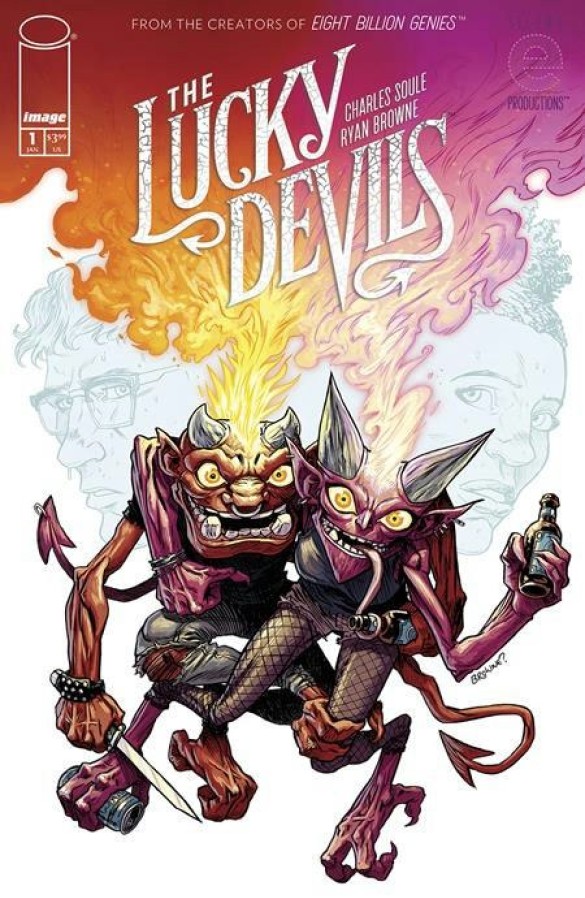
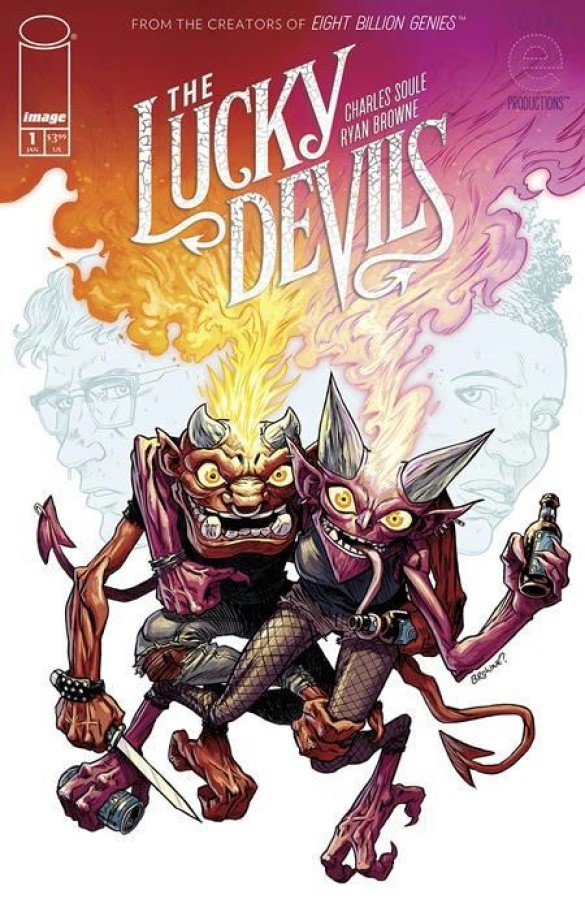
7/10The follow-up to writer Charles Soule and artist Ryan Browne‘s acclaimed Eight Billion Genies, Lucky Devils is a cracked-mirror version of a Pixar film. It is the story of Cam, a college philosophy professor with anger issues, and Starr, a hardworking nurse wracked with envy. But it’s also the story of Collar and Rake, the literal devils on Cam and Starr’s shoulders who break millennia of protocol to reveal themselves to their charges in order to upend the social and political structures holding them back from achieving a better life. Lucky Devils #1 lays all this out in a manner that is heavy on the exposition — sometimes to the point of tediousness — but which still manages to sketch in the outlines of its main characters and establish a thematic premise intriguing enough to make readers want to know what’s going to happen next.
The first half of the issue spends most of its time establishing one half of its core cast. Running in parallel, it presents a “day in the life” portrayal of Cam and Starr, with nary a supernatural or otherwise-outlandish element in sight. Instead, Soule and Browne paint effective portraits of the two protagonists as generally nice and well-meaning people caught up in the frustrating gears of bourgeois life. Neither is hard-up nor well-off, but each is struggling with challenges in their respective lives, exacerbated by specific character flaws: anger for Cam, envy for Starr.
In the course of these opening pages, each experiences flashes of those emotions which stick out in hindsight and because of Browne’s depiction of them. When Cam is struck by small incidents which spark his rage — his computer shorting out during class, discovering he has no money to pay for a date — Browne consistently renders him in shades of red, the backgrounds fading to emphasize the surge in anger Cam is feeling. Similarly, when Starr is driven by her envy to take action — pouring yogurt into the open window of her co-worker’s new Mercedes — she is awash in green light.

Only in the second half of the issue, after the story’s other two protagonists reveal themselves, do these pointed bursts of emotion take on a new significance. Collar and Rake are demons assigned to Cam and Starr and devoted to using one of the Seven Deadly sins to make them both more powerful and more terrible humans. Collar uses wrath, and Rake, envy, which makes the earlier instances where Cam and Rake’s anger and jealousy are visually highlighted examples of Collar and Rake doing their gremlin-like work to trigger those feelings.
All of this is laid out via exposition-laden conversations between Cam and Rake and Starr and Collar, drawn in parallel construction, with dialogue passing across panels as the two demons, from the reader’s perspective, finish each other’s sentences. It’s a clever visual technique that adds a little punch to a sequence that is otherwise one great info dump.

Less effective is the back half of the issue, as Lucky Devils #1 follow Rake and Collar back to Hell. One on the one hand, this is where the issue really starts to feel like a twisted Pixar movie, as it explores the inner workings of demonic society and its relationship with the human world, not unlike the way, say, Inside Out dramatizes and personifies human emotions or Elemental does the same thing with, uh, elements. Where it gets most interesting is the way it positions Rake and Collar as social revolutionaries, two beings stuck in the same mid-level water-treading spot in their world as Cam and Starr are in theirs, but who have made the decision not to accept their lot in life and work to shake things up. Which will require them to bring their humans along for the ride, kicking and screaming if need be.
Unfortunately, all of this gets laid out in the most direct way possible, with Rake and Collar simple saying it out loud to one another while sharing drinks on a rooftop. It doesn’t quite reach the level of one character saying, “as you know…” and then saying out loud the thing they just declared the other to know, but it’s not far off from that. The whole sequence is another massive infodump, but one lacking the visual panache of the earlier one.

That said, there’s still enough in Lucky Devils #1 that works to make it a successful first issue. The way it effectively and confidently establishes its central characters and the hook of the plot make up for the clunky, occasionally inelegant, exposition dumps. It simply seems like Soule had more setup than he could reasonably fit into one (even extra-sized) issue. Hopefully, with that work completed, future issues will be free to stretch out a bit more and rely less on direct infodumps.
