
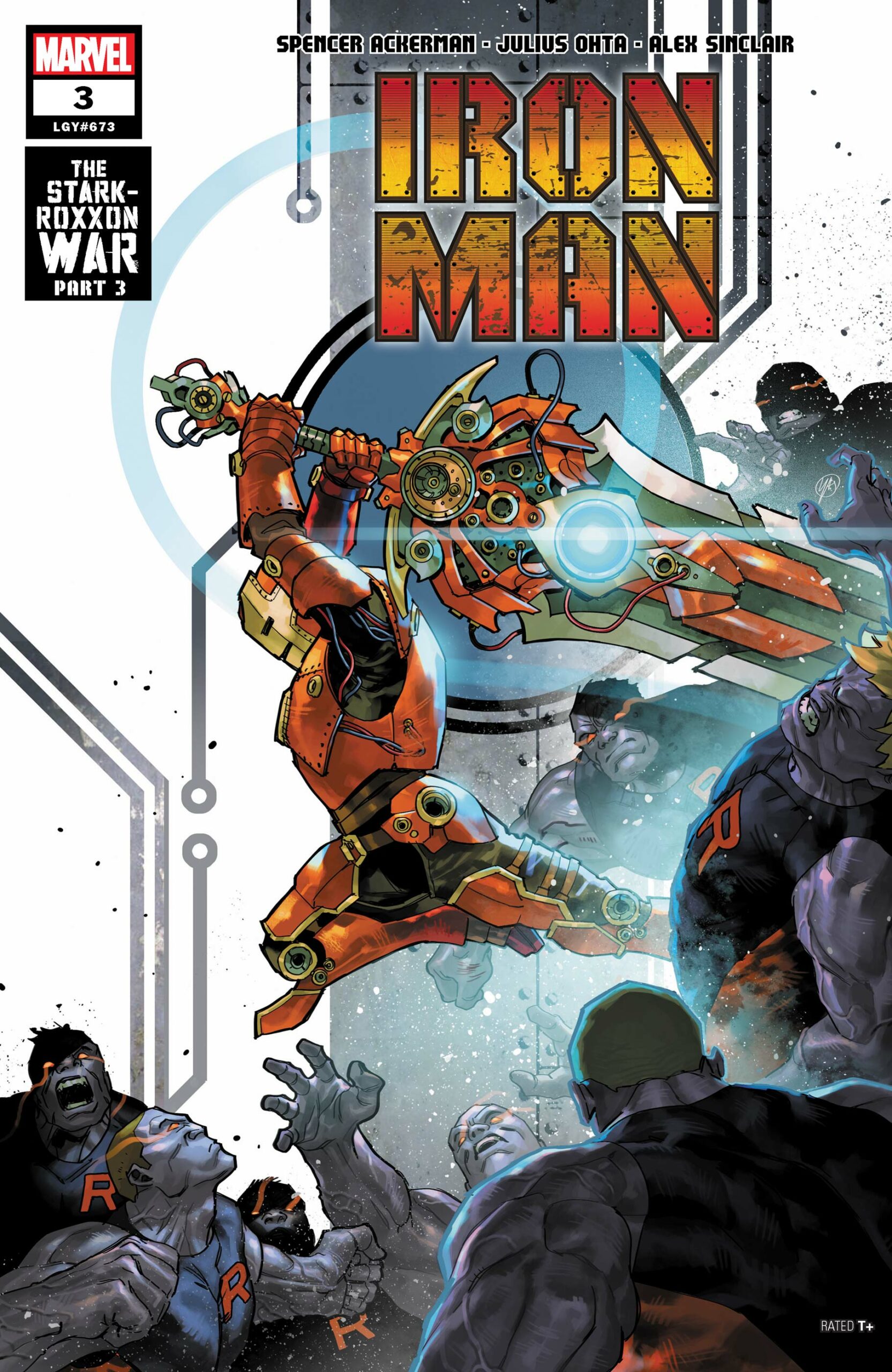
Review: ‘Iron Man’ #3 Proves The Pen And The Sword Are Equally Mighty
by Austin Gorton
Overview
Effortlessly toggling between sci-fi and fantasy, Iron Man #3 closes out the series’ first narrative arc by mixing and matching comic book and capitalistic violence to great effect.
Overall
8/10After forging magik-based armor and wielding a honking-big sword over the previous two issues, Iron Man #3 is the issue where the series goes full fantasy. It features Belasco and hell dimensions and corporate executives selling their souls. Yet, it’s also an issue which underscores the idea of superhero action as capitalism: the plot of this issue is a fight for control of a company, and that fight takes the form of both a literal superhero/supervillain battle, and the kind of business dealings that wouldn’t be out of place in the “real” world.
That tension — between an older, more fantastical aesthetic and a future-facing, cutting edge technological one, between violence delivered by fist (or sword) and by pen — is at the heart of some of the best Iron Man stories. This issue makes it clear that writer Spencer Ackerman intends to make it the centerpiece of his run on the series.
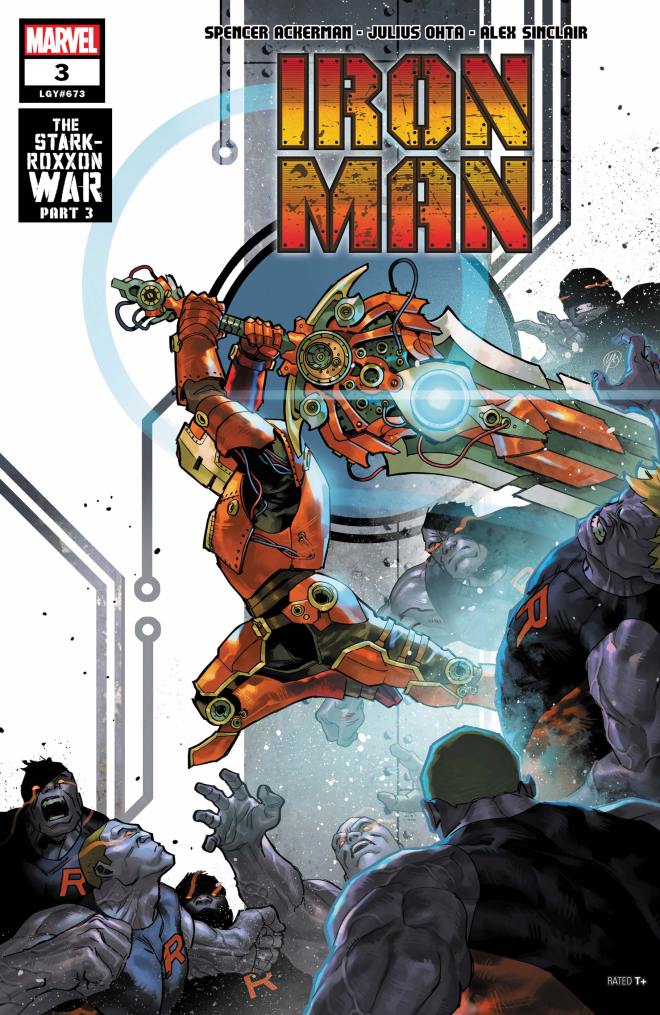
After resolving the previous issue’s cliffhanger in somewhat perfunctory manner (Tony defeats Force and races to the site of the Stark-Roxxon merger meeting in a scant few pages, all in the “cold open” before the issue’s title page appears), Iron Man #3 settles in for a back and forth battle between fantasy and sci-fi, hard and soft power, for the fate of Tony’s company.
Artist Julius Ohta‘s Tony, all long-haired, bearded and bedraggled, wearing makeshift armor held together in places by leather and cord, is a striking contrast to the (fashion) power-suit wearing board. The moment when a vote is called while Tony sits in a chair, power cables sweeping in from off panel to charge his armor (in a panel that evokes the cover to Iron Man (vol. 2) #1) captures the juxtaposition at the heart of the issue perfectly.

That juxtaposition continues, even after the more traditional bit of superhero violence as a recharged Iron Man battles Justine Hammer in her Iron Monger suit. The newly-created Stark-Roxxon — Starxxon — board is summoned by their silent partner to a hell dimension ruled by Belasco (the one-time ruler of Limbo and tormenter of the X-Men’s Magik, further carrying over Iron Man’s association with the X-Men from Gerry Duggan‘s earlier series). The setting shifts, from Iron Man in a boardroom to a boardroom in Hell. But whereas the previous sequence ended with comic book violence, here Tony “businesses” his way to victory.
The deal struck by the Starxxon board with the beings on a higher plane represented by Belasco requires them to manufacture and deliver some kind of MacGuffin drug that ruins peoples souls. Tony smartly reasons that evil on that scale will trigger an immediate response from the superhero community, himself — Iron Man — if not the Avengers, or more. And then he points out, in an almost winking fourth wall-breaking moment, whenever it comes to a battle between villains like Roxxon against superheroes like the Avengers, the superheroes usually win.
It’s a sentiment with which, when pointed out, the silent partners agree, and they back out of the deal. Thus, Tony retains control of his company, not because of his big sword or by punching someone a lot, but by smartly leveraging the realities of superhero business in the Marvel Universe.

It’s not a clean win — Justine Hammer walks away, taunting Tony with the knowledge that his company is still back in the arms trade, not an easy thing to extricate itself from. But it’s the kind of win that seems fitting for a conflict that is ultimately less about defeating the bad guy as it is outmaneuvering them. It also seems to mark the end of the first act of Ackerman’s story. The immediate threat of the Stark-Roxxon merger is resolved, but now Tony must reconcile those contrasting elements – fantasy and science, power hard and soft — to find his path forward.


