
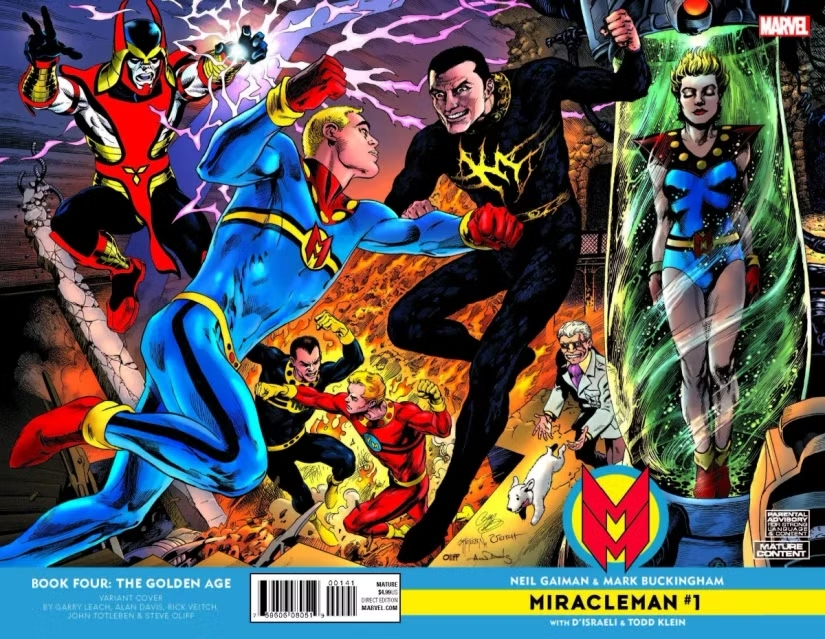
Art For Art’s Sake #298: Doesn’t Matter If It’s Miracleman Or Marvelman
by Richard Bruton
Welcome back to Comicon’s weekly round-up of all that lovely comic art out there on the internet. Well, not ALL the comic art, but you get the idea… it’s Art For Art’s Sake:

.
Another one of those Art For Art’s Sake where it started off being just a selection of Marvel/Miracleman art from here and there that I’d gathered up over time. And then, as always seems to happen, I get googling around for more art. And what was just the end of your usual Art For Art’s Sake ends up having so much art, so much rather damn good art, that it deserved an entry all its own.
If you didn’t know, Marvelman or Miracleman has rather a long and convoluted and difficult history. So much so that I’m not going into it all right now. Let’s just give you a brief summary…
First, let’s just say that it’s a really, really, really great story. Pure revisionist superhero stuff, bringing the super-type back into the real world and having them cope with the real world – and the real world having to cope with them. Marvelman was just a hell of a good book, great art from Leach and Davis, incendiary writing from Moore, iconic ideas that would shape superhero comics for decades to come. Through Moore’s three books, ‘A Dream Of Flying’, ‘The Red King Syndrome’, and ‘Olympus’, Moore and plenty of artists would shape a superhero and a world, all leading up to the inevitable conclusion of the world being ruled by the superhero. It really is impressive stuff now – but back in the early 80s, this was incredible and revolutionary.
It started out as a ‘replacement’ (or pretty much a straight copy) of Captain Marvel published by L Miller & Son in the UK between 1954 and 1963. Created by Mick Anglo, Marvelman was just the latest in the supermen trope of the times.

All was quiet until 1982, when Dez Skinn was looking for a superhero for Warrior, the iconic and revolutionary monthly anthology he was putting together. According to the tale, Dez was a Marvelman fan and thought it was in the public domain, so he brought Alan Moore onboard to create new adventures with Garry Leach on art. After Leach, Alan Davis took the artistic reins for the rest of Marvelman’s run in Warrior – ending halfway through the second book, The Red King Syndrome, in Warrior #21. Skinn blamed the halt on Marvel Comics taking legal action over the name, but the Alans, Moore and Davis had, in truth, had a bit of a falling out and because of what they all thought was the ownership structure – they thought it was split between Skinn’s Quality Communications, Moore, Leach, and Davis – without Moore and Davis agreeing to keep it going, nothing could be done.

After this, Skinn eventually found a home for Marvelman, now re-titled Miracleman to avoid those big Marvel lawyers, at Eclipse Comics in the USA. Retitled, resized, repackaged, and coloured, the now bi-monthly Miracleman kicked off with five issues of reprints in 1985, with new material written by Moore in issue #6, with new series artist Chuck Austen (then working under his birth name Beckum).
Yes. New material. Despite the previous arrangement that a continuation would require writer and artist consent. How had Eclipse gotten around this stumbling block? Well, it seems they didn’t bother getting permission and just went ahead with, one, reprinting Davis’ artwork, and two, ploughing on with Beckum regardless.
Delays and flooding at Eclipse meant the book had what was the first of many, many slipped deadlines, and Beckum was replaced by Rick Veitch to finish off Book Two. Finally, with artist John Totleben onboard, we had Book Three: Olympus in MM 11-16. It took a long time for the series to reach its conclusion, primarily caused by Totleben’s diagnosis of retinitis pigmentosa, making it possible for him to continue working on the title, just very slowly, with those six issues taking more than two and a half years.

And that was it, ‘Olympus’ done, Moore and Totleben walked away from Miracleman, with Moore passing the torch to Neil Gaiman and Mark Buckingham. They produced the new storyline, ‘The Golden Age’ – worldbuilding in the new Miracleman-built utopia, and then started the Silver Age – bringing back Young Miracleman, only to have that grind to a halt for so many years as Eclipse went into bankruptcy, leaving things up in the air.
There were then many, many legal things happening. Let’s just leave it there. But in 2009, new evidence showed that all this struggle over ownership that had gone on from the start of the revival was just pointless – Mick Anglo had always held ownership of Marvelman since 1954. That led to a deal with Marvel being struck, giving us the reprints of the Miracleman saga to date – this time back as Marvelman – although by now, Moore’s dislike of Marvel meant he only allowed the reprints if his name was taken off the book, hence why it’s listed as ‘the original writer’, and all his royalties went to Mick Anglo and his family.
Which brings us to now.’ The Silver Age’ finished recently at Marvel. Finished with something of a whimper, not a bang. Certainly not the crowning achievement so many had been waiting for for so many years. With recent events regarding Gaiman, the proposed third book of the Gaiman/Buckingham trilogy, ‘The Dark Age’, is unlikely to be released. Those recent events being that the author was accused by five women of sexual assault and abuse in 2024, all of which is ongoing and shrouded in legal disputes.
.Anyway… into the art, taking each Marvelman/Miracleman artist in turn…
Garry Leach


Alan Davis… (thanks to Lew Stringer)

Alan Davis


Alan Davis & Mark Buckingham…

.
John Ridgeway


.
Chuck Beckum / Chuck Austen


.
Rick Veitch


.
John Totleben


.
Mark Buckingham


Steve Dillon

Mick Austin


Nik Neocleous

Dave Gibbons

Dave Wachter

Mike Deodato Jr. and Jason Temujin Minor.

Fred Hembeck

Dale Keown

Marko Djurdjevic

Mico Suayan

Marv and Marvelman by Marc Laming

John Bolton

Grant Morrison
