
‘Viewing Life As A Timeless Whole: Talking ‘Blade Forger’ With The Miranda Brothers
by Tom Smithyman
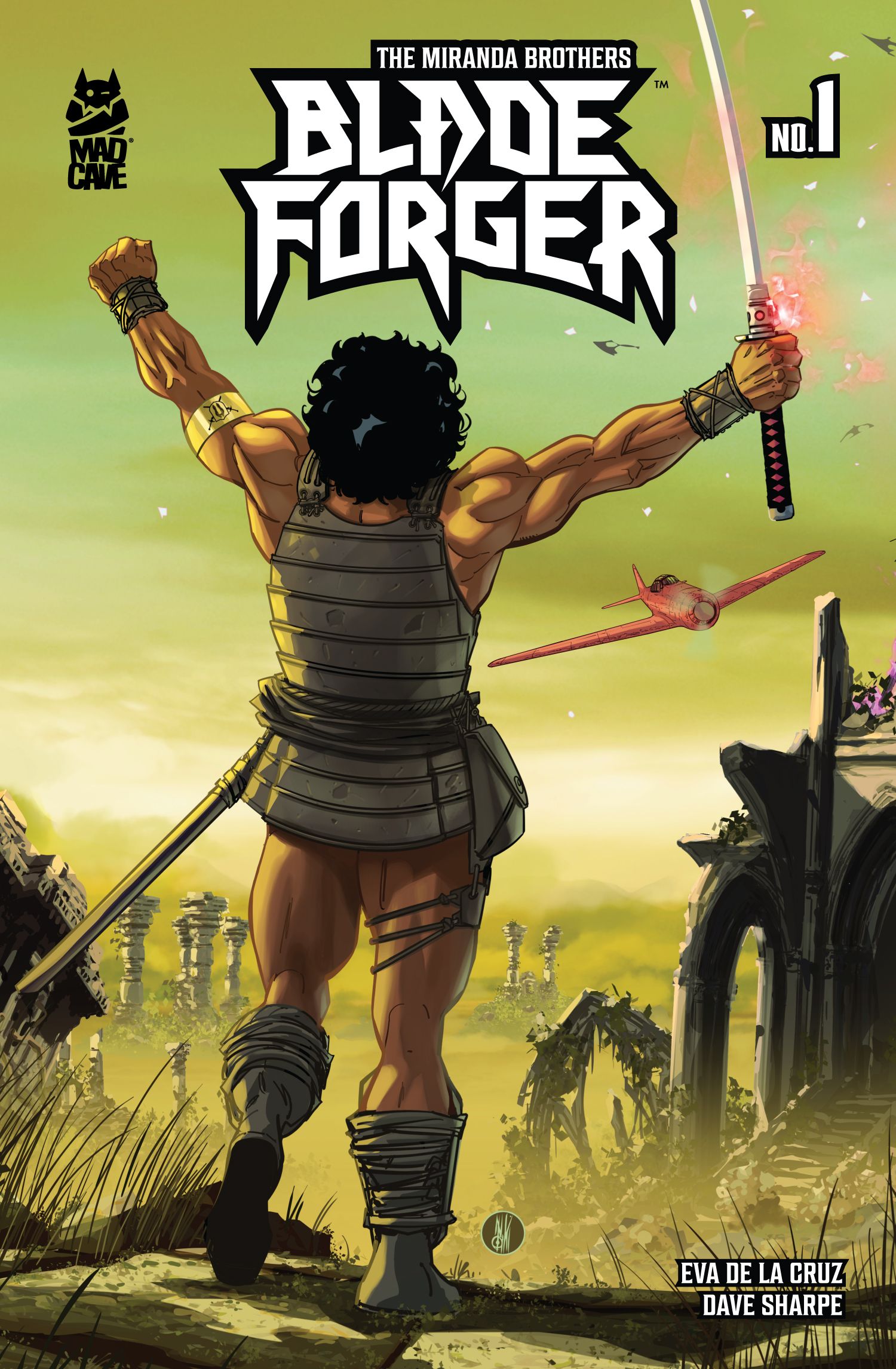
Next month, Mad Cave releases the first issue of Roy and Inkaki Miranda’s Blade Forger. The fantasy title features a young forger name Owada who challenges the emperor. Comicon.com discussed the new title with the brothers, who also talked about the questions the series raises as well as the nature of humanity’s true power.

Tom Smithyman: Without giving too much away, how do you describe Blade Forger?
Inaki Miranda: In a world where the discovery of a new and powerful energy source has led to deep social injustices and imperial oppression, a Blade Forger rises as the voice of the forsaken and makes a promise: to win the Tournament of the Five Rings, become the new emperor, and change the world.
It’s a simple and direct premise that seeks to answer equally simple and direct questions:
- “Can one person change the world?”
- “What happens when utopia is born out of necessity?”
Roy Miranda: A grand, long-form story set in an original and fantastical world that delves deep into the human conflicts that haunt us. It’s not just about battles in tournaments or mystical powers surrounding swordsmen and their blades. It’s about the real battles fought in the depths of our existence.
Yes, there is a tournament that determines the fate of an entire empire and the struggle to control a powerful energy source. But above all, this story is about family, sacrifice, and promises that must never be broken. It invites us to reflect on where humanity’s true power resides – whether in the edge of a sword or in the heart of the one who wields it.

Smithyman: The first issue is not told chronologically but rather bounces back and forth from the past to the future and back again. What challenges does that present you as writers?
Inaki: The challenge, I think, is making sure it all flows in a straight line, that the time jumps don’t feel like interruptions but like a natural progression. Each chronological shift should appear to answer a subtle question just introduced in the narrative, propelling the reader forward purely out of a hunger to keep unlocking doors.
To be honest, it all stems from a more fundamental challenge: how do we fit everything we need to tell within 24 pages? It’s like solving a sliding puzzle, where the essential scenes, panels, and the character’s timeline are the pieces that have to fall into place.
Roy: On top of that, this approach forces us to know our characters inside and out — to truly feel them. To understand someone, to grasp the reasons behind their actions and decisions, you have to reconstruct their life. You have to experience those moments that left a mark on their soul. Instead of viewing life as a straight line, we have to see it as a timeless whole.
Time has no beginning or end; it’s an eternal presence, and we move within it. Our choices change the direction of our gaze. Even after death, we remain present in the footsteps of those who once shared time with us.
To fully understand the characters of Blade Forger, you have to move through time. You have to search through their entire existence to understand their actions and accompany them in their decisions – and the consequences that follow.

Smithyman: Do you need to have the entire story mapped out before you start writing any specific scenes or dialogue?
Roy: Yes, we spent a lot of time talking about the story. A lot. When we first started building the world of BF, I honestly thought we’d never finish. It was so unique, special, and complex that we couldn’t start telling any story until we had fully shaped it.
Once that was done, scenes and dialogue began fine-tuning details, and new ideas emerged that enriched the story and its nuances.
Inaki: After [the brothers’ previous series] We Live, we had two options: either go for a simpler story or go all in and create something bigger, a vast world with its own rules and a huge cast of characters. We chose the latter!
What does that mean? It means that before we could define how a character would act or speak, we needed to be clear on the paths the world we created offered them.
And beyond that, we had to see where each path could lead – because every narrative path seeks catharsis, and catharsis has to be carefully built and nurtured so it can bloom in the reader’s mind. Scenes and dialogue are just pieces of that journey. With Blade Forger, we’ve given ourselves time. We want to lay down each piece with care and patience. We’ve planned a very big story.

Smithyman: This issue deals a lot with faith. Is faith something that is important to each of you?
Roy: If we understand faith as the ability to bend beliefs and overcome what stands in the way of utopia, then yes. In our family, faith is an internal force that refuses to acknowledge words like “impossible.” We were raised by two parents who exemplified the Pygmalion effect in the best possible way. They always told us, “You can.” And without a doubt, that mentality is woven into Blade Forger.
Inaki: Yes, I remember, when we were kids, our dad hung a big sign over our bedroom door in which he wrote, in three languages, the words: “I CAN. YO PUEDO. JE PEUX.”
One of the hardest things in life I think is learning to balance one foot in the logic of intellect and the other in the intangible and mystical realm that fuels our emotional existence. The language of faith is emotional, intuitive, and silent.
The intellect can deceive you because it operates in a world full of noise and pre-built pathways. To me, faith is the path that purifies and clarifies, that overcomes intellect and fear. We live in reverse – we allow our emotions to be shaped by our pre-established intellect, when faith seeks to do the opposite. Faith is the intuitive and vital resolution of a frustrated equation.
Smithyman: You two have a fascinating history because you come from very different creative backgrounds. How does that play out when you are writing together?
Inaki: I think we make the perfect duo because we’re unpredictable to each other. It happens all the time – one of us throws out an idea without realizing he just opened an important door for the other. And vice versa. Or one of us has seen a movie or read a book the other hasn’t, which then leads the scene we’re working on in a direction neither of us expected.
For whatever reason (and it’s hard to analyze), our minds use different, uncontrolled methods to arrive at ideas. I’m constantly amazed by Roy’s spontaneous freedom when coming up with a concept or a plot twist. My mind, on the other hand, works more from a place of depth and detail. I analyze everything thoroughly, which ensures the idea’s solidity but sometimes turns into an obsessive tunnel. Roy often snaps me out of that tunnel with an idea that feels like a slap in the face – one that realigns my perspective and opens up possibilities. Like opening windows to let out stale air.
I dig deep tunnels. Roy opens wide windows. My tunnels sometimes need to come up for air. Roy’s windows sometimes need shutters to keep the wind away.
Roy: Being able to create a story and world this rich and original is only possible because we both sharpen our creativity from different angles. It expands the range of ideas and helps us push through roadblocks. I admire my brother’s creativity, and I can trust his ideas blindly when I falter.
When I was a kid, I watched a lot of WWF (in Spain, it was called Pressing Catch). I like to think of the Miranda Brothers as a wrestling tag team, each with their own strengths and special moves. Different yet complementary. When one of us is down, we tag the other in, and the fight continues.
Being brothers helps a lot. Even when we disagree, we enrich each other’s perspectives. We’ve spent our whole lives talking, debating, arguing, and sharing references, books, movies, and ideas. That’s created a unique wavelength between us.
There are ideas I can only reach when my brother’s mind is right next to mine.

Smithyman: Inaki, what is your artistic process like? Do you two discuss the visuals as part of the scripting process or are you on your own at the drawing board?
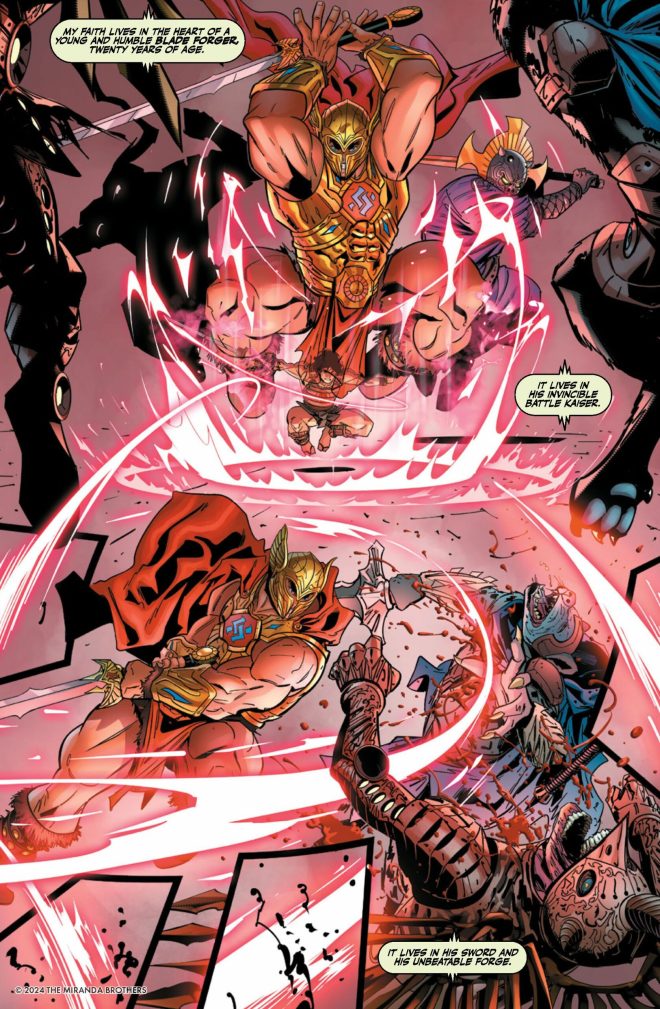
Inaki: Here, my brother lets go of my hand — this is my domain. Our finished scripts contain very little visual description. They focus on action and emotion. A simple “small red airplane” might be the only visual note in a panel description. But when I sit down to draw, that plane might turn into a Japanese Mitsubishi A6M fighter.
Visual language needs the freedom and intuitive spontaneity that only comes when you’re actually drawing the page – just like writing needs that same freedom to shape a scene’s emotional outcome.
Smithyman: This project is clearly important to you both. What makes it so special?
Roy: These first five issues are just the tip of the iceberg. There’s so much to explore and discover that all we want to do is keep pushing forward and tell the story all the way to the end. I don’t want to reveal too much or spoil what’s coming, but what lies ahead for Blade Forger is something truly big.
Inaki: It’s also important because it’s our second original creation, after the success of We Live. As our next step, it means a lot to us. We spent four years crafting these new pieces — it was crucial for us to create something very different while still preserving the signature touch we hold ourselves to in all our work.
It’s so special that what was originally supposed to be just the first five pages of the story ended up demanding more space, eventually becoming what is now the first five issues. When your characters demand their own room to grow, that’s when you know you have something truly special in your hands.

Smithyman: Roy, you’re a hip-hop singer. Can you give us a short rap to promote the book?
Roy: This is unexpected. Okay, here goes. If a Blade Forger character were a rapper (anything is possible!), they might say:
“Give me the sword when I drop the mic
I fight to be the best, training day and night,
I’m the chosen one on this quest,
Unbeatable across the empire.
My name on the fanatic’s lips. The crowd’s favorite.
Epic state of mind.
I rock the forge, master of codes and the mystique.
In the fifth ring, bet on me. Don’t believe the hype.”
Inaki: We’ve just witnessed the birth of a new character! We told you, this world is huge!
Smithyman: I can’t imagine how to follow up with that so we’ll leave it there. Best of luck with Blade Forger!

