
Christopher Priest Talks “The Long Night” Of ‘Vampirella’ And More
by Anton Kromoff
Welcome to the table,
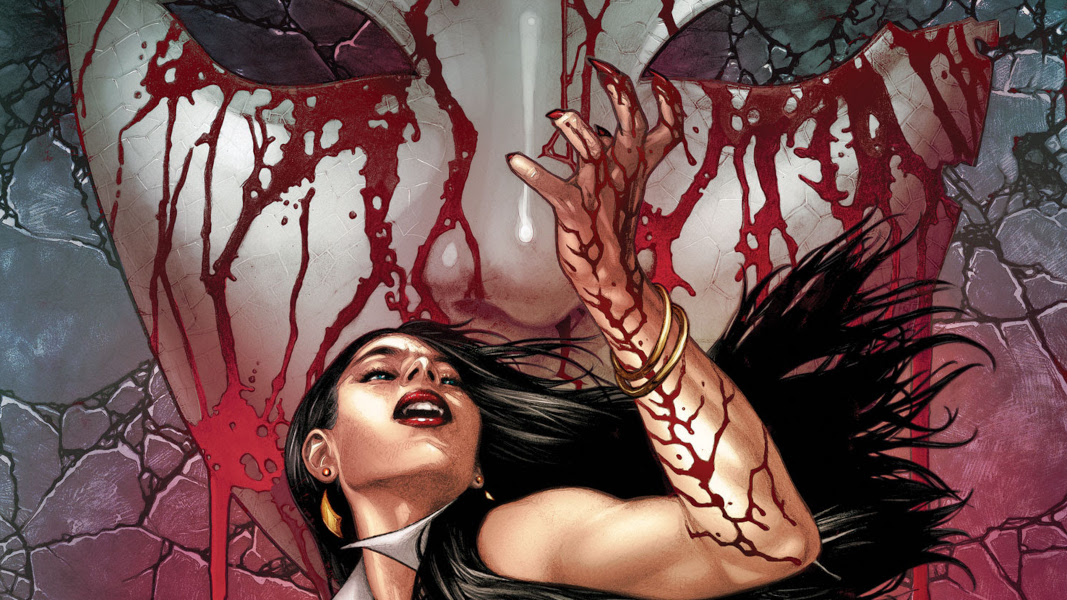
A little bit back, Dynamite Entertainment announced the next chapter of Christopher Priest‘s run on Vampirella launching this March. The new story — titled “The Long Night” — has Priest reuniting with artist Ergün Gündüz, and is setup to take readers on a duel path adventure set in both the present and a far -lung future where the Vampire nuclear apocalypse has been kicked off. The whole thing is thick with emotion and turmoil giving such a rad depth to a character that I have heard so many who have never read the title dismiss.
I got a chance to sit down with Priest and talk about the upcoming series, you can find that interview below.

Anton: Hello, Christopher, I really appreciate you taking the time to sit and talk with me. You have this amazingly brilliant career as an author, creator, musician, minister, and a slew of other things. Your name is spoken openly and behind closed doors, at least in the rooms I don’t roll out of, with the utmost respect and fondness. It feels almost silly to ask this but just in case we have some new readers who do not yet know who you are, could you please tell us a little bit about yourself, sir?
Christopher Priest: Hey Anton, thank you for having me. What can I say about myself? I’d say I’m a creative person who has been very blessed to survive nearly a half century in a challenging career!
A: This newest chapter in the legend of Vampirella sees her infant son finally being returned to her after being stolen by Vampi’s evil twin Draculina. When she had her son stolen, her whole vibe changed, turning into less of a do-gooder and more of a mother wracked with rage and grief and hell bent on getting her son back. That story had a really unique tone from what we had seen before in Vampirella comics. Will having her son returned also come with a tone shift for the story and the character?
P: I imagine our new volume, which begins with a new number one, will actually bring closure to this long running plot thread which began with Vampirella’s “wedding” to Dracula at the conclusion of our previous volume, issue number 25.
Through several miniseries, beginning with Unholy, bridging across our Year One miniseries, and finally into Vampirella: Rage, we’ve been able to explore in some detail a kind of wish fulfillment for Vampirella. She wants what we all want: community, purpose, love, family. If you think about it, she’s really just a single girl trying to make it in the big city, which makes the character’s personal story arc universal.
Our new launch becomes a cautionary tale about wish fulfillment. If you have children, or if you know anyone who does, then you have some idea of the immeasurable impact bringing a child into your life has. I have seen this portrayed in popular media only rarely. Usually, the characters welcome their happy new addition, who rarely makes noise or craps on himself or demands constant attention and has virtually no impact on the show’s status quo. Everybody is happy and life goes on as usual. The baby is usually somewhere off stage, sleeping peacefully or playing with their toys. Which, of course, bears absolutely no resemblance to the actual trauma, the atomic mushroom cloud, a new baby effects on a household. Everything changes, nothing is the same, and nothing bears any resemblance to TV babies.
The other big problem is, once the TV people get married and have a baby, well now you’ve written yourself into a dead-end cul-de-sac. Soon as Jeannie married Major Nelson, the audience lost interest. Tabatha, on Bewitched, was a little less harmful, but then they switched Darrens on us and added a baby brother.
“The Long Night,” which begins with our new number one, presents us with a bunch of challenges: How to finally resolve the story arc of Vampirella’s domestic adventure in a credible way and without driving into the dead end.

A: What role does motherhood play in reshaping Vampirella’s identity as both a character and a supernatural being?
P: I think most people who are not mothers look at motherhood through benign, rose-colored glasses. As a result, we tend to become observational and ultimately judgmental when our moms come up short. Motherhood involves a complex series of variables and imposes enormous stress on the caregiver. In this new story, Vampirella runs headlong into all of that.

A: The story is going to see this mysterious figure named Cicero arriving on the scene who claims to be Vampi’s son and has traveled back in time from a dark future where Vampirella, after being consumed by bitterness, has unleashed a nuclear holocaust. While Cicero may or may not actually be her son, it does feel like this dark future is something that has been hinted at in past issues of your run on the series. Are we going to be getting glimpses at the foretold “Long Night?”
P: “The Long Night,” first mentioned way back in our Volume 5 issue #2, implies a kind of Vampire Armageddon. Because we are comic book creators and comic book fans, we can assume there will ultimately be wiggle room as to whether this is an actual future or just a possible one. I think the likely harm Vampirella is most eager and best motivated to prevent is what apparently happened to her child, and the estrangement 2069 Vampirella suffers.
Every child begins their journey as perfect human beings. It is only environmental and personal circumstance that ultimately define us and in many cases damage us along the way. The adult Cicero is a man who has suffered the loss of his own humanity, despite his mother’s best efforts to prevent that from happening.

A: With “The Long Night” being described as a kind of “Ragnarök” for vampires and news that your working title for this run was, “Season of the Witch” — emphasizing Vampi’s possible transformation into the Witch of Ashthorne — there seems to be a rich layer of symbolism at play. Does the name “Ashthorne” intentionally reference ash trees and their associations with life, healing, and rebirth, or even the world tree Yggdrasil? How does this symbolism tie into the themes of the story and the broader journey you’re crafting for Vampirella?
P: Well, you’re way smarter than I am. Ashthorne refers to a location established in our Sacred Six spinoff series a few years back. It is a kind of green zone for vampires, where they live in peaceful coexistence with humans.
2069 Vampirella is like a vampire version of Eva Peron, an allegedly benign authoritarian figure who has seized control of the levers of power mainly because she was just sick of how we humans were screwing up the planet. Of course, in order to a mass that level of control, you have to do quite a bit of damage.
It is worth mentioning that I wrote all of this long before the 2024 election. People may tend to read some political agenda into the story arc, which I find a little unfortunate. Crazy how life tends to imitate art. Just understand that, whatever it is you’re reading today was likely written at least a half a year ago.

A: Now, you’ve spoken about conflict in comics being more compelling when it isn’t solved through violence. Does that philosophy manifest in this series?
P: My writing typically contains very little violence. Not that I am anti-violence, but I am anti-hackery. I am so bored to death with the contrived, stupid fights. Let me ask you, when was the last time you were in an actual fistfight? When was the last time you were in a car chase? I realize that’s kind of what we’re selling, but it has become cliché to the point of, in our business at least, the word “action” literally meaning violence.
Action can take all manner of forms, and I personally think our business has lost its way a bit to the extent that the fascination we had as children with colorful heroes using their superpowers in creative ways to resolve conflicts has been replaced by Hulk Smash. Now, mind you, I’m into a bit of that Hulk Smash myself. But it tastes best when it is earned; when it is not just superhero porn.
Also, when you’re dealing with vampires, our version of that is the neck bite. Dracula was never about punching or chasing anybody.

A: Mental health has long been a part of your Vampirella stories, going all the way back to her early couch conversations with Dr. Chary. What led you to explore such an intimate and human experience within this supernatural superhero framework?
P: I think that, at their core, our superhero characters are really only human and subject to the same stressors as the rest of us. Tom King explored this idea over at DC.
One of my models for my take on Vampirella is Casper the Friendly Ghost. Casper wants what we all want; friends, community, love, purpose. The only problem is, Casper is a dead baby. And, as soon as people realize that he’s different, that he’s an immigrant, or he’s black, or he’s trans, they scream and run away. And it breaks his heart every time.
Vampirella is not as naïve as Casper. She’s smart enough to not reveal her true nature because frankly we can’t handle it. This speaks to our shortcomings, our ignorance and intolerance, that the very people she routinely risks her life to save would immediately turn on her given the chance. But those who are aware of her special nature tend to want to exploit her to one degree or another. Her chief exploiter is her mother, who is marginally and lovingly based on my former mother-in-law, whom I adore but who is an inexplicable mystery. The most unique relationship in the book is that of Vampirella and her mother, who is at times Vampirella’s greatest foil and other times Vampirella’s chief defender.
Lilith, Vampirella’s mother, is a character that is not easy to define or pigeonhole, which makes her so much fun to write. Vampirella begins her journey, with this new issue one, desperate to keep her newborn son hidden from her mother because she does not want Lilith to screw up Cicero the way she screwed up Vampirella. However, by isolating herself, the traumatic impact of her sudden motherhood becomes overwhelming. That’s a rich emotional vein to mine. Unresolved postpartum depression can and often does lead to dire repercussions.

A: For new readers, is this series accessible as a jumping-on point, or do you recommend revisiting prior arcs in your run? If so, what issues should they pay attention to to get up to speed?
P: Vampirella is yet another book assigned to me that is the kind of comic people don’t read because they assume they know what the book is about. Deathstroke was a constant sales struggle because people assumed it was about this bloodthirsty homicidal maniac. Deathstroke was actually a book about the World’s Worst Dad, about a man’s struggle to reclaim his own lost humanity. It was a far more nuanced proposition than Hulk Smash.
Similarly, most people who have never read Vampirella assume they know what the book is about; salacious, juvenile soft-core porn for basement dwellers. Now, I wouldn’t speak for everybody, but my take on Vampi is, as was my Deathstroke, much more nuanced and complex; a book about a real woman working to find her place in a world where everyone alternatively loathes her or seeks to exploit her. Artist Ergün Gündüz’s work is brilliant and we’ve done some really terrific things together that far too many people have passed on because they think they know what we’re about.
You don’t actually have to know anything at all about Vampirella. Our issue one begins very simply, following Vampirella on an average day in her life, establishing her status quo and introducing her main conflict. Her baby had been stolen from her immediately after birth, so she never had time to bond with him. Now reunited, the baby is a stranger in her home, a helpless soul who needs her attention 24/7.
She doesn’t love him, at least not yet. She doesn’t know him at all. And, if you know anything at all about babies, you will hopefully have some appreciation for just how much work caring for them is and how heavy a lift being a mother is. Now factor in the fact that Vampirella has not bonded with this child, and you have an emotional crisis of some proportion. Even if you’ve never read Vampirella and know nothing at all about the character, you should be fine. However, issue #675, the issue which immediately precedes this new volume, is a done-in-one primer on the character and her world, and should properly arm you for reading the series.

A: The series is building toward a milestone 700th issue. Did the weight of such a legacy influence your creative decisions?
P: No, actually. My creative decisions are more or less dictated by the characters themselves. Once you’ve been writing a character for a certain amount of time, they actually start speaking to you. They start telling you what they would do, where they should go, what would challenge them in their journey.
The Vampirella character has so much untapped potential, there are so many different ways you can go with this character and so much depth to explore, that it becomes more a matter of winnowing those choices to which I think I would work best. If you check out Vampirella Year One, we did a couple of stories with Vampirella as a homeless child, abandoned after her mother was captured and banished. There’s a series in that, something I’d love to do. The problem is, how do you sell “Kid Vampirella”, a little girl who drinks blood to survive, as a kids book? Who would buy that? Adult fans buy Vampirella to one extent or another for the intrinsic sensuality the series explores. Obviously, Kid Vampi would lose that. Later in our Year One series, we had a couple stories of Vampirella’s coming of age, Smallville Vampi. Her first flight, her first love, that was all very exciting for me and there are years of “Vampirella Girl”, a Superboy variant, stories we could tell. But again, we would need to compromise much of the rationale Vampirella fans have for buying the book. Vampirella 2069, our future-state Eva Perón Vampi, is yet another iteration of the character that could conceivably have legs. She is very different from the heroic Vampi of our series. I was actually thinking about Tom DeFalco’s Arno Stark to some small extent from Herb Trimpe and Barry Windsor-Smith’s Machine Man. In any case, it would certainly be nice to make it to issue 700. I’m grateful Dynamite has invited me back. In this business, a long run is a real luxury. Books get canceled very quickly, and it really does take time for writers to get to know their characters and to get them dialed in properly.
Look at the pilot episode of your favorite TV show and you’ll see what I mean. The actors don’t quite have it down yet, the haircuts look weird, everyone’s talking wrong. The longer you write these characters, The more alive they become, and ultimately the characters start dictating the story and the narrative moves along in a much more organic way. I can’t promise we’ll make it to 700 or that I’ll be still on the book when we get there, but I sure hope so!

A: As a character who has existed for over 50 years in publication, why do you think Vampirella continues to draw readers in and maintain relevance in the ever changing pop-culture landscape.
P: I actually don’t know how to answer that question. 50 years ago, there really wasn’t anything like her. I’m not actually sure if Elvira was out before Vampirella, but Forrest J. Ackerman’s satire, which is what this is, was a fanciful bit of business I doubt most people gave a lot of deep thought to. For better or worse, I’m a guy who thinks very deeply about literally everything. Read page one of my Black Adam #1 and you’ll see what I mean; my taking a fairly silly Fawcet character and turning him into Hosni Mubarak.
So, later I read Josie Campbell and Evan Shaner’s New Champion of Shazam, wherein Mary Marvel (silly that we can’t call her that anymore) gets promoted, and that book is so much better and a much better fit for the Fawcet characters. Similarly, does Vampirella need the level of depth I invest in the series? Is that even appropriate, given Ackerman and Archie Goodwin and Steve Skeates’ more fanciful original works? It’s a fair question to ask.
Beyond that, my assumption is Vampirella is … fun. It’s Betty Paige with fangs. How could you not love that?

A: What do you hope readers will take away from this storyline, both in terms of its emotional resonance and its broader implications for Vampirella’s legacy?
P: I’d imagine first and foremost we would realize the potential power of this character. The fact she prefers to work a day job and live a fairly normal life, as normal as a space vampire can, is a testament to the character’s intrinsic goodness. What “The Long Night” demonstrates is the character’s actual potential for good and evil, the unspeakable damage on an unimaginable scale a single person is capable of, something we are ironically, seeing played out in real time today.

A: Looking ahead, do you see this storyline as a definitive turning point in Vampirella’s legacy, and if so, in what ways?
P: Definitive? That’s difficult to say. I’ve learned the hard way that the minute I am no longer on a book, the next writer can, and frequently does, come along and invalidate everything I’ve done. Which is really insulting, and it happens way too often. Just, poof, oh, all that stuff never happened. Very annoying.
A: Before we wrap up, I wanted to thank you again for taking the time to talk with me. Where can our readers keep up with you and the projects you are working on?
P: I am actually not on social media. I have a website that I kind of abandoned a long time ago because I just don’t have the time to work on it. Please forgive the old code and pages which may or may not still work. It’s at christopherpriest.com.
Beyond that, there are several new projects coming, including a new graphic novel for Dynamite we’re all real excited about, as well as unannounced projects from Marvel, Humanoids, Skybound, and others.
 Anton: Thank you again for taking the time to talk to me today. I truly appreciate it.
Priest: Great chatting with you. Thanks!
Until next time, you can check out Vampirella #1 (#676) at local comic book shops in March 2025.

