
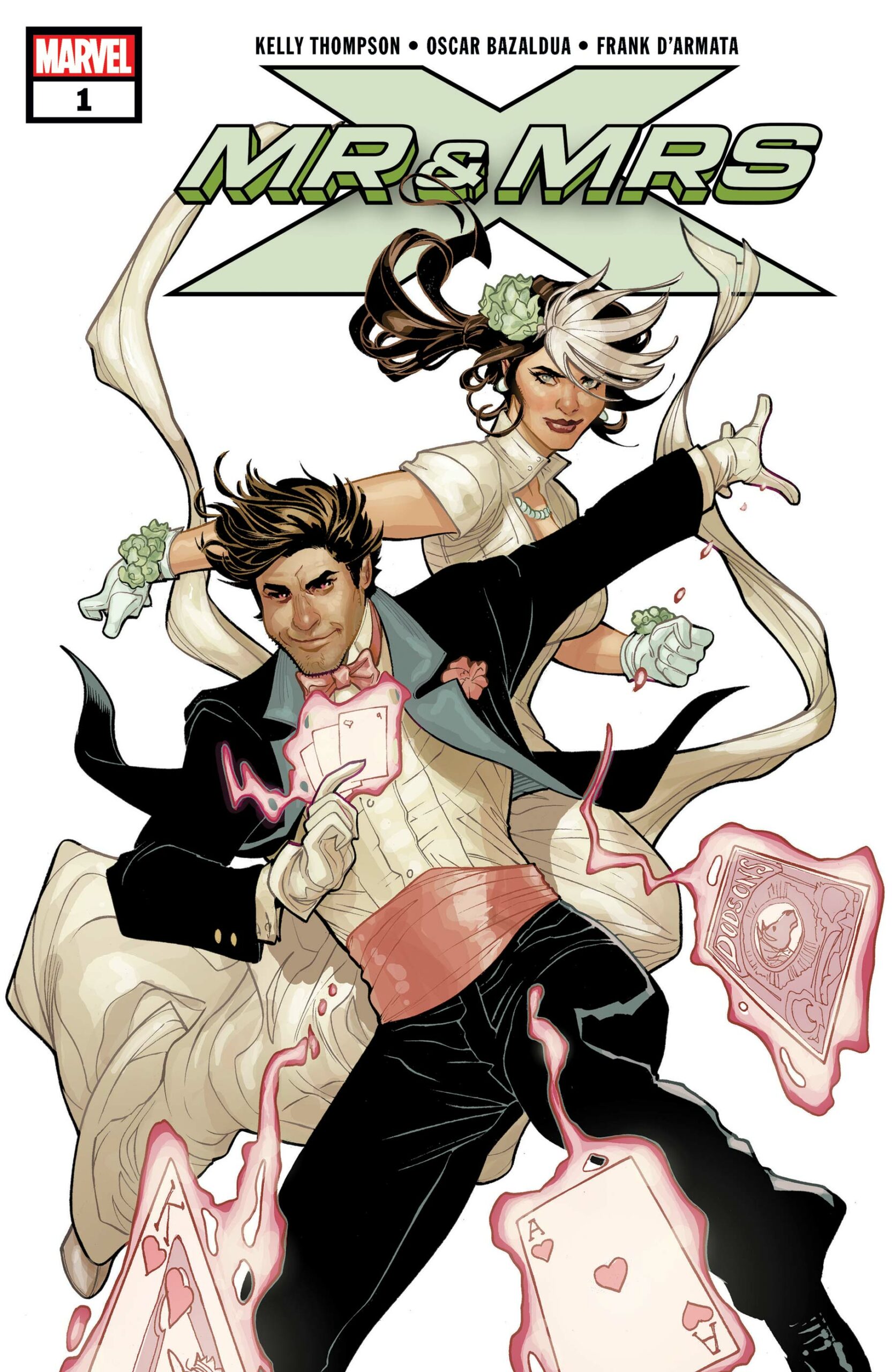
Comic Couples We Love: Rogue & Gambit Are ‘Mr. & Mrs X’
by Austin Gorton

I’ve never been the biggest fan of the Rogue/Gambit relationship. Sure, when it was running hot in the early 1990s X-books and I was an angsty teen, the romance between a woman who couldn’t be touched and the skeezy thief whose heart she stole seemed a tragedy on par with Shakespeare. But the older I got (and yes, got married myself), the more their long drawn out will they/won’t they relationship felt like a case of “shit or get off the pot”. All of that changed, however, in Mr. & Mrs. X.
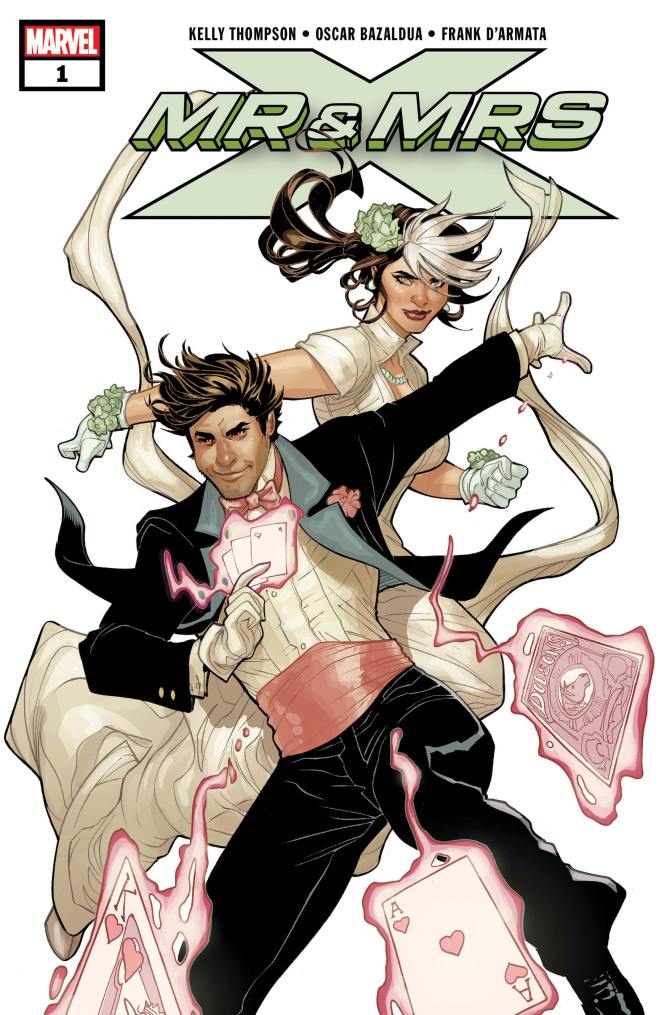
There is a generally accepted notion in serial fiction that the moment two characters get together as a romantic couple — especially when they marry — both the romance and the drama die, and they become harder to write. Kelly Thompson and (chiefly) Jan Bazaldua‘s Mr. & Mrs. X is the series that puts that notion to lie. [Ed. Note: If you’re confused about the artist credit on the cover above, Bazaldua transitioned around the time she was drawing this series.] Launched in the wake of Gambit and Rogue’s late 2010s marriage (which came about after Kitty Pryde smartly left Colossus at the altar after the X-books spent a few months teasing a big X-wedding), it follows the newlyweds as they settle into married life.
Which of course means a honeymoon interrupted by the Shi’ar and the birth of Professor Xavier’s daughter Xandra (it’s…a whole thing), a “try to avoid the sales slump of a #2 issue by featuring a popular guest star” appearance by Deadpool, a cross-genre battle with Mojo, and more “T’ieve and Assassin Guild” New Orleans-based nonsense with the External Candra.

Through it all, Thompson centers Rogue & Gambit as a loving, sex-positive married couple. There is drama and stakes: Rogue spends much of the series dealing with changes to her powers, Gambit with his conflicted loyalties, to his wife, his blood-family, and the X-Men, while the Xandra story basically serves as a high-octane, alien-filled version of one of those “do we want to have kids? Let’s see how it goes taking care of this kid who is not our own!” stories into which newlywed characters inevitably get drawn. But none of that drama or those stakes are developed at the expense of the married couple’s relationship.
They argue, they disagree, but remain free of the kind of “the angst, the fist-clenching angst!” turmoil of their earlier stories. Gambit and Rogue are entertaining as themselves and as a couple, the stories are not lifeless conflict-free affairs, and the status of their marriage is never in doubt. Anyone who says stories about married characters are boring simply aren’t trying hard enough (or much at all).
Thompson is joined on most issues of the series by Jan Bazuldua, one of the best in the biz when it comes to facial expressions. Channeling Oliver Coipel a bit, she brings a sleek, sexy visual palette to the series, one perfectly suited to the kind of high adventure stories starring attractive people ridiculously in love with each other that she and Thompson are crafting. Issue #7is a particular highlight. With Gambit and Rogue trapped by Mojo, the pair are forced to work their way through a series of stories based on different genres of storytelling. Bazaldua effortlessly shifts her style from film noir to Western to fairy tale and more.

Ultimately, Mr. & Mrs. X came to an end with its 12th issue, caught up in the linewide revamp of House of X/Powers of X and the start of the Krakoan Age. Yet its legacy as a vehicle for a happily married Rogue and Gambit who can still star in exciting, dramatic and action-packed stories without a will they/won’t they component or other forced relationship drama, lives on. The pair were minor but recurring fixtures together in Tini Howard’s Excalibur, and Gail Simone’s depiction of their relationship in the current Uncanny X-Men book is one of the rare examples of Simone getting the characterization right in that series.
Most importantly (for me), Mr. & Mrs. X lives on in my heart. It is the series that finally made me fall for Rogue and Gambit as a couple after decades of repetitive false starts, tragic misunderstandings, and convoluted love triangles. And it stands as an example that when it comes to serialized storytelling, marriage doesn’t have to be a death sentence for exciting and engaging stories featuring two characters who love one another and finally get to be together.
