
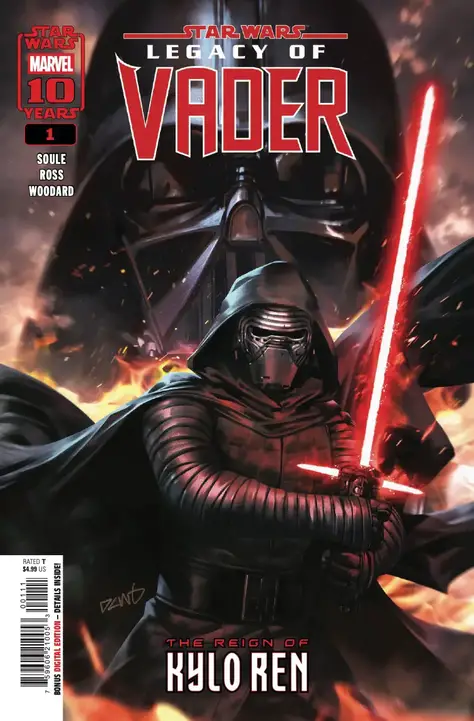
Review — ‘Star Wars: Legacy Of Vader’ #1 Is A Strong, Character-Driven Start To The New Era
by Austin Gorton
Summary
The first issue of the new era of Star Wars comic publishing, Star Wars: Legacy of Vader #1 is a relatively quiet, character-focused kickoff. But by staying zeroed-in on Kylo Ren throughout the issue, Charles Soule and Luke Ross turn in a compelling and visually-engaging presentation of that character that makes the comic a resounding success.
Overall
8/10With the Star Wars: The Battle of Jakku maxi-series wrapped up — and in the wake of the celebratory Star Wars: A New Legacy — Star Wars: Legacy of Vader #1 marks the first issue in the newest era of Star Wars comics publishing. While the previous eras (the first of which began when Marvel re-acquired the comic book license ten years ago in 2015, and the second of which in 2020, when the “main” Star Wars book jumped into the post-Empire Strikes Back, pre-Return of the Jedi period of time) were relatively self-contained, creating little clusters of titles set in roughly the same time periods, this third era is poised to be more chronologically expansive. Legacy of Vader is set in the Sequel Trilogy era, between the second and third installments. The forthcoming Star Wars: Jedi Knights will be set in the Prequel era, while the next main Star Wars title will pick up where Jakku left off, and bridge the gap between the Original and Sequel Trilogies. As such, Legacy of Vader #1 is neither a sweeping statement of purpose for the line nor is it particularly expansive in its specific narrative goals (Kylo Ren is the main character, and receives 90% of the dialogue and attention). Nevertheless, it is a well-crafted issue that makes for a strong start to this new era of Star Wars comics publishing.

Picking up in the wake of the events of Star Wars: The Last Jedi, Legacy of Vader #1 stars Kylo Ren, the newly-ascendant Supreme Leader of the First Order, as he begins to come to terms with the events of that film — from his execution of Snoke, his rebuke by Rey, and getting pwned by his Uncle Luke. On the one hand, Kylo is the the Sequel Trilogy character the most on an arc. Building a series around his transition from apprentice to Supreme Leader while seeding the eventual redemption that comes in Star Wars: The Rise of Skywalker makes sense. On the other hand, setting this series at this specific time is more or less a requirement if the goal is to play around in the Sequel era (given that Star Wars: The Force Awakens and The Last Jedi occur within minutes of each other). But writer Charles Soule and, particularly, artist Luke Ross make the most of the opportunity. In their hands, Kylo Ren is a roiling — and compelling — font of rage, anguish and frustration.
There is a plot to the debut issue. Convinced that he still doesn’t feel whole because he’s left the work of his grandfather unfinished, Kylo heads to Vader’s castle on Mustafar, meets the disembodied head of Vanee, and gets set on the path exploring the book’s titular legacy — but this comic is less a vehicle for story as it is a tone poem capturing the inner conflict tearing Kylo apart. Reflecting his anger, this a “red” comic, with colorist Nolan Woodward punctuating multiple scenes with different hues and shades of red and orange, from the First Order banners to the backdrops of Kylo’s flashbacks to his lightsaber to the glowing fires of Mustafar.

Meanwhile, Ross is putting considerable spin on his fastball in this issue, finding ways to visually punch up a comic in which little happens beyond “people talking” and “Kylo Ren gets mad at thoughts”. Ross keeps the main character’s face front-and-center throughout, consistently spelling out the emotions roiling inside him via his expressions. He punches up dialogue scenes with shifting perspectives, moving the “camera” around the space to create a sense of momentum even if, action-wise, little is happening. And when the issue does briefly burst into violent action, Ross turns in a spectacular two page sequence in which Kylo fights his way up a set of stairs, gaining self-confidence as he climbs, the steps mimicked in the inset panels beneath the central image, capturing specific moments of his attack.

Legacy of Vader #1 represents a relatively quiet start for the new era of the comics line. It is much more character-focused than these things usually are, especially in their early goings. It technically pushes the narrative of its particular “between movies” setting forward, but does so more from the perspective of character than plot. Yet, it stands as a successful kickoff to the new era; if subsequent books are this well-crafted, then this latest iteration of Star Wars comics could become one of the best.
