Review: ‘Wolverine’ #6 Improves (Slightly) On Previous Issue
by Austin Gorton
Summary
Wolverine #6 succeeds thanks to its guest star – Laura Kinney – and by finally advancing the series-long Adamantine plot. But it falters by doing so in a way that mostly just catches the characters up to what readers have already figured out, and by priming the plotline to move into territory where pulling off a satisfying conclusion will be harder than ever.
Overall
6/10Wolverine #6 is largely the issue that Wolverine #5 should have been. Which is to say, this is the issue where Wolverine finally catches up to the readers, figures out at least part of the Adamantine’s deal, and takes proactive steps to advance the plot. Yet at the same time, this is far from a perfect issue: there’s still a lot of treading water going on, plot-wise, the art continues to be a mixed bag, and a last-page cliffhanger reveal threatens to sink the whole thing.

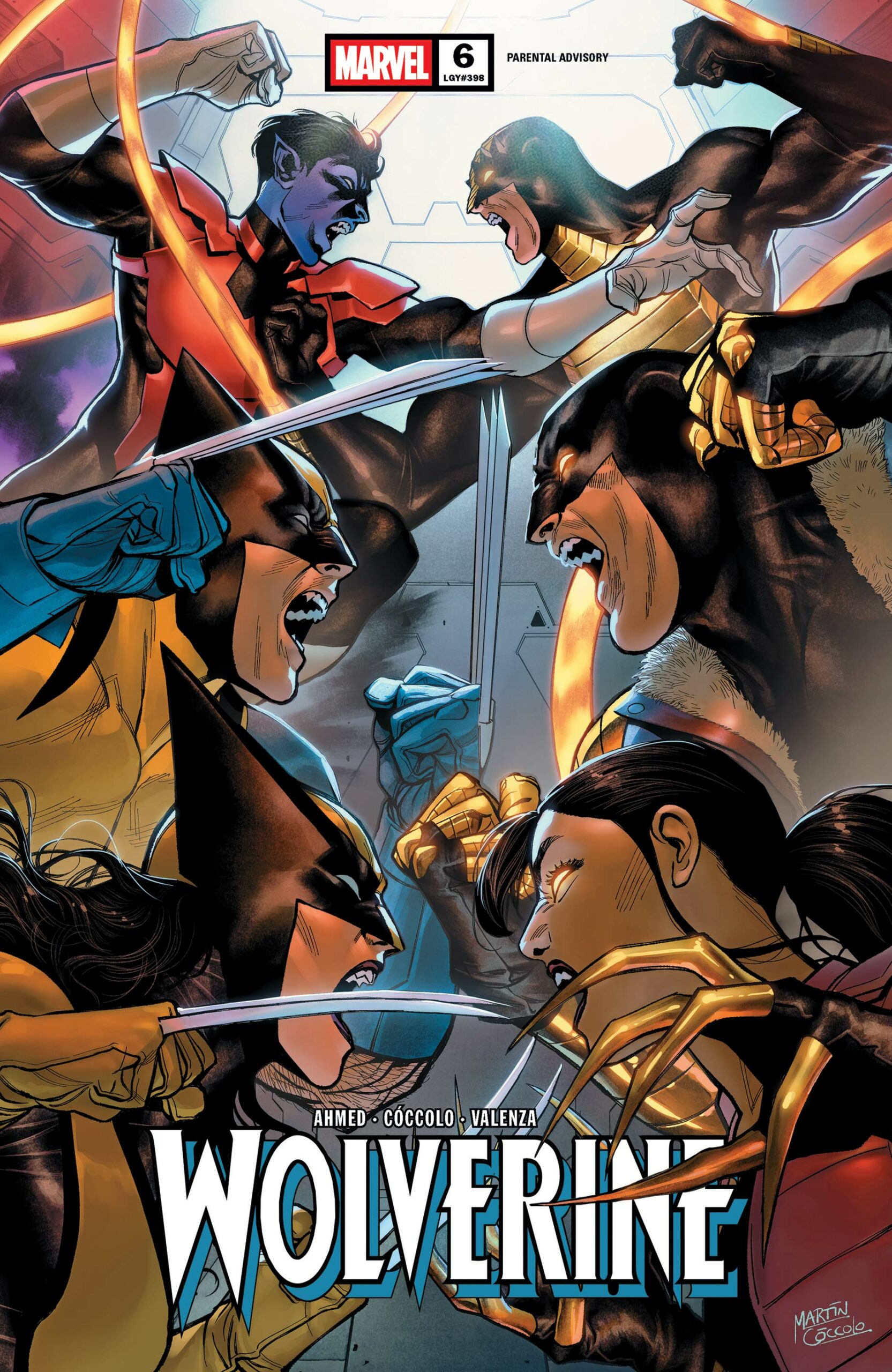
Like the previous issue, Wolverine #6 opens with Wolverine trapped in the weird netherspace his contact with the Adamantine triggers. He quickly snaps out of it, having realized what it is trying to do: eliminate adamantium from the world. This plot is further expounded on after writer Saladin Ahmed draws Laura Kinney: Wolverine — Wolverine’s daughter — into the mix, and they discuss the larger beats of the plot. The possession of adamantium-using villains like Cyber and Lady Deathstrike, the way the Adamantine calls to Wolverine’s bones, all that stuff. It is appreciated, but at the same time, this is all stuff readers already know or have pieced together. Sometimes, it’s necessary to keep characters in the dark relative to readers, and sometimes, it’s necessary to awkwardly catch the characters up to speed, bring them to the same level of knowledge as the readers. That’s essentially what is happening here, and while it may be structurally necessary, it’s also not exactly the most satisfying thing to read.

The art from Martin Còccolo is similarly both effective and disappointing in places. Action sequences — such as Laura’s battle with Teen Wendigo, whom she briefly pegs as a threat before Wolverine sets her straight — continue to be a highlight as Còccolo brings a fantastic sense of movement to static images. Even the layout of the opening page, a representation of Wolverine’s trapped mind that slowly zooms in as the character’s consciousness fights to escape the pull of whatever place the Adamantine has trapped it, is exciting and energetic despite just being, essentially, Wolverine in a fetal position surrounded by blackness. Yet for all that, he continues to struggle with his figures as characters seem to change size and proportion from panel to panel. Sometimes, facial expressions are expressive and detailed, other times, they seem tossed off and rushed.
Spoilers Ahead
And then there’s the last page reveal. The person behind the Adamantine stuff is Romulus, Wolverine’s old foe who is responsible for pulling the strings in his life or centuries. To say this reveal is a bummer is an understatement. Some of that stems from personal taste — I’ve never been big on the Romulus retcons (“Wolverine is evolved from dogs!”), and he’s not my “mysterious shadowy figure secretly orchestrating events from behind the scenes.” But more objectively, Romulus just doesn’t work; in an attempt to simplify Wolverine’s backstory into some kind of “unified field theory” in which Romulus is the mastermind behind it all, Wolverine’s backstory instead becomes even more cluttered and confusing. So, Romulus just becomes another symptom of the problem he’s ostensibly meant to solve.

Even on the micro level of Wolverine #6, this holds true: instead of answering the question of “what is the Adamantine?” with a relatively straightforward answer, we get a solution that, instead, immediately sparks a bunch of questions about the character’s past goals and interactions with Wolverine. We’re left thinking about that instead of the immediate story. As a standalone comic and a finite chunk of serialized story, this issue is a slight improvement. But it comes at the cost of advancing the story into some potentially-dangerous narrative territory.