

Daredevil Week: Re-Evaluating Frank Miller’s ‘Daredevil’
by Benjamin Hall
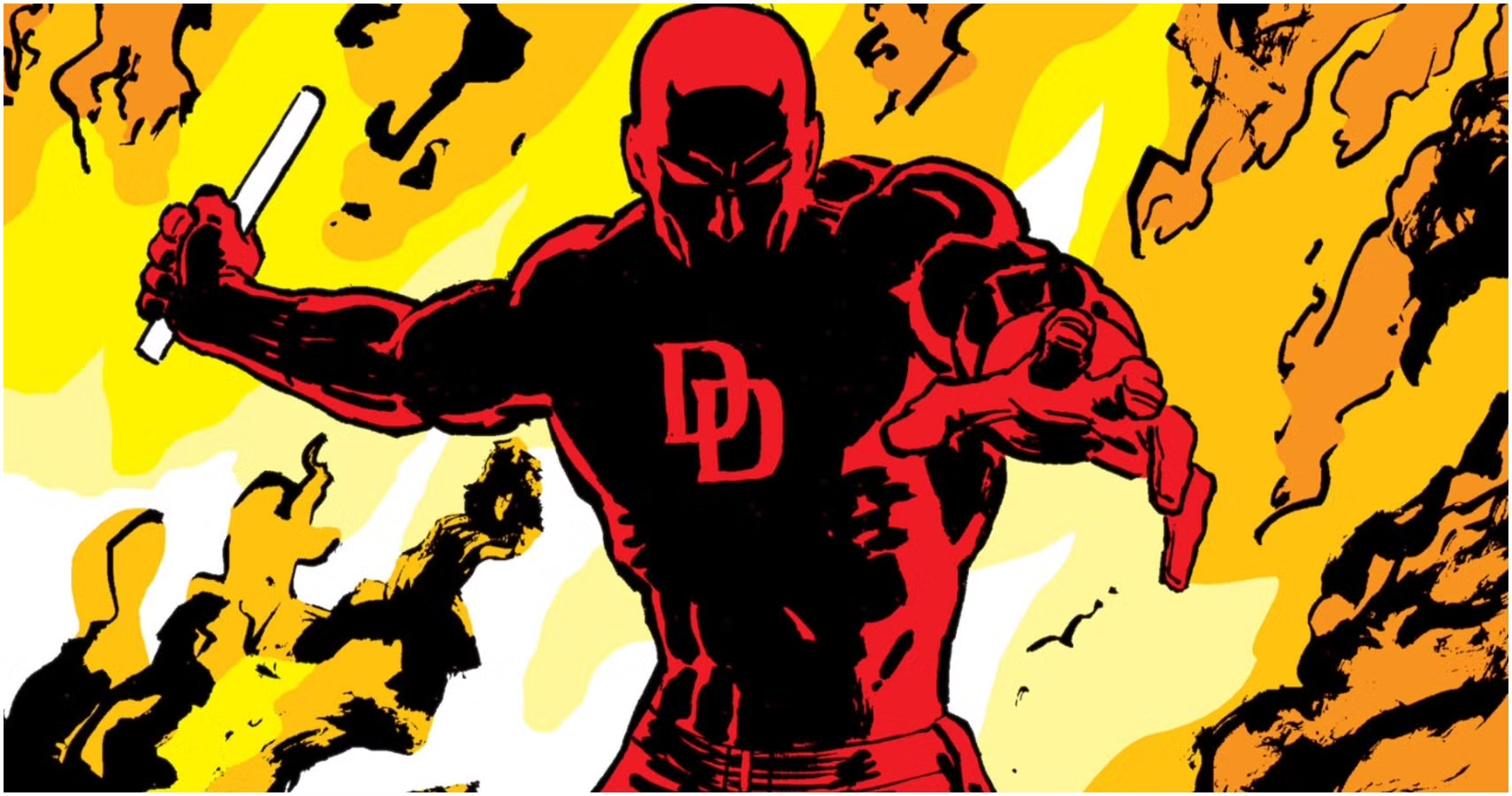
A lot of fans of both Frank Miller and Daredevil exist. However, most of these fans over-hype the former for his work on Daredevil. Yes, it is a commendable body of art and writing, but the writing isn’t actually revolutionary. This is because Miller rehashes a lot of elements from previous Daredevil stories. While some may see this article as bashing Miller the meaning of this piece is to accurately relate history.
The most common rehash in comics is the origin story. There is a redo or update of pretty much every major character in comics. Thus, it is no surprise to see Miller attempt what writers Stan Lee and Roy Thomas accomplish decades earlier. (Daredevil #1 [1964] and Daredevil #53 [1969]). Readers also see the basics of Matt Murdock/Daredevil’s radar sense, blindness, childhood, and dual identity in the first issue. All these things would see a noir style update under Miller’s pen (Daredevil by Frank Miller Omnibus Companion [2007]). Yet, it is the connection Daredevil has with gangsters from his first appearance that Miller will most use.

Murdock also has a connection to larger than life elements that don’t really exist, such as scent-detecting, size-changing robots in the issues that Stan Lee writes (Daredevil #49 [1969]). While in Miller’s work this type of element primarily appears as the hordes of the mystical group The Hand (Daredevil Visionaries: Frank Miller Volume 3 [2001]). Though if one wants to go further there is also Thor during the conclusion of the “Born Again” storyline. Speaking of that storyline one can also see a comparison between both Miller’s take on Wilson Fisk/Kingpin and Roy Thomas’s take on the villainous scientist Starr Saxon (Daredevil #51 [1969]). This is because both villains learn Murdock’s secret identity although they differ with what they do with this knowledge.
Darker noir elements such as the non-consensual acts involving Karen Page in “Born Again” are to an extent already a thing by the time Miller gets to the title. Possibly the earliest non-consensual action occurs with Wilbur Day/The Stilt-Man threatening to order a scientist’s daughter to see harm unless the father does as he says. Despite nothing overt happening, and there being no clear mention of it, Stilt-Man’s words evoke the implication of rape (Daredevil #102 [1973]). It is also worth mentioning that during Lee’s first penning of Daredevil that the hero’s actions result in a villain dying from a heart attack. This means dire consequences exist in Daredevil’s adventures from their onset.

Bringing it back to Murdock’s love interests it is simple to view Elektra Natachios as a mirror of Karen Page and Natasha Romanova/Black Widow (Daredevil #88 [1972]). Karen being a damsel-in-distress type mirrors Elektra when the latter dies for the first time against Bullseye (Daredevil Visionaries: Frank Miller Volume 2 [2001]). Yet, Elektra is like the Black Widow in that both are deadly and capable fighters as well as killers. This is not to say that Elektra isn’t a character all of her own or one of Frank’s devising. Still, one can see the echoes of these bits of characterization in Elektra’s own.
In conclusion it is clear that Miller probably knows a lot about Daredevil if one looks at his work. Nevertheless, saying his writing of Daredevil is a revolutionary thing goes too far.


